
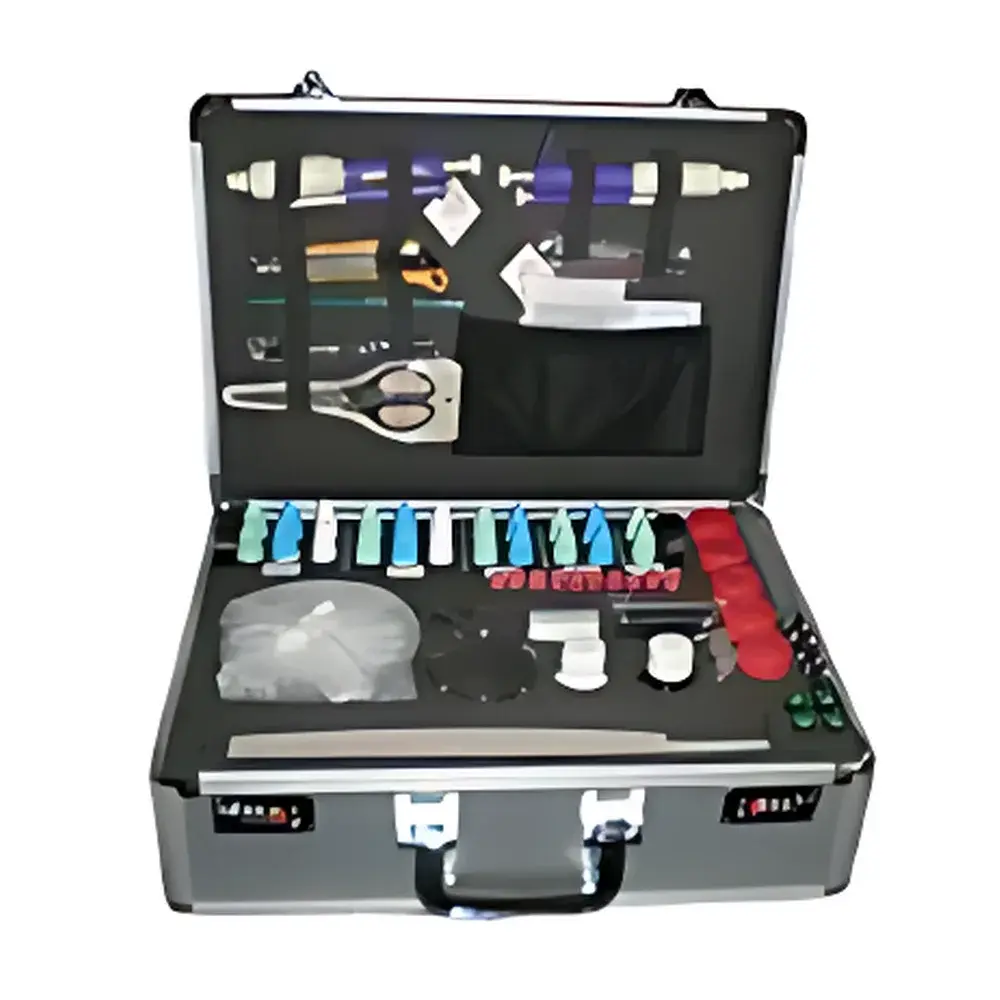
Ruixin JCX-04D Food Safety Rapid Detection Kit
| Brand | Ruixin |
|---|---|
| Origin | Shanghai, China |
| Model | JCX-04D |
| Function Type | Multi-analyte (28 target parameters) |
| Sample Compatibility | Solid & liquid food matrices (meat, dairy, grains, oils, condiments, aquatic products, spices) |
| Optical Range | 400–680 nm |
| Assay Time | <2 minutes per test |
| Repeatability | CV <5% |
| Detection Channels | Single-channel (sequential analysis) |
| Kit Contents | 28 pre-formulated rapid test reagents, calibrated portable instruments (pH meter, moisture analyzer, conductivity meter), supporting labware (aluminum case, digital balance, homogenizer, pipettes, timers, glassware) |
Overview
The Ruixin JCX-04D Food Safety Rapid Detection Kit is an integrated, field-deployable analytical platform engineered for on-site screening of 28 priority chemical and physical hazards in food supply chains. It operates on established colorimetric, enzymatic, and electrochemical principles—such as acetylcholinesterase inhibition for organophosphate/carbamate pesticide detection, spectrophotometric quantification of formaldehyde via chromotropic acid reaction, and potentiometric titration for total acidity—enabling qualitative or semi-quantitative assessment without laboratory infrastructure. Designed for regulatory enforcement agencies, municipal market supervision bureaus, mobile food inspection units, and wholesale food markets, the kit meets operational requirements for portability (<12 kg net weight), battery-powered instrumentation, and ambient-temperature reagent stability (2–30°C). Its architecture complies with foundational performance criteria outlined in ISO/IEC 17025:2017 for field screening methods and aligns with national food safety rapid testing guidelines issued by China’s State Administration for Market Regulation (SAMR).
Key Features
- Comprehensive hazard coverage: Simultaneous screening for pesticides (organophosphates, carbamates), adulterants (borax, formaldehyde, Sudan dyes, mineral oil,桐 oil), processing contaminants (hydrogen peroxide, SO₂, nitrites), nutritional markers (protein in milk powder, glutamic acid in monosodium glutamate), and spoilage indicators (acid value, peroxide value in edible oils).
- Modular assay design: Each test component—including test strips, microtiter plates, and lyophilized reagent vials—is individually barcoded and validated against reference standards traceable to NIM (National Institute of Metrology, China).
- Integrated instrumentation suite: Includes a calibrated pH meter (±0.02 pH unit accuracy), handheld meat moisture analyzer (capacitance-based, 0–100% w/w range), and conductivity meter (0–19.99 mS/cm) with auto-ranging and temperature compensation.
- Rugged field deployment: Housed in a shock-absorbing aluminum alloy case (IP54 rated) with custom-cut foam inserts; includes battery-operated tools (digital balance ±0.01 g resolution, sample grinder, timer, pipettors) and disposable consumables (sterile plastic cuvettes, filter papers, sampling swabs).
- Standardized workflow: All assays follow step-by-step SOPs compliant with GB/T 5009.x series standards; documentation supports GLP-aligned recordkeeping including analyst ID, sample ID, date/time stamp, and raw signal values.
Sample Compatibility & Compliance
The JCX-04D supports direct analysis of unprocessed or minimally prepared samples—including fresh produce, raw meat, dried fruits, cooking oils, condiments, dairy powders, and aquatic products—without requiring centrifugation or solvent extraction in most cases. Sample preparation follows AOAC Official Method guidelines where applicable (e.g., AOAC 2007.01 for nitrite in cured meats). Reagents are formulated to minimize matrix interference: e.g., the formaldehyde assay incorporates masking agents to suppress interference from endogenous aldehydes in seafood; the borax test uses curcumin-based color development resistant to common food pigments. The kit conforms to Chinese national standards GB 5009.33–2016 (nitrites), GB 5009.34–2016 (SO₂), GB 5009.199–2016 (formaldehyde), and GB/T 5009.193–2003 (melamine screening protocol). While not intended for definitive regulatory confirmation, results serve as legally admissible preliminary evidence under SAMR’s Administrative Measures on Food Safety Sampling Inspection (Order No. 15).
Software & Data Management
The kit does not include embedded software or cloud connectivity; data management is paper-based and audit-ready. Each assay sheet provides dedicated fields for recording instrument readings, visual color comparisons (using included CIELAB reference charts), calculated concentrations, and pass/fail judgments against statutory limits (e.g., ≤0.2 mg/kg for Sudan I in chili products per GB 2760–2022). Optional QR-code-labeled logbooks enable manual digitization into LIMS systems. All reagent lot numbers and calibration certificates are archived with batch-specific validation reports meeting ISO/IEC 17025 documentation requirements for traceability. For laboratories operating under GMP or FDA 21 CFR Part 11 environments, supplementary electronic records can be generated using third-party ELN platforms compatible with scanned assay sheets and instrument output logs.
Applications
- Regulatory surveillance: Routine inspections at wet markets, school canteens, and cold-chain distribution hubs to verify compliance with GB 2760 (food additives), GB 2761 (mycotoxins), and GB 2762 (contaminants) limits.
- Supply chain verification: On-dock screening of imported spices, edible oils, and frozen seafood to detect adulteration (e.g., palm oil substitution in olive oil, mineral oil contamination in roasted nuts).
- Emergency response: Rapid triage during foodborne illness outbreaks—e.g., detecting methanol in illicit liquor batches or clenbuterol residues in pork supply chains.
- Quality assurance: In-house screening by food processors for incoming raw materials (e.g., iodine content in salt, peroxide value in frying oils, free mineral acid in vinegar) prior to production release.
- Capacity building: Training tool for provincial CDC labs and rural food safety officers under China’s National Food Safety Risk Monitoring Program.
FAQ
Is the JCX-04D certified for use in official regulatory testing?
It is approved as a Class II rapid screening device under SAMR’s Catalogue of Rapid Testing Methods for Food Safety (2023 Edition) and listed in the National Food Safety Supervision Sampling Inspection Manual.
Can test results be used as court-admissible evidence?
Preliminary positive findings require confirmatory analysis by accredited labs using GC-MS or HPLC-MS/MS per GB/T 27404–2008; however, negative results from properly executed JCX-04D assays are accepted as evidence of compliance in administrative proceedings.
What is the shelf life of reagents, and how is stability verified?
All reagents have a minimum 18-month shelf life when stored at 4–25°C; each lot undergoes accelerated stability testing (40°C/75% RH for 6 weeks) and real-time monitoring per ICH Q5C guidelines.
Does the kit support quantitative reporting?
Yes—22 of the 28 assays provide semi-quantitative results via calibrated color charts or digital instrument readouts; full quantification requires external calibration curves generated with CRM-certified standards.
Are replacement reagents available separately?
All 28 assay components are sold as individual replenishment kits with lot-specific CoA, traceable to CNAS-accredited reference materials.





