
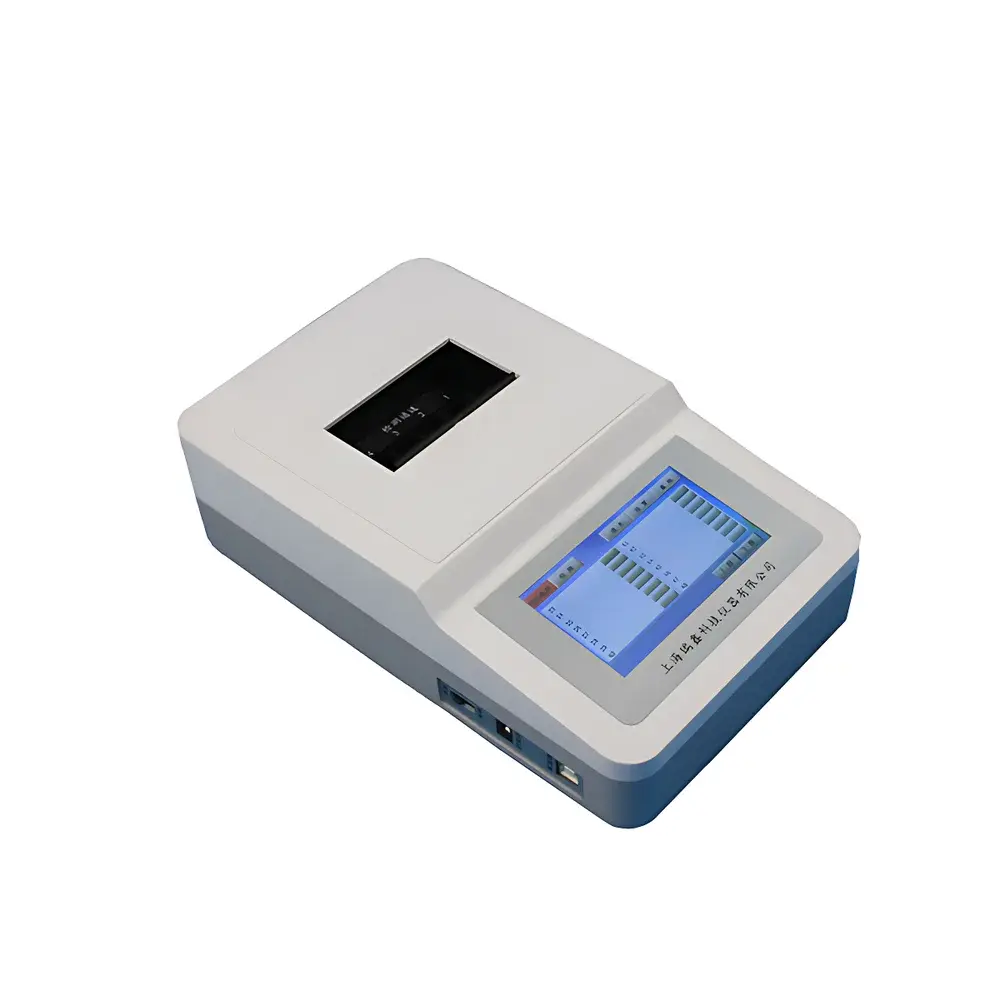
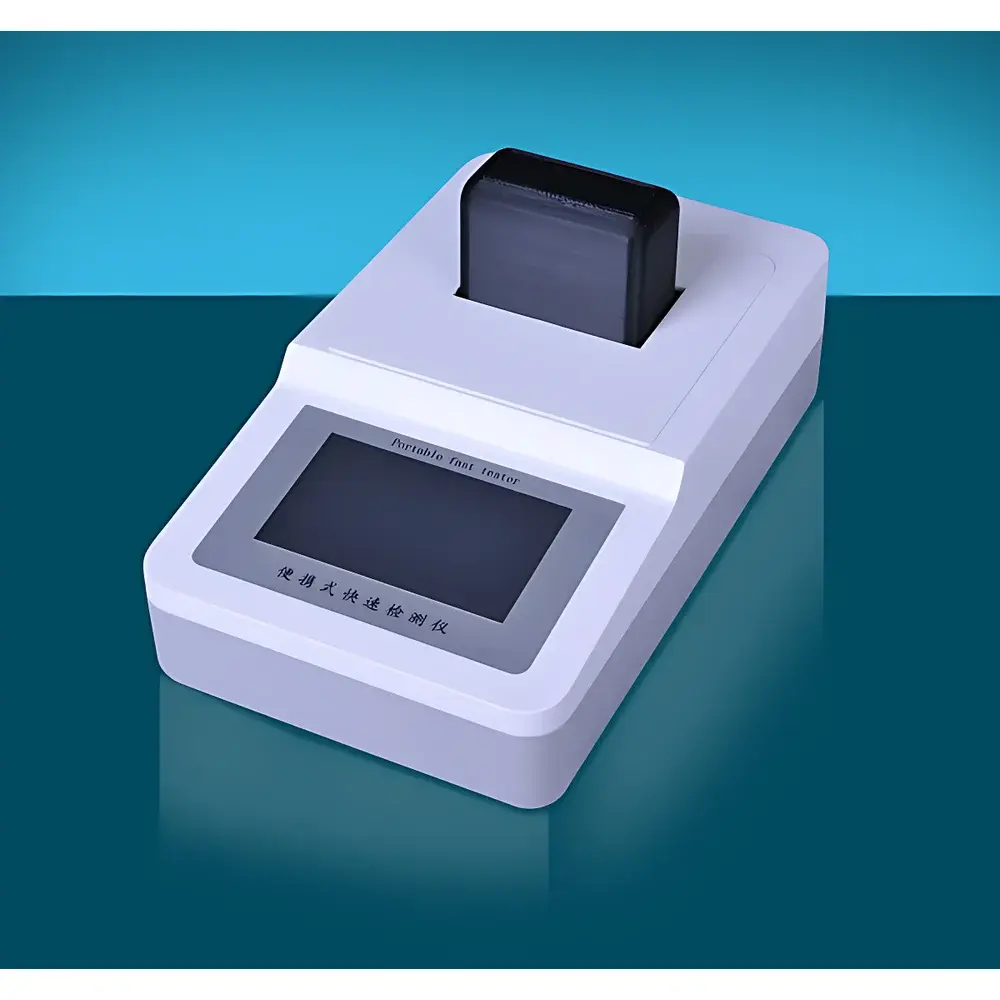
Ruixin SPb-HF2 Volatile Basic Nitrogen (VBN) Analyzer for Diseased Meat Detection
| Brand | Ruixin |
|---|---|
| Origin | Shanghai, China |
| Manufacturer Type | Authorized Distributor |
| Regional Classification | Domestic (China) |
| Model | SPb-HF2 |
| Price | ¥7,800 |
| Functionality | Single-Analyte Detection |
| Sample Format | Single-Sample Dedicated |
| Wavelength | 540 nm |
| Assay Time | ≤3 min |
| Repeatability | ≤0.2% |
| Detection Channels | 1 |
Overview
The Ruixin SPb-HF2 Volatile Basic Nitrogen (VBN) Analyzer is a field-deployable photometric instrument engineered for rapid, quantitative determination of volatile basic nitrogen in meat and poultry samples—a key chemical indicator of microbial spoilage and tissue decomposition. It operates on the principle of colorimetric analysis: VBN compounds (primarily trimethylamine, dimethylamine, and ammonia) are liberated under alkaline conditions, reacted with ninhydrin or similar chromogenic reagents, and quantified via absorbance measurement at 540 nm using a fixed-wavelength optical path. Designed to meet the operational demands of food safety enforcement agencies, the SPb-HF2 delivers laboratory-grade analytical consistency in non-laboratory environments—enabling real-time assessment of meat freshness during market inspections, cold-chain audits, or mobile surveillance operations. Its optical architecture incorporates an integrated self-calibration system that eliminates manual zero/100% transmittance adjustments, ensuring measurement stability across variable ambient conditions.
Key Features
- Portable form factor with built-in rechargeable lithium battery—enables uninterrupted operation for ≥6 hours in field settings without external power.
- 4.3-inch high-resolution color TFT touchscreen with full Chinese GUI—supports intuitive navigation, real-time parameter adjustment, and on-device data review.
- Embedded thermal printer—generates compliant hard-copy reports containing analyte concentration (mg/100g), sample name (Chinese input supported), test date/time, operator ID, and testing unit.
- Dual-mode optical readout—simultaneously displays absorbance (0.000–4.000 AU, resolution 0.001) and transmittance (0.00–100.00%, resolution 0.01%), facilitating method validation and cross-platform comparison.
- Automated data management—stores up to 1,000 test records locally with timestamped metadata; supports chronological search, group filtering, and export via USB or RS232.
- Optical self-correction algorithm—performs automatic baseline drift compensation at startup and during extended use, maintaining ±2.0% transmittance accuracy per ASTM E275 and ISO 7027 standards.
Sample Compatibility & Compliance
The SPb-HF2 is validated for homogenized meat extracts prepared according to GB/T 5009.44–2003 (National Standard of the People’s Republic of China for Food Safety—Determination of Volatile Basic Nitrogen in Meat and Poultry Products). It accommodates standard 1-cm cuvettes and accepts sample volumes of 1.0–2.0 mL following standardized extraction protocols. While optimized for porcine, bovine, and avian tissues, its assay chemistry is compatible with fish and aquatic products when adapted per AOAC Official Method 972.17. The instrument meets electromagnetic compatibility requirements per GB/T 18268.1–2010 (IEC 61326-1) and conforms to electrical safety standards GB 4793.1–2007 (IEC 61010-1). Data integrity features—including operator-authenticated entries and immutable timestamping—support alignment with GLP documentation practices for regulatory submissions.
Software & Data Management
Data generated by the SPb-HF2 is structured in CSV-compatible format and supports bidirectional communication with centralized food safety monitoring platforms via RS232 serial interface or USB mass storage mode. The embedded firmware implements audit-trail functionality: all calibration events, result modifications, and user logins are time-stamped and retained in non-volatile memory. When connected to municipal or provincial food traceability networks (e.g., Shanghai Food Safety Supervision Platform), the device transmits encrypted VBN results with geotagging metadata for spatial trend analysis. No proprietary software installation is required—raw data files are readable in Excel, LabChart, or LIMS systems compliant with HL7 or ASTM E1467 standards.
Applications
- Rapid screening of suspect meat at wholesale markets, slaughterhouses, and border inspection points to identify advanced spoilage or post-mortem degradation.
- Field verification of cold-chain integrity during transportation audits—detecting temperature-abuse events through early-stage VBN elevation (≥15 mg/100g).
- On-site compliance checks by CIQ, CDC, and Market Supervision Bureaus against national limits: ≤15 mg/100g for fresh chilled pork (GB 2707–2016), ≤25 mg/100g for frozen beef (GB 2707–2016).
- Supporting HACCP critical control point monitoring in processing facilities where VBN serves as a process indicator for enzymatic activity and microbial load.
- Integration into mobile food testing laboratories mounted on regulatory vehicles equipped with GPS, environmental sensors, and wireless broadband connectivity.
FAQ
What is the detection limit for volatile basic nitrogen using the SPb-HF2?
The instrument achieves a practical detection limit of 1.0 mg/100g in meat homogenates, verified using certified reference materials traceable to NIST SRM 1577c (Bovine Liver).
Can the SPb-HF2 be used for quantitative analysis beyond VBN?
While optimized for VBN, its dual-mode photometer (absorbance/transmittance) and stable 540 nm LED source permit adaptation to other colorimetric assays requiring fixed-wavelength measurement—provided reagent chemistry and calibration curves are independently validated.
Does the device support multi-user access with role-based permissions?
No. The SPb-HF2 operates in single-user mode with operator identification entered manually per test; it does not implement password-protected user roles or hierarchical access control per FDA 21 CFR Part 11.
How often must optical calibration be performed?
The self-calibration system executes automatically at power-on and every 30 minutes during continuous operation; no manual recalibration is required under normal usage conditions.
Is the thermal printer compatible with third-party label formats?
The embedded printer outputs fixed-layout reports conforming to CNCA-certified food safety documentation templates; custom formatting requires firmware modification by authorized service centers only.






