
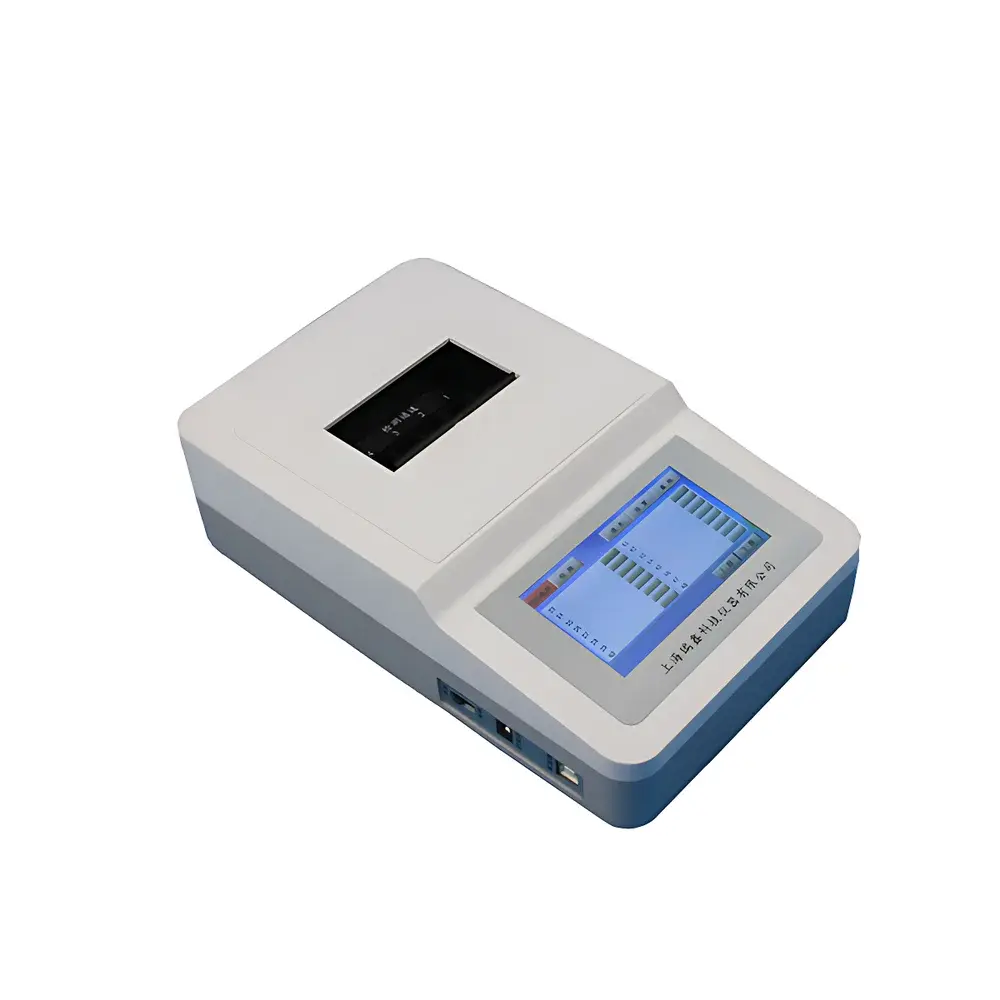
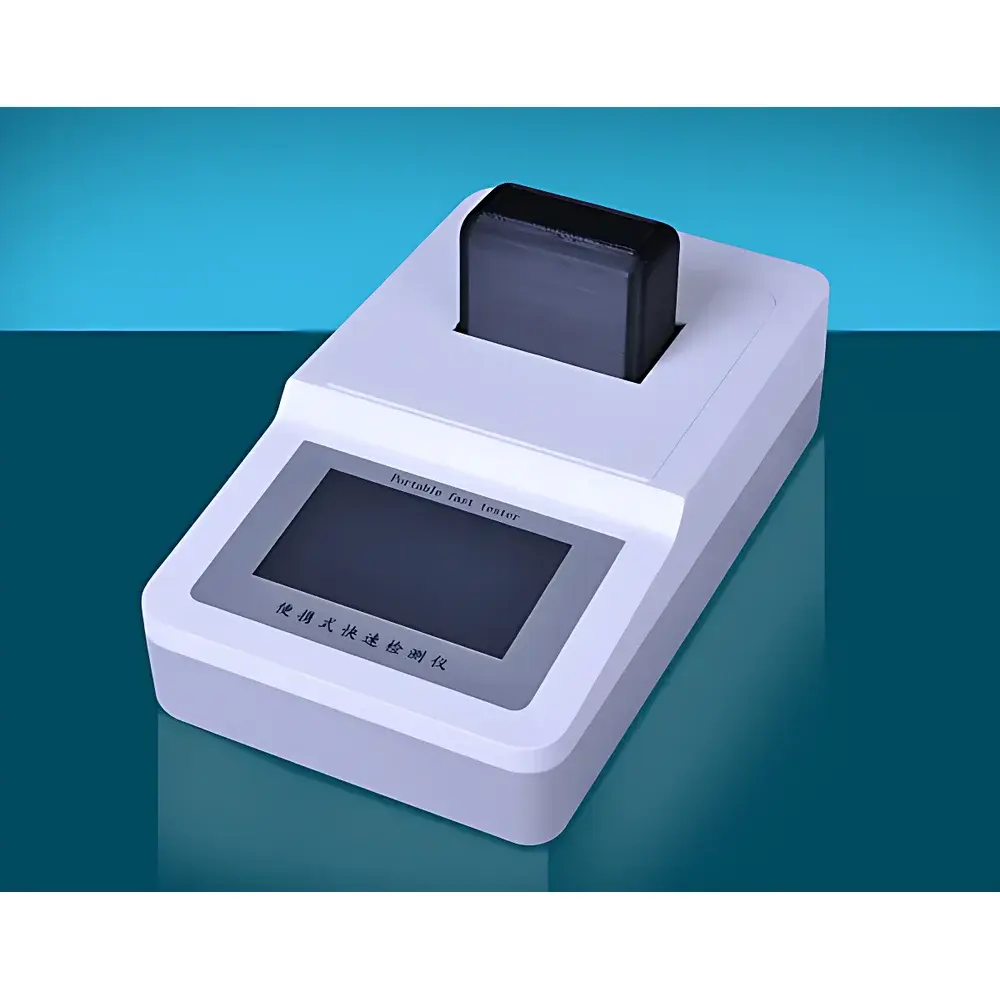
Ruixin SPb-TM2 Cyclamate Rapid Detection Analyzer
| Brand | Ruixin |
|---|---|
| Origin | Shanghai, China |
| Manufacturer Type | Authorized Distributor |
| Country of Origin | China |
| Model | SPb-TM2 |
| Price | USD 780 (FOB Shanghai) |
| Functionality | Single-Analyte Dedicated System |
| Sample Format | Single-Sample Cartridge-Based |
| Wavelength | 410 nm |
| Assay Time | ≤ 3 min |
| Photometric Repeatability | ≤ 0.2% (at 410 nm) |
| Optical Channels | 1 |
Overview
The Ruixin SPb-TM2 Cyclamate Rapid Detection Analyzer is a compact, field-deployable photometric analyzer engineered for quantitative determination of sodium cyclamate (E952) in food matrices using fixed-wavelength absorbance measurement at 410 nm. Based on standardized colorimetric reaction principles—where cyclamate is converted to cyclohexanol under acidic conditions and subsequently diazotized and coupled to form a stable azo dye—the instrument delivers trace-level quantification via Beer–Lambert law correlation between absorbance and analyte concentration. Designed specifically for regulatory screening workflows, the SPb-TM2 operates as a dedicated single-analyte platform compliant with national food safety standards (e.g., GB 5009.97-2023 in China) and supports method validation protocols aligned with ISO/IEC 17025 requirements for routine testing laboratories. Its optical architecture integrates an LED light source, precision interference filter, and silicon photodiode detector optimized for stability and low drift, enabling reliable operation in mobile labs, inspection vehicles, or ambient field environments without climate control.
Key Features
- Portable handheld design with integrated rechargeable lithium-ion battery (up to 8 hours continuous operation), enabling true off-grid deployment in markets, border checkpoints, or roadside inspection units.
- 4.3-inch high-resolution color TFT-LCD touchscreen with full Chinese GUI; supports stylus and predictive Chinese input for sample ID, operator name, and institutional metadata entry.
- Self-calibrating optical path system: automatic zero and reference adjustment upon power-on eliminates manual calibration steps and reduces operator dependency.
- Dual-mode photometric display: simultaneous real-time readout of absorbance (0.000–4.000 AU, resolution 0.001) and transmittance (0.00–100.00%, resolution 0.01%), supporting method development beyond cyclamate.
- Built-in thermal line printer outputs fully traceable reports containing analyte concentration (g/kg), sample name (Chinese/English), test date/time, operator ID, and laboratory identifier.
- Robust data integrity architecture: automatic local storage of ≥10,000 test records with timestamp, operator log, and result audit trail; all entries are non-editable post-acquisition.
Sample Compatibility & Compliance
The SPb-TM2 accepts pre-processed liquid extracts from solid and semi-solid food samples—including beverages, candied fruits, pickled vegetables, baked goods, and dairy-based desserts—following standardized extraction protocols outlined in GB 5009.97-2023. Each assay requires a single-use disposable cuvette or pre-filled reagent cartridge to minimize cross-contamination and ensure inter-laboratory reproducibility. The system meets essential performance criteria for rapid screening instruments under China’s SAMR Technical Guidelines for Food Safety Rapid Detection Devices (No. 128/2021), including detection limit (LOD) of 0.1 g/kg, linear range of 0–2.0 g/kg, and within-run precision ≤0.2% RSD. While not certified to ISO 17025 as a standalone device, it supports GLP-aligned documentation when integrated into validated laboratory workflows.
Software & Data Management
Data export and remote monitoring are enabled via dual communication interfaces: RS-232 (for legacy lab network integration) and USB 2.0 (for direct PC transfer). Optional firmware upgrade supports CSV-formatted batch export compatible with LIMS platforms (e.g., LabWare, STARLIMS). All stored results include embedded digital signatures tied to operator login credentials and instrument serial number, satisfying basic traceability requirements for internal QA audits. Though not FDA 21 CFR Part 11-compliant out-of-the-box, the device’s immutable record structure and time-stamped logs provide foundational elements for laboratories pursuing electronic record compliance through supplemental procedural controls.
Applications
- Routine surveillance testing by municipal market supervision bureaus during food circulation inspections.
- On-site verification at cold-chain logistics hubs and wholesale distribution centers prior to retail release.
- Supplemental screening in QC labs where HPLC confirmation is reserved for borderline or nonconforming results.
- Educational use in food science programs for teaching fundamental spectrophotometric assay principles and regulatory threshold logic.
- Integration into centralized food safety monitoring networks via optional TCP/IP gateway modules (sold separately).
FAQ
What regulatory methods does the SPb-TM2 implement for cyclamate analysis?
It follows the principle of GB 5009.97-2023, adapted for rapid photometric format using the nitrosation–diazotization–coupling reaction sequence.
Can the instrument be used for other analytes besides cyclamate?
No—it is a single-analyte dedicated system. Optical filter and reagent chemistry are fixed for 410 nm detection; no wavelength tuning or multi-reagent compatibility is supported.
Is external calibration required before each use?
No. The built-in optical self-check performs automatic dark-current and reference correction at startup, eliminating daily zero/100% adjustments.
How is data security ensured during transmission?
Raw data remains stored locally in non-volatile memory; exported files contain no encryption but retain full metadata provenance for chain-of-custody review.
What power sources are supported in field conditions?
Three options: internal Li-ion battery (5 V DC), AC adapter (100–240 V, 50/60 Hz), or external 5 V DC power bank via micro-USB port.
Related Products






