
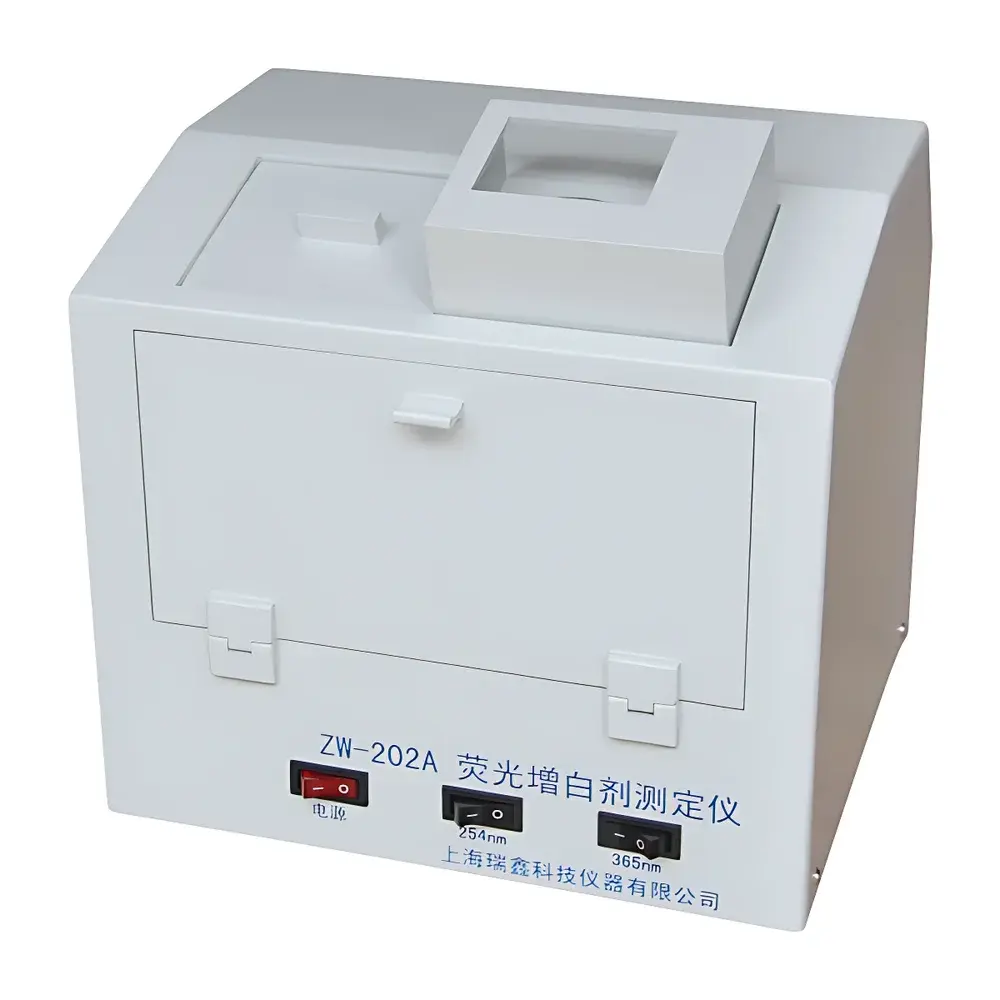
Ruixin ZW-202B Fluorescent Whitening Agent Analyzer
| Brand | Ruixin |
|---|---|
| Origin | Shanghai, China |
| Manufacturer Type | Authorized Distributor |
| Origin Category | Domestic (China) |
| Model | ZW-202B |
| Function Type | Single-Analyte Detection System |
| Sample Type | Dedicated Single-Sample Format |
| Excitation Wavelengths | 254 nm and 365 nm (independently selectable or dual-mode operation) |
| Detection Time | ≤ 180 seconds per sample |
| Repeatability | ≤ 0.3% RSD |
| Detection Channels | 1 |
Overview
The Ruixin ZW-202B Fluorescent Whitening Agent Analyzer is a purpose-built, benchtop UV fluorescence detection instrument engineered for rapid, qualitative and semi-quantitative screening of fluorescent whitening agents (FWAs), mycotoxins (e.g., aflatoxin B₁ under UV excitation), and other native or derivatized fluorophores in food matrices. It operates on the principle of ultraviolet-induced fluorescence emission—specifically leveraging fixed-wavelength UV excitation at 254 nm (high-energy short-wave UV, optimal for detecting conjugated aromatic systems and certain mycotoxins) and 365 nm (long-wave UV, widely used for visualizing FWAs in flour, edible fungi, and processed grains). The instrument employs a sealed dark-box architecture to eliminate ambient light interference, ensuring high signal-to-noise ratio during fluorescence observation and digital capture. Its design prioritizes operational robustness in field-deployable or QC-lab environments where rapid triage—rather than full chromatographic quantification—is required for regulatory compliance screening.
Key Features
- Dual-wavelength UV excitation source: Independently switchable or simultaneously active 254 nm and 365 nm LEDs with integrated optical filtering to minimize spectral crosstalk.
- Hermetically sealed dark chamber with UV-blocking observation window fitted with certified bandpass filters—ensuring operator safety and measurement consistency.
- Dual-mode visualization: Real-time color LCD display (7-inch, 800 × 480 resolution) for digital preview and post-capture review; plus direct visual inspection via the filtered observation port for immediate qualitative assessment.
- Integrated 8-megapixel CMOS imaging system with auto-exposure control and high-dynamic-range (HDR) capability—capable of capturing and storing ≥1,000 fluorescence images internally.
- USB 2.0 interface compliant with UVC (USB Video Class) and mass storage protocols—enabling direct image export to Windows/macOS/Linux workstations without proprietary drivers.
- Low-power electronic ballast-free UV source architecture: Instant-on operation, <20 W total power consumption, and thermal stabilization for stable output over extended use cycles.
- Portable aluminum carrying case included—designed for transport between sampling sites, mobile labs, or regulatory inspection units.
Sample Compatibility & Compliance
The ZW-202B is validated for use with solid and semi-solid food samples requiring minimal pretreatment—including wheat flour, rice, dried mushrooms, soy products, and surface-swab extracts. It supports thin-layer chromatography (TLC) plate analysis, paper chromatography, and direct surface inspection of textiles or packaging materials suspected of FWA contamination. While not a quantitative HPLC replacement, it aligns with preliminary screening workflows defined in GB/T 5009.78–2003 (Chinese National Standard for Fluorescent Whitening Agents in Food) and supports risk-based decision-making per Codex Alimentarius GLP-aligned practices. Instrument operation meets IEC 61000-6-3 (EMC emissions) and IEC 62471 (UV radiation safety classification for Group 1 LED sources).
Software & Data Management
The device operates standalone with embedded firmware; no host PC is required for acquisition or storage. All captured images are timestamped and stored with EXIF metadata (including excitation wavelength, exposure time, and gain setting). Exported JPEG files retain embedded calibration reference markers for traceable documentation. When connected to a computer, images may be imported into third-party image analysis software (e.g., ImageJ, FIJI) for region-of-interest (ROI) intensity profiling—facilitating comparative semi-quantitative assessment across batches. Audit trails are maintained via internal file-system logging, supporting basic data integrity requirements under ISO/IEC 17025 Clause 7.5.2 for non-accredited screening laboratories.
Applications
- Routine screening of illegally added fluorescent whitening agents in wheat flour, starch, and edible fungi per Chinese food safety monitoring protocols.
- Preliminary detection of aflatoxin-contaminated commodities (e.g., peanuts, corn) using UV-induced blue-white fluorescence under 365 nm illumination.
- Verification of textile fiber authenticity (e.g., wool vs. synthetic blends) and detection of optical brighteners in laundry detergents and fabric softeners.
- Field-level verification of TLC-developed samples in pesticide residue or veterinary drug metabolite analysis.
- Archaeological and geological specimen screening—e.g., distinguishing natural calcite fluorescence from synthetic coatings or identifying fossilized organic residues.
FAQ
Is the ZW-202B compliant with FDA or EU food safety regulations?
It is not an FDA-registered or CE-marked medical device, but its detection methodology supports screening activities aligned with FDA’s Import Alert 99-05 (for FWAs in food) and EU Commission Regulation (EC) No 2073/2005 Annex I criteria for rapid verification.
Can it quantify fluorescence intensity in arbitrary units?
Yes—the onboard imaging system provides raw pixel-intensity values per ROI; however, absolute quantification requires external calibration with reference standards and is outside the scope of this instrument’s intended use.
What maintenance is required for the UV sources?
LED modules are rated for ≥10,000 hours; no lamp replacement or alignment is needed during normal operation.
Does the instrument support GLP-compliant audit trails?
It maintains internal timestamps and file logs, but lacks electronic signature or 21 CFR Part 11-compliant user authentication—making it suitable for pre-screening, not final release testing in GMP environments.
Can it detect substances other than fluorescent whitening agents?
Yes—any compound exhibiting native fluorescence under 254 nm or 365 nm excitation (e.g., riboflavin, quinine, chlorophyll degradation products, certain PAHs) may be visualized, though specificity depends on sample preparation and matrix interference.







