
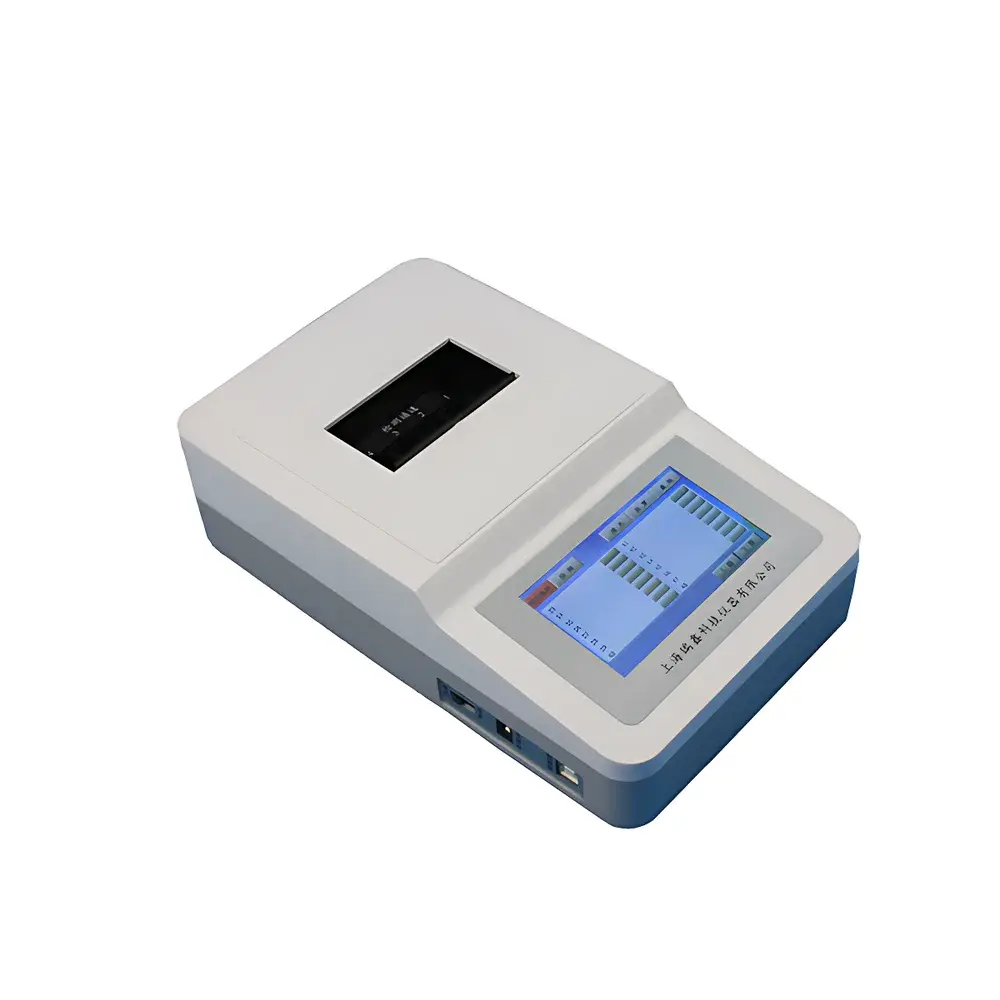
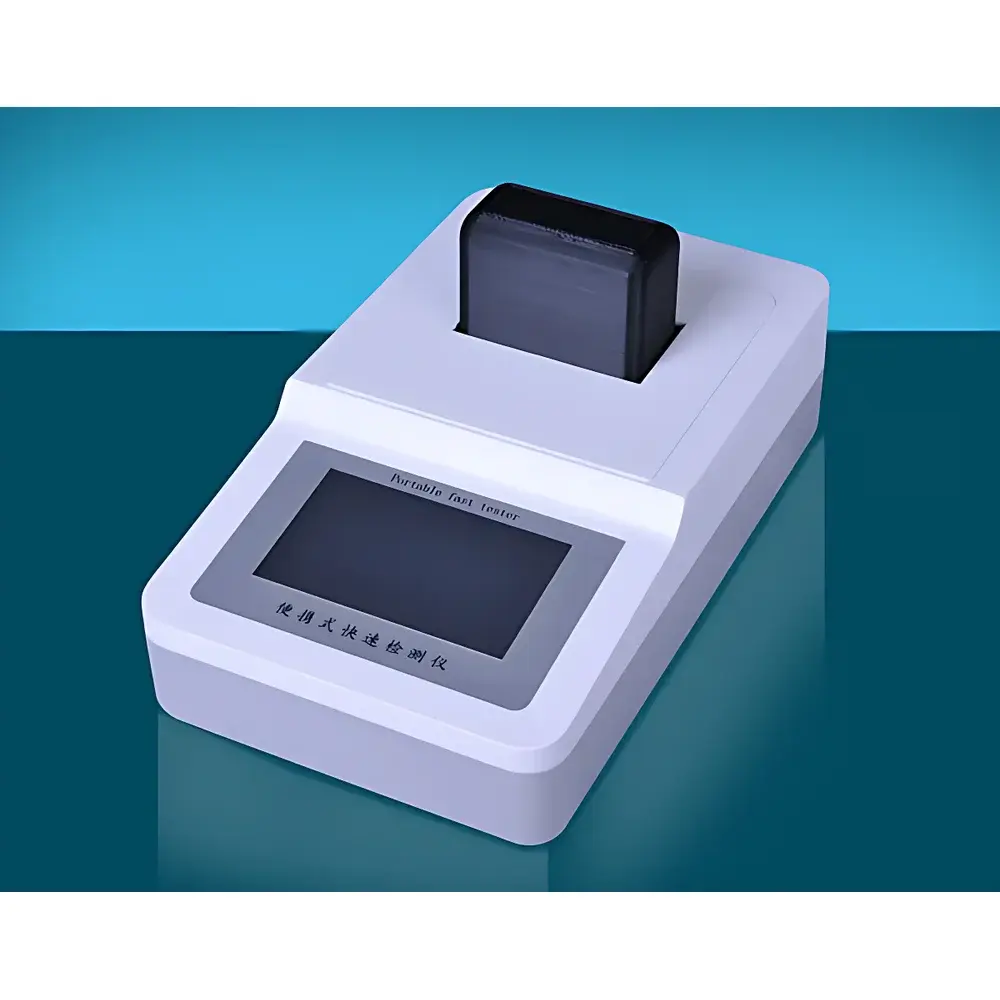
Ruixin SZ-COD COD Analyzer
| Brand | Ruixin |
|---|---|
| Origin | Shanghai, China |
| Manufacturer Type | Authorized Distributor |
| Country of Origin | China |
| Model | SZ-COD |
| Function Type | Single-Parameter Analyzer (COD only) |
| Application Scope | Single-Sample Dedicated Instrument |
| Wavelength Range | 380–630 nm |
| Measurement Time | ≤3 min |
| Repeatability | ≤0.2% |
| Detection Channels | 1 |
| Display | 4.3-inch HD color LCD touchscreen (Chinese UI) |
| Absorbance Range | 0.000–4.000 AU |
| Transmittance Range | 0.00–99.99% |
| Transmittance Resolution | 0.01% |
| Absorbance Resolution | 0.001 AU |
| Photometric Accuracy (Transmittance) | ±2.0% |
| Photometric Stability (3 min) | ≤0.3% |
| COD Measurement Ranges | 10.0–500.0 mg/L and 500–10,000 mg/L |
| Communication Interface | USB |
| Power Supply | AC 220 V / DC 5 V / Rechargeable Li-ion battery |
Overview
The Ruixin SZ-COD COD Analyzer is a portable, single-parameter spectrophotometric instrument engineered for rapid, on-site and laboratory-based quantification of Chemical Oxygen Demand (COD) in aqueous samples. It operates on the principle of dichromate digestion followed by photometric measurement at selected wavelengths within the visible spectrum (380–630 nm), conforming to standard methods such as ISO 6060 and APHA Standard Methods 5220 B. Designed for operational flexibility, the analyzer integrates a rugged aluminum chassis, low-power electronics, and dual-mode power support—enabling uninterrupted use in field environments without grid access. Its fixed optical path and pre-calibrated multi-point calibration curves eliminate manual wavelength selection and reduce operator dependency, ensuring consistent performance across environmental monitoring, wastewater treatment, food processing effluent screening, and regulatory compliance testing.
Key Features
- 4.3-inch high-resolution color LCD touchscreen with full Chinese graphical interface for intuitive navigation and real-time parameter visualization
- Integrated thermal printer for immediate hard-copy reporting—no external peripherals required
- Dual-range COD detection capability: high-sensitivity mode (10.0–500.0 mg/L) and high-concentration mode (500–10,000 mg/L), optimized for diverse industrial wastewater matrices
- Photometric performance validated per ISO 9001-aligned quality protocols: absorbance resolution of 0.001 AU, transmittance resolution of 0.01%, and repeatability ≤0.2% (n = 10, same sample)
- Onboard data management system with non-volatile memory supporting ≥1,000 test records, timestamped and user-tagged
- USB 2.0 interface compliant with CDC/ACM device class standards—enables direct data export to Windows/Linux hosts or integration into LIMS via standardized CSV output
- Triple power architecture: mains-powered (AC 220 V), USB bus-powered (DC 5 V), and internal rechargeable lithium-ion battery (≥8 hours continuous operation)
Sample Compatibility & Compliance
The SZ-COD analyzer is validated for use with pretreated liquid samples from municipal wastewater, industrial effluents (including food processing, brewing, pharmaceutical manufacturing, and chemical synthesis streams), and potable water distribution systems. Sample preparation follows standard closed-reflux dichromate oxidation per ISO 6060:1989 and EPA Method 410.4—requiring no additional instrumentation beyond a heating block or digester. The instrument’s optical design minimizes interferences from turbidity and chloride ions when used with appropriate masking agents (e.g., HgSO₄). While not certified to IEC 61000-6-3 for EMC immunity or IP67 for ingress protection, its enclosure meets GB/T 14710-2009 environmental adaptability requirements for Class II laboratory and field equipment. It supports GLP-compliant workflows through audit-trail-capable data logging (user ID, date/time stamp, method ID, raw absorbance values).
Software & Data Management
No proprietary PC software is required for basic operation; all configuration, calibration, and reporting occur locally on-device. However, exported CSV files contain structured columns: Sample_ID, Test_Date, Test_Time, Wavelength_nm, Absorbance_AU, Transmittance_%, Calculated_COD_mgL, Range_Mode, Operator_Name, and Calibration_Curve_ID. These files are compatible with common analytical platforms including Microsoft Excel, LabArchives, and OpenLab CDS. Firmware updates are delivered via USB mass-storage mode—no drivers or admin privileges needed. The system does not implement FDA 21 CFR Part 11 electronic signature controls but provides traceable, immutable record generation suitable for internal QA/QC and third-party audit readiness under ISO/IEC 17025 Clause 7.7.
Applications
- Routine COD screening in food & beverage production facilities (e.g., dairy, brewery, soy sauce fermentation, vegetable processing)
- Pre-discharge verification for wastewater from pharmaceutical API synthesis and formulation units
- Field-level compliance checks by municipal water authorities and provincial ecological environment bureaus
- Process control in anaerobic digesters and activated sludge systems
- Educational use in university environmental engineering laboratories for method validation exercises
- Emergency response testing during industrial spill incidents involving organic contaminants
FAQ
Is the SZ-COD analyzer compliant with ISO 6060 or EPA Method 410.4?
Yes—the optical detection module and default calibration curves are aligned with the photometric endpoints specified in ISO 6060:1989 and EPA Method 410.4. Users must perform digestion externally using certified reagents and temperature-controlled blocks.
Can the instrument store calibration curves for multiple reagent lots?
Yes—up to 8 user-defined curves can be saved onboard, each with unique identifiers, expiration dates, and slope/intercept parameters.
Does it support Bluetooth or Wi-Fi connectivity?
No—only USB 2.0 host/device mode is implemented. Wireless transfer requires intermediate USB-to-WiFi adapters configured externally.
What maintenance is required for long-term accuracy?
Annual verification of photometric linearity using NIST-traceable neutral density filters and quarterly cleaning of the cuvette chamber with lint-free isopropyl alcohol wipes are recommended.
Is the thermal printer replaceable or serviceable in the field?
The embedded printer uses standard 58-mm thermal paper rolls (commonly available globally); no tools are required for paper loading or head cleaning.




