
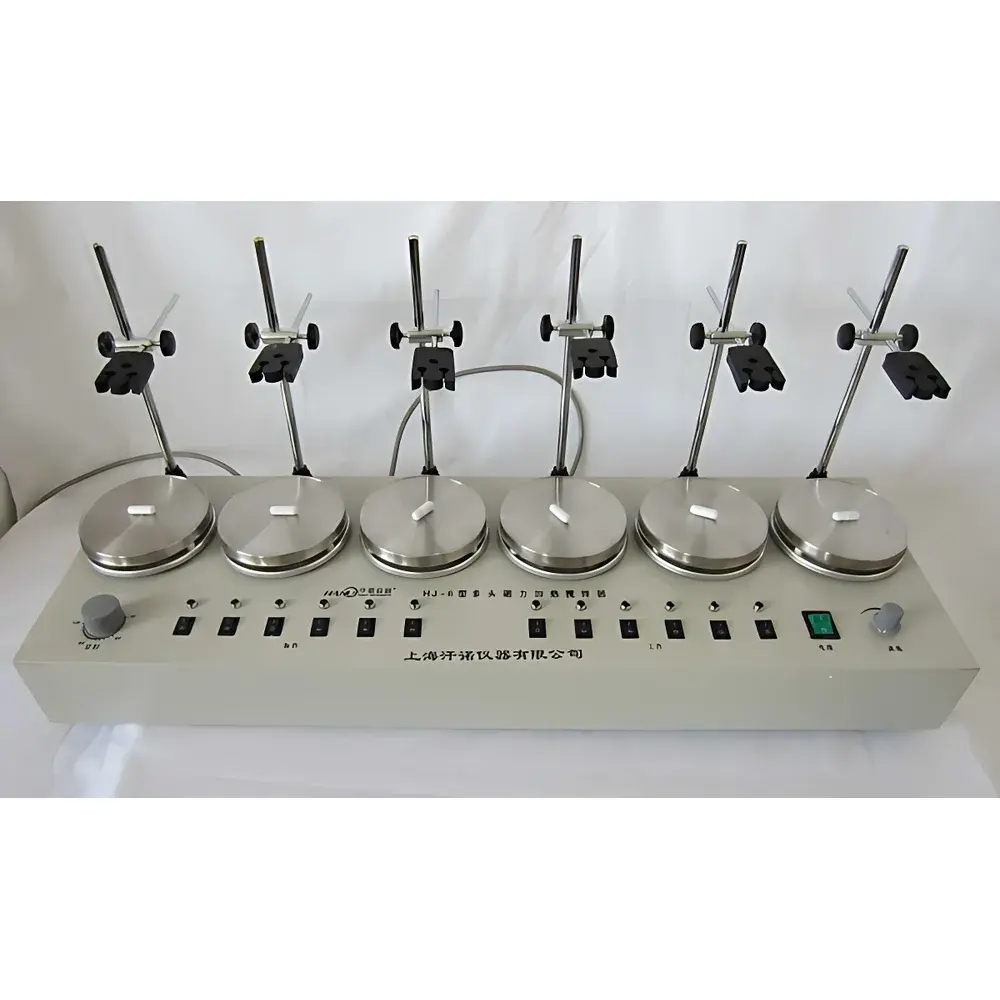
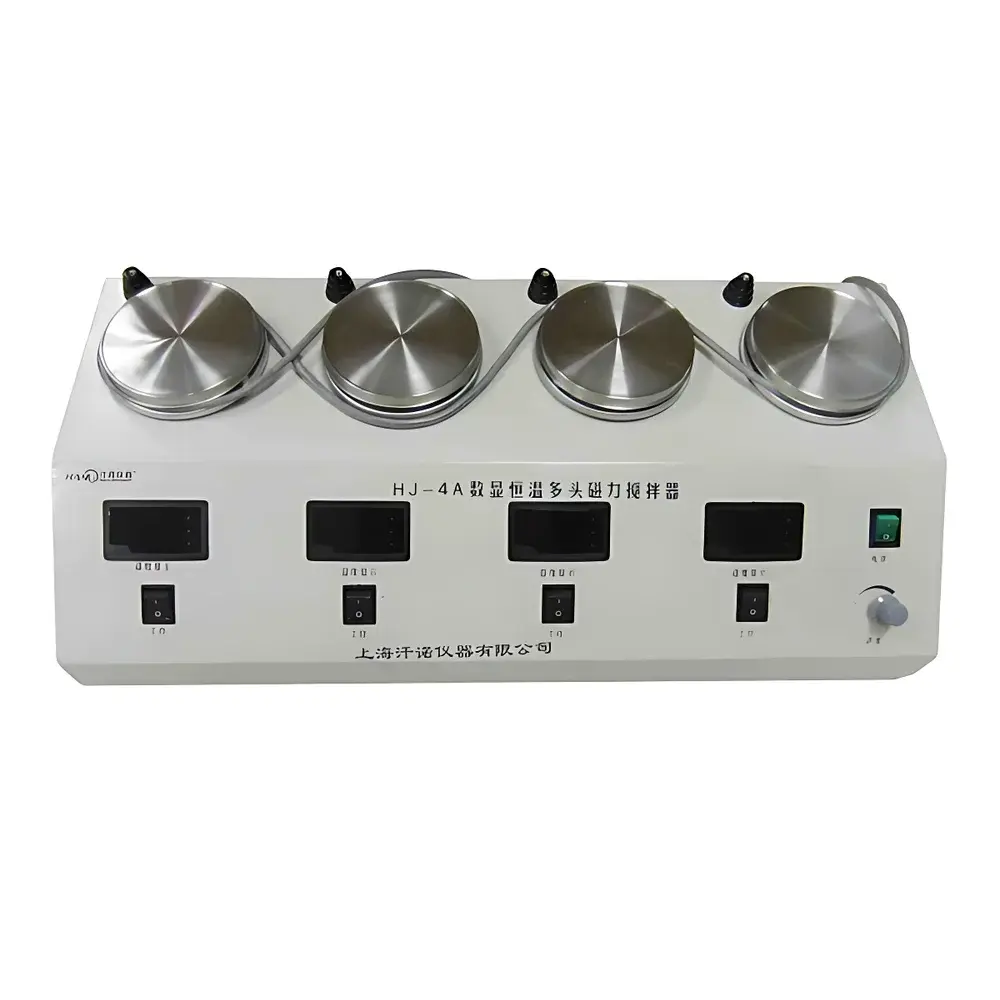
Hanuo HJ-2A Digital Multi-Position Magnetic Stirrer
| Brand | Hanuo |
|---|---|
| Origin | Shanghai, China |
| Model | HJ-2A |
| Stirring Capacity | 6 × 1000 mL |
| Speed Range | 0–2400 rpm |
| Heating Function | None |
| Instrument Type | Magnetic Stirrer |
| Manufacturer Status | Authorized Distributor |
| Country of Manufacture | China |
Overview
The Hanuo HJ-2A Digital Multi-Position Magnetic Stirrer is an engineered solution for laboratories requiring simultaneous, independent stirring across up to six sample vessels. Designed around the principle of rotating magnetic field coupling, the device generates a precisely controlled alternating magnetic field beneath each station using high-efficiency permanent magnets driven by brushless DC motors. This field induces synchronous rotational motion in PTFE- or glass-coated magnetic stir bars placed inside non-magnetic containers (e.g., borosilicate glass beakers, polypropylene bottles), enabling homogeneous mixing without mechanical shaft penetration. Unlike hotplate-integrated models, the HJ-2A is a non-heating stirrer—optimized for applications where temperature control is managed externally (e.g., water baths, environmental chambers) or where exothermic reactions require thermal isolation. Its architecture prioritizes long-term operational stability, low electromagnetic interference, and consistent torque delivery across the full speed range.
Key Features
- Digital LED display with real-time RPM readout per station—enabling precise speed verification and inter-station repeatability.
- Six independently controllable stirring positions, each equipped with dedicated speed adjustment knobs and status LEDs for visual operation confirmation.
- Brushless DC motor design ensures maintenance-free operation, minimal heat generation, and extended service life (>10,000 hours MTBF).
- Robust aluminum alloy housing with anti-slip silicone feet provides mechanical stability during high-speed agitation of viscous or dense suspensions.
- Low-noise operation (<45 dB at 2000 rpm), suitable for shared lab environments and noise-sensitive analytical workflows.
- Overload protection circuitry automatically disengages power to any station experiencing excessive load (e.g., oversized stir bar, highly viscous medium), preventing motor stall and thermal damage.
Sample Compatibility & Compliance
The HJ-2A accommodates standard laboratory vessels up to 1000 mL per position—including round-bottom flasks, crystallizing dishes, and tall-form beakers—provided they rest flat on the platform surface and are constructed from non-ferromagnetic materials (e.g., glass, PP, PC, PTFE). It supports stir bars ranging from 15 mm to 40 mm in length, with optimal performance observed using cross-shaped or oval PTFE-coated bars for enhanced vortex formation in low-to-medium viscosity fluids (0.5–500 mPa·s). While the unit itself carries no intrinsic regulatory certification, its electrical design complies with IEC 61010-1:2010 for laboratory equipment safety. When integrated into GxP-compliant workflows (e.g., QC testing per USP , ISO 17025-accredited labs), users may document operational parameters (speed, duration, vessel ID) manually or via external logging systems to satisfy audit trail requirements.
Software & Data Management
The HJ-2A operates as a standalone analog-digital hybrid instrument with no embedded firmware, network interface, or proprietary software dependency. All parameter settings are retained locally via mechanical potentiometers and digital encoder circuits—ensuring deterministic behavior and immunity to software corruption or cybersecurity vulnerabilities. For laboratories implementing electronic lab notebooks (ELNs) or LIMS integration, speed values can be manually recorded or captured via external USB-connected data loggers synchronized with process timestamps. No FDA 21 CFR Part 11 compliance features (e.g., electronic signatures, audit trails) are built-in; however, the device is compatible with externally validated procedural controls for regulated environments.
Applications
- Parallel dissolution testing of pharmaceutical tablets across multiple pH buffers (USP Apparatus II simulation).
- Simultaneous buffer equilibration and reagent homogenization in molecular biology workflows (e.g., lysis buffer prep, antibody dilution series).
- Consistent slurry mixing for catalyst preparation in heterogeneous catalysis research.
- Multi-vessel titration pre-mixing prior to automated endpoint detection.
- Cell culture media component dispersion under sterile hood conditions—leveraging its non-heating design to avoid unintended thermal stress.
- Quality control of industrial emulsions and colloidal suspensions where batch-to-batch consistency depends on uniform shear history.
FAQ
Does the HJ-2A include heating functionality?
No. The HJ-2A is a non-heating magnetic stirrer. For combined heating and stirring, consider the HJ-6A or HJ-4A variants, which integrate PID-controlled heating plates with digital temperature display.
What is the maximum viscosity this stirrer can handle reliably?
It maintains stable rotation for Newtonian fluids up to approximately 500 mPa·s when using appropriately sized stir bars (30–40 mm) and 1000 mL vessels. Performance decreases above this range due to torque limitation; rheologically complex gels or pastes are not recommended.
Can the HJ-2A be used in a fume hood with corrosive vapors?
Yes—the housing is sealed against incidental splashes and resistant to common lab solvents. However, prolonged exposure to concentrated acidic or halogenated vapors may degrade the front-panel membrane keypad over time; optional protective acrylic covers are available.
Is calibration required or supported?
Speed calibration is not user-serviceable. The device is factory-calibrated to ±3% accuracy across the 0–2400 rpm range per station, traceable to internal reference oscillators. Routine verification using an optical tachometer is recommended every 6 months in GLP environments.
What stir bar size is recommended for 1000 mL beakers?
A 35 mm oval or 40 mm cross-shaped PTFE-coated stir bar delivers optimal vortex depth and mixing efficiency in standard 1000 mL low-form beakers at speeds between 800–1600 rpm.



