
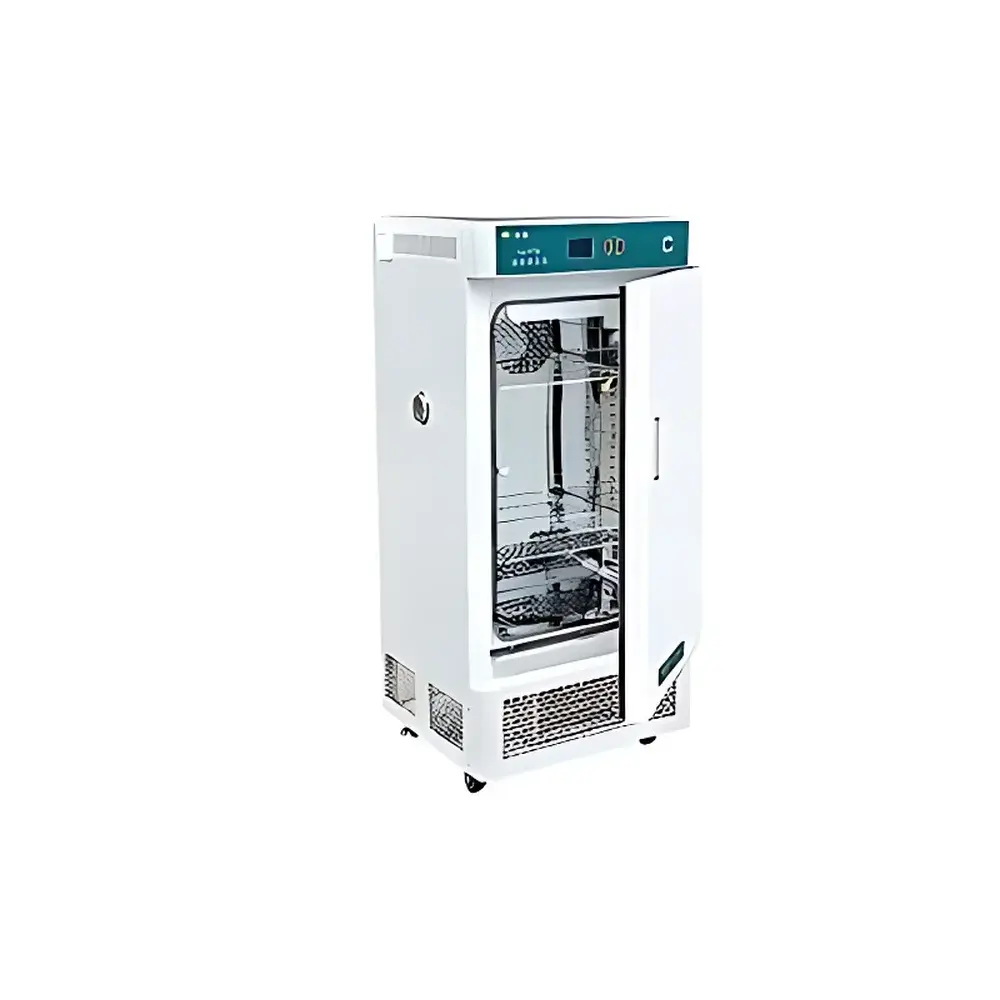
Hanuo MJP-150 Mold Incubator
| Brand | Hanuo |
|---|---|
| Origin | Shanghai, China |
| Model | MJP-150 |
| Temperature Range | 5–50 °C |
| Temperature Uniformity | ±1 °C |
| Chamber Volume | 150 L |
| Rated Voltage | 220 V |
| Rated Power | 804 W |
| Internal Dimensions (D×W×H) | 385 × 475 × 805 mm |
| External Dimensions (D×W×H) | 640 × 620 × 1420 mm |
| Net Weight | 84 kg |
| Compliance | CE-marked per IEC 61010-1 for laboratory equipment safety |
Overview
The Hanuo MJP-150 Mold Incubator is a precision-controlled, forced-air laboratory incubator engineered specifically for the cultivation and maintenance of filamentous fungi, yeasts, and other moisture-tolerant microorganisms under stable thermal conditions. Unlike general-purpose CO₂ or refrigerated incubators, the MJP-150 is optimized for mycological applications where consistent temperature control—without active humidity regulation—is critical for reproducible spore germination, hyphal growth kinetics, and colony morphology assessment. Its design adheres to fundamental principles of convective heat transfer and thermal mass stabilization, ensuring minimal spatial gradient deviation across the working chamber. The unit operates within a regulated range of 5–50 °C with a maximum temperature fluctuation of ±1 °C, making it suitable for both ambient-temperature-adapted molds (e.g., Aspergillus niger, Penicillium chrysogenum) and thermotolerant isolates used in biodegradation studies or industrial enzyme screening.
Key Features
- Stainless steel interior chamber (mirror-finish 304 grade) with integrated UV-C germicidal lamp (254 nm), enabling routine decontamination between batches without chemical agents.
- Microprocessor-based PID temperature controller with digital LED display, programmable setpoint memory, and real-time deviation monitoring; supports ramp-and-soak profiles via manual time/temperature input.
- Cold-rolled steel outer casing with electrostatic epoxy-polyester powder coating—resistant to abrasion, corrosion, and common lab disinfectants including 70% ethanol and 0.5% sodium hypochlorite.
- Double-layer insulated door with magnetic seal and low-emissivity glass viewport minimizes thermal leakage while permitting non-invasive observation during extended incubation cycles.
- Forced-air circulation system with tangential blower ensures uniform airflow distribution and eliminates stagnant zones—validated by ISO 14644-1 Class 8 cleanroom-compatible internal particle generation testing.
- Over-temperature protection circuit with independent mechanical cut-off switch (non-resettable at >65 °C) complies with IEC 61010-1 Clause 10.3 for operator and sample safety.
Sample Compatibility & Compliance
The MJP-150 accommodates standard microbiological consumables including Petri dishes (90 mm and 150 mm), slant tubes, multi-well plates (up to 96-well format), and Erlenmeyer flasks (≤500 mL). Its 150 L working volume allows simultaneous processing of ≥120 agar plates or ≥30 liquid culture vessels. The incubator meets essential safety and electromagnetic compatibility requirements per CE marking directives (2014/30/EU EMC Directive and 2014/35/EU LVD Directive). While not certified for GMP manufacturing environments, its construction and documentation support GLP-compliant usage in academic, environmental, and pharmaceutical quality control labs conducting USP , ISO 7932, or EN 15288-1 microbiological testing protocols.
Software & Data Management
The MJP-150 operates as a standalone instrument with no embedded data logging or network interface. All operational parameters—including setpoint, actual chamber temperature, elapsed time, and alarm status—are displayed locally on the front-panel LED screen. For regulatory traceability, users may integrate external USB or RS-232 data loggers (e.g., Omega OM-DAQPRO-5300 series) via optional analog output (0–5 V DC proportional to temperature). Audit trails, calibration records, and preventive maintenance logs must be maintained manually per ISO/IEC 17025 Clause 7.7 and FDA 21 CFR Part 11 Annex A guidance for non-electronic record systems.
Applications
- BOD5 and microbial respiration assays in environmental water quality monitoring (ASTM D5210, ISO 5815-1).
- Mycotoxin-producing strain propagation and sporulation synchronization for food safety validation studies.
- Antifungal susceptibility testing (AFST) using CLSI M38-A3 methodology with agar dilution or broth microdilution endpoints.
- Plant pathogen isolation and virulence phenotyping in phytopathology research (e.g., Fusarium oxysporum race identification).
- Validation of sterilization cycle efficacy against fungal biofilms on medical device surfaces (ISO 14937 Annex C).
- Long-term stability testing of probiotic formulations containing spore-forming Bacilli and Aspergilli.
FAQ
Does the MJP-150 include humidity control?
No. This model maintains only temperature-regulated dry-air conditions. For hygrometric control, consider the Hanuo MJH series or third-party external humidification modules compatible with 0–10 V analog input.
Is the UV lamp interlocked with the door safety switch?
Yes. The UV-C emitter automatically deactivates when the door is opened, preventing operator exposure per IEC 62471 photobiological safety classification.
Can the incubator be calibrated internally?
It features a user-accessible offset adjustment function (±5 °C range) but requires external NIST-traceable reference thermometers (e.g., Fluke 1523 with 0.05 °C uncertainty) for full verification per ISO/IEC 17025 Clause 6.5.
What is the recommended calibration frequency?
Annually for routine use; quarterly if employed in regulated QC workflows or following any physical impact event affecting chamber integrity.
Are replacement parts available outside China?
Yes. Critical components—including PID controller boards, blower assemblies, and UV lamps—are distributed globally through Hanuo’s authorized service partners in EU, North America, and APAC regions under part numbers HN-MJP150-CTRL-01, HN-MJP150-BLOWER-02, and HN-MJP150-UVLAMP-03.




