
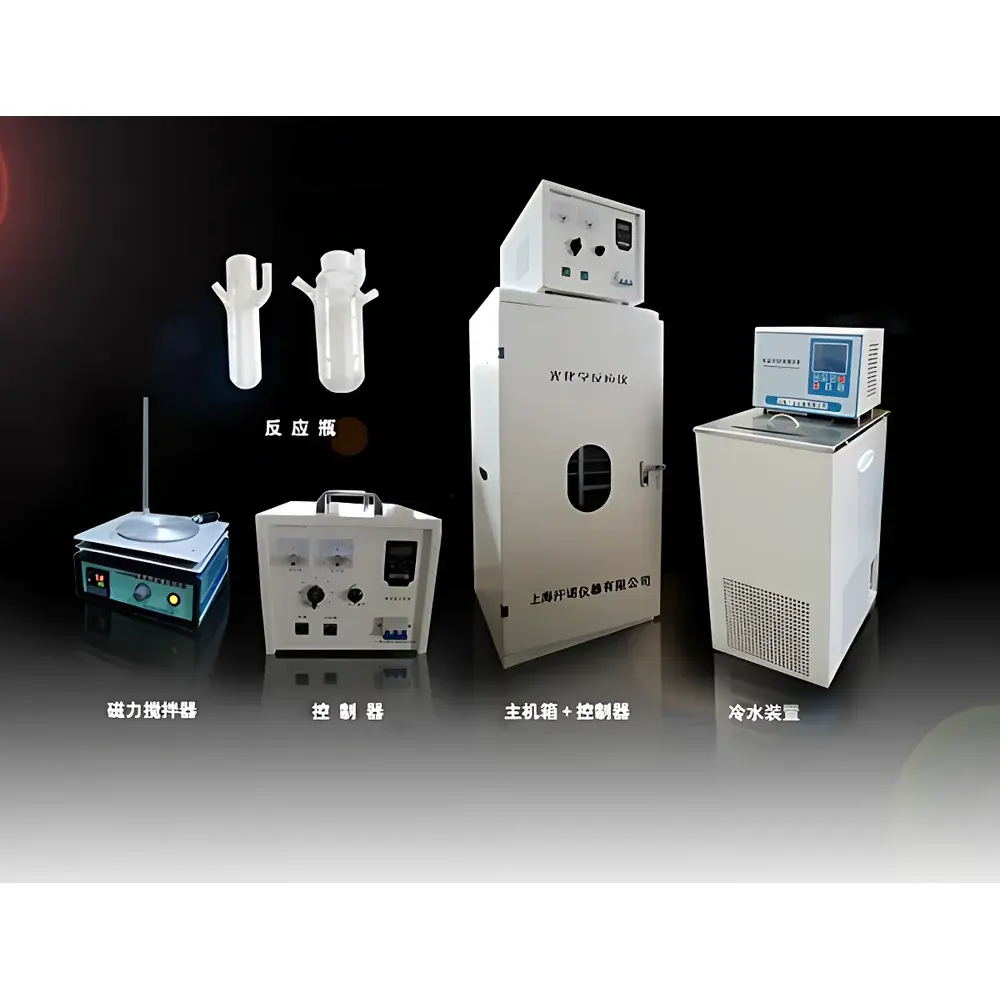
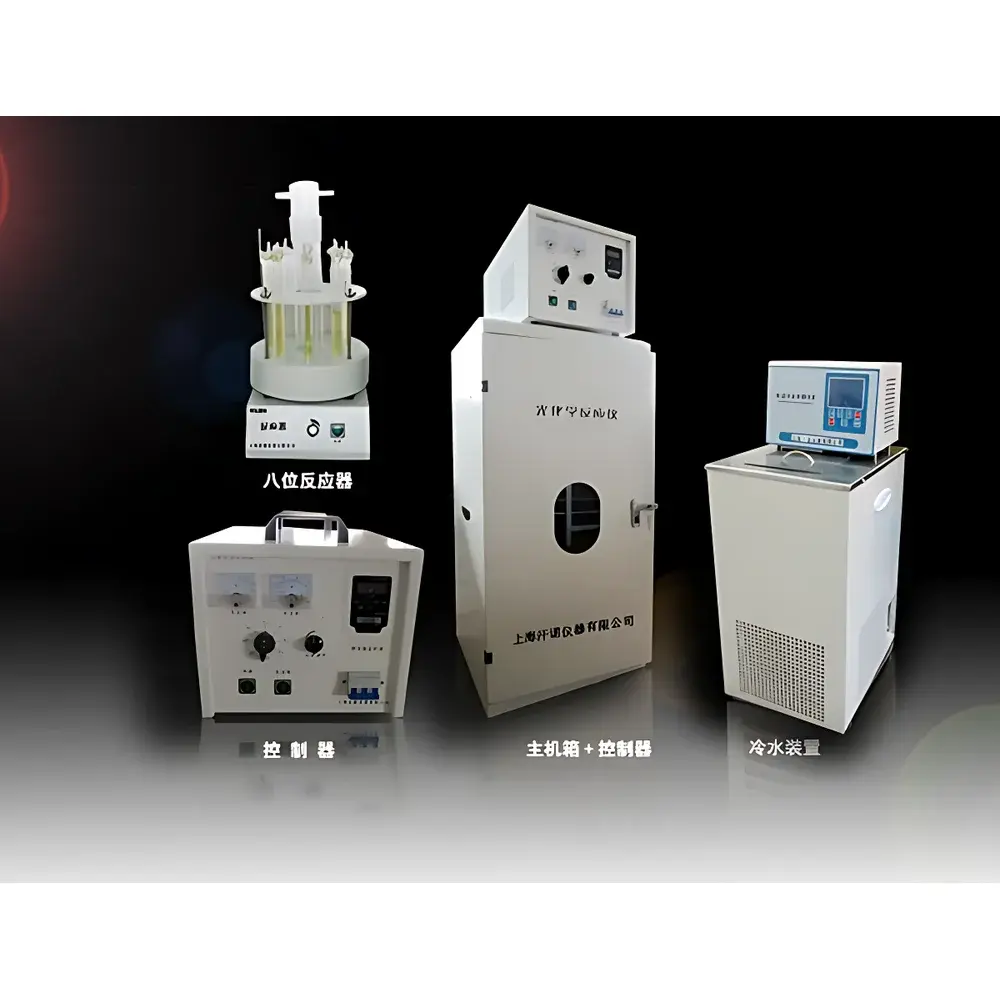
Hanuo HANUO-ZH Multi-Functional Photochemical Reactor
| Brand | Hanuo |
|---|---|
| Origin | Shanghai, China |
| Manufacturer Type | Authorized Distributor |
| Product Origin | Domestic (China) |
| Model | HANUO-ZH |
| Price | USD 6,800 (FOB Shanghai) |
| Light Source Type | Xenon Lamp |
| Irradiation Mode | Internal Illumination |
| Adjustable Power Range (Xenon) | 100–1000 W |
| Adjustable Power Range (Mercury) | 100–1000 W |
| Adjustable Power Range (Metal Halide) | 100–450 W |
| Cooling Capacity (Circulating Chiller) | >1000 W |
| Sample Capacity (Parallel Mode) | 8 positions |
| Tube Volume Options | 30 mL & 50 mL quartz |
| Reactor Vessel Options | 250 mL / 500 mL / 1000 mL borosilicate glass |
| Stirring | Dual-mode magnetic stirring (8-channel synchronized + high-torque single-vessel) |
| Quartz Cold Finger | Included |
| Compliance | Designed for ISO/IEC 17025-compliant photochemical laboratories |
| Software Interface | RS-485 + analog 0–5 V control output (no embedded GUI) |
Overview
The Hanuo HANUO-ZH Multi-Functional Photochemical Reactor is an engineered platform for controlled, reproducible photochemical experimentation under simulated solar or monochromatic irradiation. It operates on the principle of photon-driven reaction kinetics—where incident photons (typically 200–800 nm, tunable via spectral filtering) initiate bond cleavage, electron transfer, or radical generation in gaseous, liquid-phase, or heterogeneous catalytic systems. The system supports both batch and quasi-continuous flow configurations, with internal illumination geometry ensuring uniform photon flux distribution across reaction volumes. Its modular architecture enables precise decoupling of light delivery, thermal management, and mixing dynamics—critical for quantifying quantum yields (Φ), determining apparent rate constants (kapp), and mapping wavelength-dependent reactivity profiles per ASTM E2057 and ISO 10677 standards.
Key Features
- Triple-source compatibility: Integrated lamp controller supports xenon (broadband, 300–1100 nm), mercury (line spectra at 254, 365, 405, 436 nm), and metal halide (enhanced visible output) lamps—all with continuous 100–1000 W (Xe/Hg) or 100–450 W (MH) power regulation.
- Thermal stabilization: Built-in recirculating chiller (cooling capacity >1000 W) maintains reactor temperature within ±0.5 °C during extended irradiation, mitigating photothermal artifacts in kinetic studies.
- Dual-scale reaction capability: Simultaneous operation of eight parallel 30–50 mL quartz tube reactors (with synchronized 0–1200 rpm magnetic stirring) and one large-volume (250/500/1000 mL) borosilicate vessel equipped with high-torque magnetic stirring (0–800 rpm).
- Optical integrity: Quartz cold finger assembly minimizes UV absorption and thermal lensing; all optical paths conform to Schott UG11/UG5 spectral transmission specifications for UV-A/UV-B fidelity.
- Modular safety integration: Reaction chamber features interlocked dark box enclosure (IP54 rated), emergency stop circuitry, and ozone exhaust port compatible with laboratory fume hood ducting per EN 14175-3.
Sample Compatibility & Compliance
The HANUO-ZH accommodates homogeneous solutions (aqueous/organic solvents), gas-saturated liquids, immobilized photocatalysts (e.g., TiO2-coated beads or thin films), and slurry-phase suspensions. Quartz tubing ensures >90% transmittance down to 190 nm, enabling deep-UV photolysis studies. All wetted components comply with USP Class VI biocompatibility requirements. The system supports GLP-aligned experimental documentation when paired with external data loggers (e.g., NI CompactDAQ), and its analog/digital control interface facilitates audit-trail-capable integration into FDA 21 CFR Part 11–compliant LIMS environments. Calibration traceability follows NIST SRM 2036 (spectral irradiance) and ISO/IEC 17025-accredited procedures for radiometric validation.
Software & Data Management
The HANUO-ZH does not include embedded firmware or proprietary software. Instead, it provides standardized RS-485 Modbus RTU and 0–5 V analog outputs for seamless integration with third-party acquisition platforms (LabVIEW, MATLAB, Python-based PySerial control). Lamp power, chiller setpoint, and stirrer RPM are externally programmable and logged with timestamped metadata. Optional add-ons include a calibrated silicon photodiode sensor (NIST-traceable, ±3% uncertainty) and spectral irradiance mapping kit (32-point scanning probe) for spatial uniformity verification per ISO 17025 Annex A.3.
Applications
- Photocatalytic degradation kinetics of organic pollutants (e.g., methylene blue, phenol) under simulated sunlight (ASTM G154 Cycle 1).
- Quantum yield determination of ROS generation (•OH, 1O2, O2•−) using chemical actinometry (ferrioxalate, Reinecke’s salt).
- Photoinduced C–H activation and cross-coupling reactions in synthetic organic chemistry.
- Photostability testing of pharmaceuticals per ICH Q1B guidelines (optionally coupled with HPLC-UV analysis).
- Development and benchmarking of novel photocatalysts (g-C3N4, MOFs, perovskite quantum dots) under controlled irradiance and thermal conditions.
FAQ
What spectral range does the xenon lamp cover, and is spectral filtering supported?
The 1000 W xenon lamp emits from 200 nm to >1100 nm. Optional bandpass filters (254, 300, 365, 405, 450 nm) and cut-on/cut-off filters are mechanically compatible with the quartz cold finger mount.
Can the system operate under inert atmosphere or controlled gas flow?
Yes—the large-volume reactor vessel includes dual PTFE-sealed ports for gas inlet/outlet, supporting N2, Ar, O2, or synthetic air purging per ASTM D5232 protocols.
Is the chiller unit integrated or external?
The chiller is a standalone unit (mounted on casters) connected via quick-release fluid couplings; it is not housed within the main chassis to ensure serviceability and thermal isolation.
Are calibration certificates provided for the lamp output and temperature sensors?
Factory calibration reports (irradiance at 365 nm, chiller temperature accuracy) are included. NIST-traceable recalibration services are available through Hanuo’s Shanghai metrology partner (CNAS-accredited).
Does the system meet CE or UL safety certification requirements?
The HANUO-ZH complies with IEC 61000-6-3 (EMC) and IEC 61010-1 (safety) for laboratory equipment. CE marking is applied for EU export; UL listing requires customer-initiated third-party evaluation per regional import regulations.






