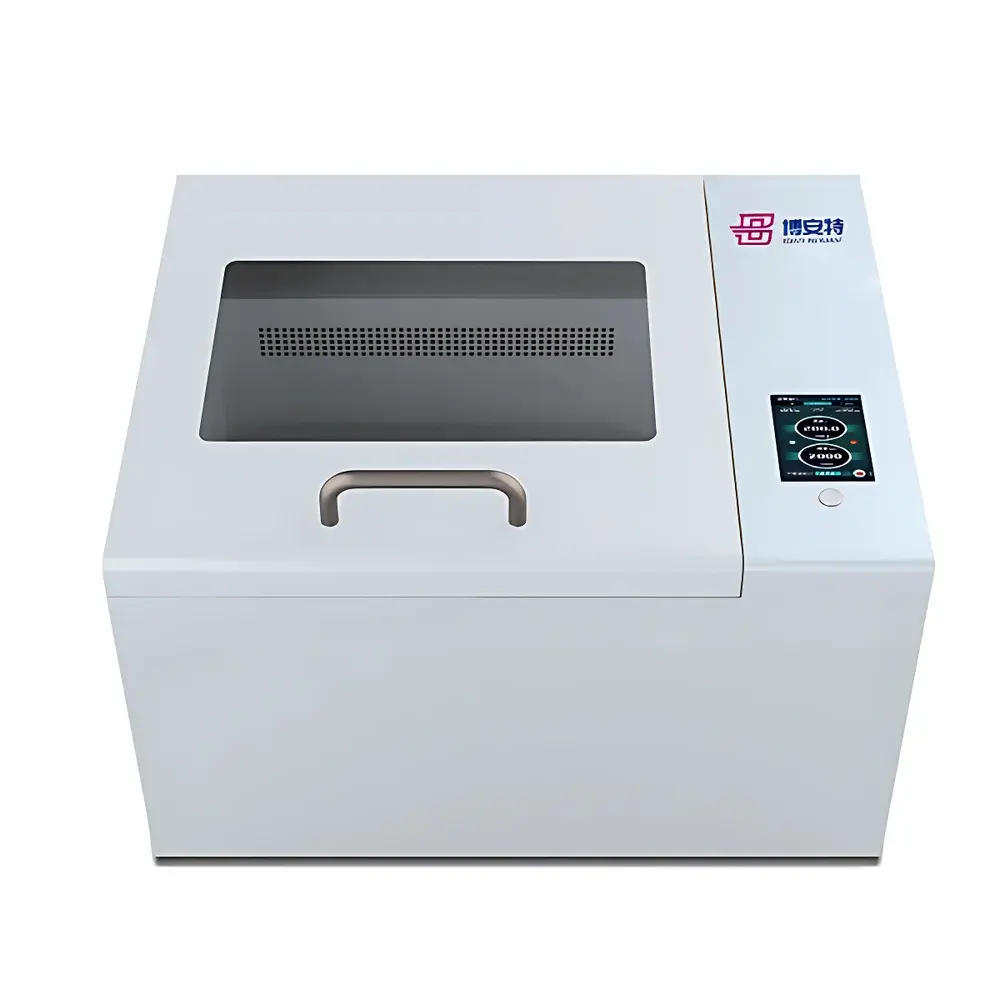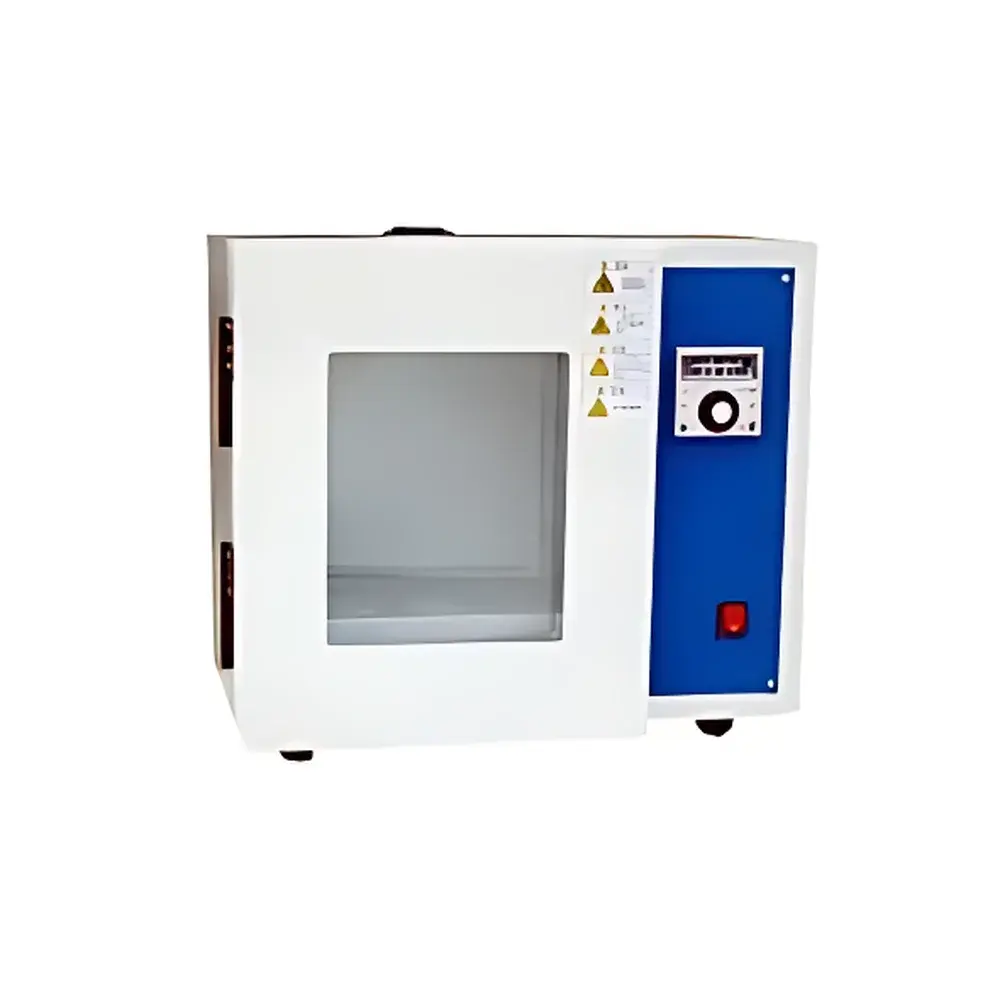
Hanuo DHG-9030A Benchtop Stainless Steel Forced-Air Constant-Temperature Oven
| Brand | Hanuo |
|---|---|
| Origin | Shanghai, China |
| Model | DHG-9030A |
| Chamber Capacity | 40 L |
| Temperature Range | RT + 10 °C to 250 °C |
| Temperature Uniformity | ±0.5 °C |
| Temperature Fluctuation | ±1 °C |
| Heating Rate | 1.0–3.0 °C/min |
| Timer Range | 1–9999 min |
| Display Resolution | 0.1 °C |
| Construction | Mirror-finish stainless steel inner chamber |
| Insulation | High-density ultra-fine glass fiber |
| Air Circulation | Vertical forced convection via high-temperature-resistant centrifugal blower |
| Viewing Window | Dual-layer tempered glass |
| Safety Features | Independent over-temperature cut-off protection (optional) |
| Surface Finish | Powder-coated carbon steel exterior |
Overview
The Hanuo DHG-9030A is a benchtop forced-air constant-temperature oven engineered for precision thermal processing in life science laboratories, quality control environments, and academic research settings. It operates on the principle of vertical forced convection—using a high-temperature-rated centrifugal blower to circulate heated air uniformly throughout the insulated chamber. This architecture ensures rapid thermal equilibration and exceptional spatial temperature uniformity (±0.5 °C), critical for applications requiring reproducible drying, baking, sterilization, or thermal stability testing. Unlike natural-convection ovens, the DHG-9030A’s active airflow system eliminates thermal stratification and accelerates moisture removal from samples, making it suitable for both routine dehydration of biological specimens and pre-conditioning of analytical standards. Its maximum operating temperature of 250 °C supports ASTM D563–22 (drying organic coatings) and ISO 293–2004 (plastic sheet conditioning), while its RT+10 °C lower limit enables low-heat stabilization protocols compliant with USP for sterile product packaging validation.
Key Features
- Mirror-polished 304 stainless steel inner chamber—welded via TIG process for corrosion resistance, cleanability, and compliance with GLP laboratory hygiene requirements
- Microprocessor-based digital temperature controller with 0.1 °C display resolution and ±1 °C fluctuation tolerance across the full range
- Programmable timer (1–9999 minutes) with audible end-of-cycle alert and automatic power cutoff
- Dual-layer tempered glass observation window with anti-fog coating, enabling real-time visual monitoring without thermal interruption
- High-efficiency thermal insulation using 80 mm thick ultra-fine glass fiber—minimizing heat loss and surface temperature rise (<45 °C at ambient 25 °C)
- Vertical airflow design optimized for uniform heat distribution; validated per ISO 15378:2017 Annex C for chamber homogeneity
- Optional independent over-temperature safety circuit (DIN 12880-compliant) that interrupts heating if setpoint exceeds user-defined threshold by >5 °C
- Powder-coated mild steel exterior with reinforced structural frame for long-term mechanical stability under continuous operation
Sample Compatibility & Compliance
The DHG-9030A accommodates standard laboratory vessels including Petri dishes, weighing boats, glass desiccators, aluminum sample pans, and stainless steel trays up to 340 × 325 × 320 mm (W × D × H). Its 40 L internal volume supports batch processing of multiple samples simultaneously while maintaining regulatory-grade consistency. The unit complies with IEC 61010-1:2010 for electrical safety in laboratory equipment and meets EMC requirements per EN 61326-1:2013. For GMP-regulated environments, optional audit-trail-enabled controllers support 21 CFR Part 11-compliant data logging when integrated with validated PC software. It is not designed for humidity control or inert-atmosphere operation; therefore, it is unsuitable for moisture-sensitive oxidation studies or anaerobic culture drying.
Software & Data Management
While the base configuration includes a standalone microcontroller with LED interface, an optional intelligent programmable LCD controller (model HLC-2000) is available. This module supports up to 30 user-defined ramp-soak profiles, real-time graphing of chamber temperature vs. time, and USB export of timestamped CSV files. All logged data include operator ID, start/stop timestamps, deviation alerts, and calibration event markers—enabling traceability during FDA or ISO 17025 audits. Firmware adheres to IEC 62304 Class B medical device software standards, and data integrity is preserved via write-protected memory with battery-backed clock.
Applications
- Drying of tissue sections, filter papers, and chromatography media prior to gravimetric analysis
- Baking of glassware and metal instruments in microbiology labs per CLSI M22-A3 guidelines
- Thermal aging of polymer films and pharmaceutical excipients per ICH Q1A(R2)
- Moisture content determination in botanicals and dietary supplements (AOAC 925.09)
- Pre-heating of crucibles and volumetric flasks in analytical chemistry workflows
- Stabilization of reference standards before calibration of HPLC autosamplers
- Post-curing of 3D-printed biocompatible scaffolds in regenerative medicine R&D
FAQ
Is the DHG-9030A suitable for sterilization of surgical instruments?
No—it lacks steam generation, pressure control, and validated lethality cycles required for autoclave-level sterilization. It may be used for dry-heat depyrogenation of glassware at ≥250 °C for ≥45 min per USP , but validation must be performed in-house.
Can this oven be connected to a building management system (BMS)?
Not natively. Optional analog 4–20 mA output or RS485 Modbus RTU interface modules are available upon request for integration into centralized lab monitoring networks.
What is the recommended recalibration interval?
Annual calibration against NIST-traceable reference thermometers is advised. Internal sensor drift should not exceed ±0.5 °C over 12 months under normal usage conditions.
Does the unit meet CE marking requirements for export to the EU?
Yes—certified to EN 61010-1:2010 + A1:2011 and EN 61326-1:2013, with Declaration of Conformity supplied with each shipment.
Is the stainless steel chamber electropolished?
No—the interior uses mechanically polished 304 stainless steel (Ra ≤ 0.8 µm), sufficient for routine cleaning and residue-free operation but not certified for ultra-high-purity semiconductor applications.