
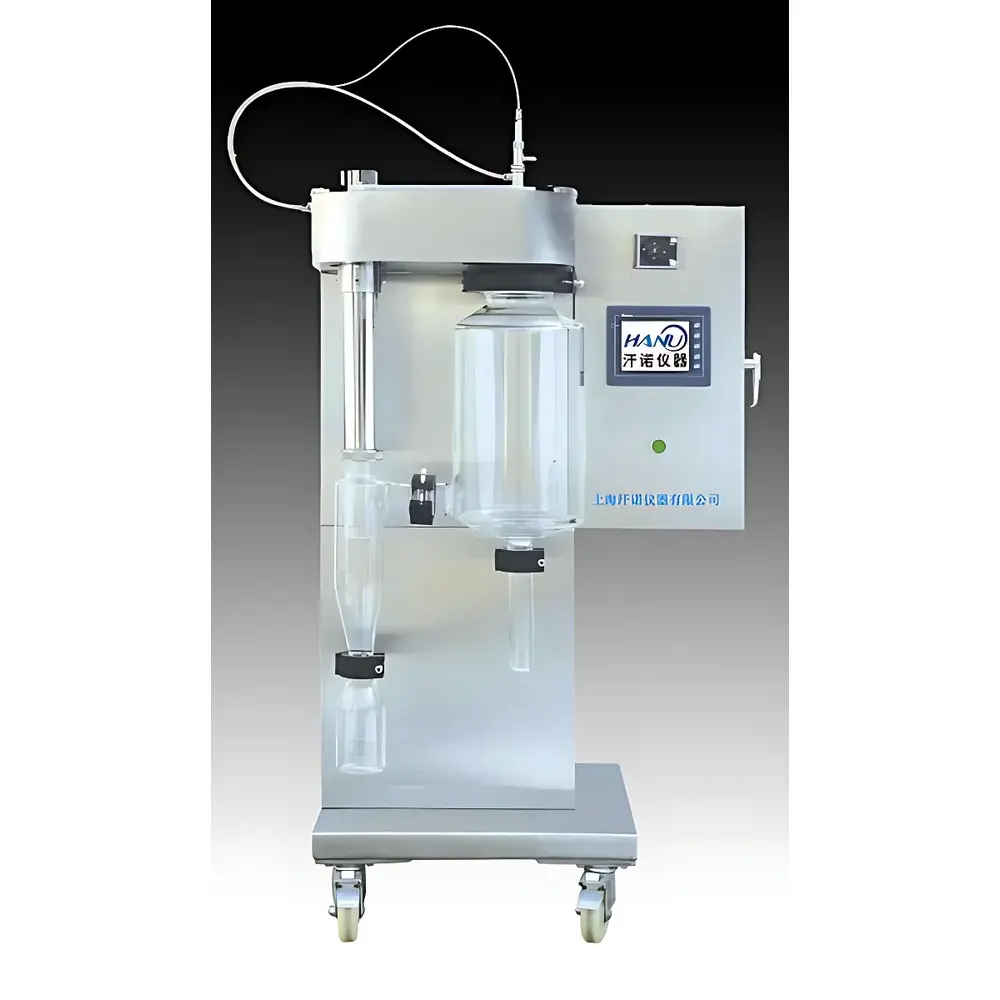
Hanuo HN-2000P Laboratory Spray Dryer
| Brand | Hanuo |
|---|---|
| Origin | Shanghai, China |
| Model | HN-2000P |
| Sample Type | Aqueous solutions only |
| Max Feed Rate | 2000 mL/h |
| Inlet Temperature Range | 30–300 °C |
| Outlet Temperature Range | 30–140 °C |
| Evaporation Capacity | 1500–2500 mL/h |
| Drying Residence Time | 1.0–1.5 s |
| Temperature Control Accuracy | ±1 °C |
| Power Supply | 3 kW / 220 V |
| Dimensions (H×L×W) | 1300 × 650 × 500 mm |
| Construction Material | Full 316 stainless steel frame + borosilicate glass drying chamber & collection system |
| Atomization | Two-fluid nozzle (compressed air-assisted) |
| Minimum Sample Volume | 30 mL |
| Touchscreen Interface | Color LCD with real-time display of inlet/outlet temperature, peristaltic pump speed, airflow rate, and needle cleaning cycle |
Overview
The Hanuo HN-2000P Laboratory Spray Dryer is an engineered solution for gentle, scalable powder production from aqueous feedstocks in research and development environments. It operates on the principle of flash evaporation via two-fluid nozzle atomization: liquid samples are pneumatically dispersed into fine droplets (typically 10–100 µm diameter) within a controlled hot-air stream; rapid solvent removal occurs within 1.0–1.5 seconds, minimizing thermal exposure to thermolabile compounds. This short residence time—combined with precise inlet temperature control (30–300 °C) and real-time outlet monitoring (30–140 °C)—enables reproducible drying of heat-sensitive biomolecules including enzymes, peptides, probiotics, monoclonal antibodies, and plant extracts without denaturation or activity loss. Designed for benchtop use in academic labs, pharmaceutical QC units, and pilot-scale formulation development, the HN-2000P delivers consistent particle morphology and residual moisture control under GLP-aligned operating conditions.
Key Features
- Two-fluid pneumatic nozzle system optimized for uniform droplet generation and high atomization efficiency across variable viscosities (up to 500 cP)
- Full 316 stainless steel structural frame with electropolished surfaces for corrosion resistance and cleanability—compliant with ISO 14644-1 Class 7 cleanroom handling protocols
- Borosilicate glass drying chamber and cyclone collector (Schott Duran® grade) enabling visual process monitoring and contamination-free powder recovery
- Integrated PID-controlled heating system with ±1 °C thermal stability at setpoint, validated per ASTM E2251-22 for laboratory thermal instrumentation
- Peristaltic feed pump (0–2500 mL/h range) with programmable ramping and minimum 30 mL batch capability for precious sample conservation
- Automated needle cleaner (‘通针’) with adjustable frequency and dwell time—prevents nozzle clogging during prolonged operation with suspensions or viscous emulsions
- Color TFT touchscreen interface displaying synchronized real-time parameters: inlet/outlet temperature, airflow rate (m³/h), pump RPM, and cleaning cycle status
- Safety-critical shutdown logic: pressing STOP halts heater and pump immediately while maintaining fan operation for safe cooldown—preventing thermal runaway or glass fracture
Sample Compatibility & Compliance
The HN-2000P is validated for aqueous-based feeds only—including solutions, colloidal dispersions, nanoemulsions, and low-solids suspensions (≤25% w/w). It is not rated for organic solvents, flammable liquids, or high-viscosity polymer melts. Its design supports compliance with core regulatory expectations for early-phase R&D: the all-stainless construction meets FDA-recommended material standards for non-GMP lab equipment (21 CFR Part 11 Annex A considerations), while traceable temperature logging (via optional USB export) facilitates audit-ready documentation. Though not certified for GMP manufacturing, its repeatable drying profiles align with ICH Q5C stability protocol requirements for lyophilized/bioactive powder characterization.
Software & Data Management
The embedded controller records all operational parameters at 1-second intervals and stores up to 99 batch histories locally. Data export is supported via USB flash drive in CSV format for post-processing in MATLAB, JMP, or Python-based analytical workflows. While no cloud connectivity or remote access is provided, the system supports manual calibration verification logs required under ISO/IEC 17025 clause 7.8.2 for testing laboratories. Audit trail functionality includes timestamped operator ID entry (via touchscreen login), parameter change history, and automatic error-code logging (e.g., “Nozzle blockage detected at T=124.3°C”).
Applications
- Preformulation studies of protein therapeutics and vaccine adjuvants
- Rapid screening of excipient compatibility in amorphous solid dispersion development
- Production of inhalable dry powders for pulmonary delivery (particle size distribution centered at ~5 µm, aerodynamically optimized)
- Drying of microbial cultures and fermentation broths for starter culture preservation
- Encapsulation of nutraceuticals (e.g., omega-3 oils, polyphenols) using maltodextrin or gum arabic matrices
- Material science research on ceramic precursors, metal oxide nanoparticles, and MOF-derived catalysts
FAQ
Is the HN-2000P suitable for organic solvent-based feeds?
No. The system is designed exclusively for aqueous solutions and suspensions. Organic solvents require explosion-proof enclosures, inert gas purging, and condensate recovery systems not present in this configuration.
What is the typical particle size distribution achieved?
Median particle diameter (D50) ranges from 5–25 µm depending on feed concentration, inlet temperature, and atomization pressure—consistent with literature-reported values for two-fluid spray dryers under comparable conditions.
Can the instrument be integrated into a larger automated workflow?
Not natively. It lacks Ethernet/RS-485 ports or OPC-UA support. Integration requires external PLC interfacing via dry-contact I/O signals (available upon request as factory option).
Does it comply with USP <1211> or Ph. Eur. 2.9.36 for sterile processing?
No. It is a non-sterile R&D tool. Sterility assurance requires terminal sterilization of collected powder and separate ISO 5 isolator integration.
What maintenance intervals are recommended?
Daily: glassware cleaning, nozzle inspection, air filter check. Quarterly: PID calibration verification, peristaltic pump tubing replacement, and bearing lubrication of main blower motor per manufacturer’s service manual (Rev. 3.1, 2023).



