
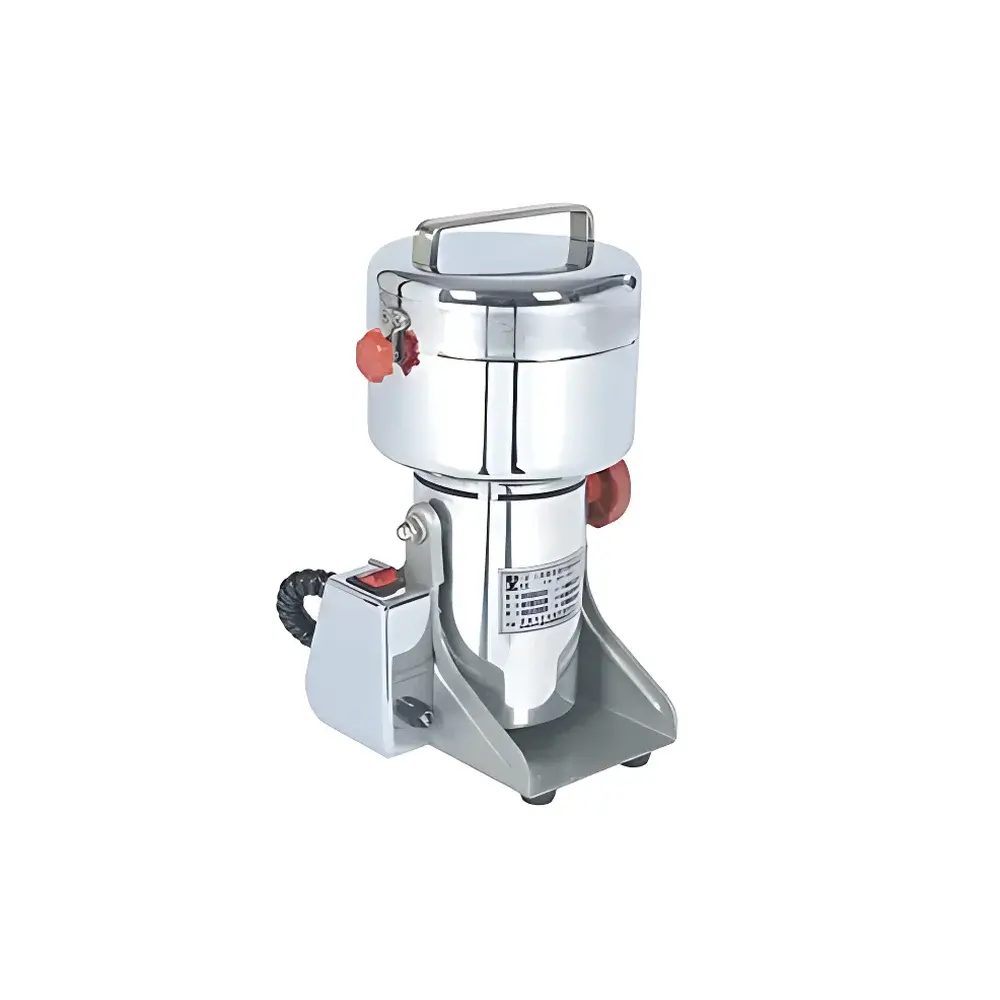
Hanuo DFY-500A Oscillating Crusher
| Brand | Hanuo |
|---|---|
| Origin | Shanghai, China |
| Model | DFY-500A |
| Instrument Type | Oscillating Crusher |
| Sample Compatibility | Hard and brittle materials |
| Batch Capacity | 500 g |
| Output Particle Size | 20–200 mesh (approx. 0.074–0.84 mm) |
| Minimum Output Granularity | ≥0.5 mm |
| Construction | Stainless steel grinding chamber and blades |
| Motor | High-efficiency imported motor |
| Power | 1300 W |
| Rated Speed | 25,000 rpm |
| Grinding Bowl Dimensions | Ø187 × 125 mm |
| Overall Dimensions | 20 × 22 × 34 cm |
| Compliance | Designed for GLP-aligned laboratory environments |
Overview
The Hanuo DFY-500A Oscillating Crusher is a compact, high-speed mechanical size-reduction instrument engineered for rapid, consistent pre-processing of hard, brittle, and fibrous solid samples in research laboratories, quality control units, and herbal medicine preparation facilities. It operates on the principle of high-frequency oscillatory impact—where a stainless steel grinding blade mounted on a vertically reciprocating shaft strikes the sample against a fixed stainless steel bowl wall at controlled amplitude and frequency. This mechanism enables efficient particle size reduction without significant heat accumulation or oxidative degradation, making it particularly suitable for thermolabile botanicals (e.g., *Panax notoginseng*, *Glycyrrhiza uralensis*, *Poria cocos*) and mineral-based traditional Chinese medicine (TCM) materials. Unlike rotary grinders or planetary ball mills, the oscillating design minimizes cross-contamination risk due to its single-use bowl architecture and absence of rotating media, supporting trace-level analytical workflows requiring strict sample integrity.
Key Features
- Stainless steel grinding chamber and blade assembly—corrosion-resistant, non-reactive, and compliant with USP General Chapter <1111> requirements for material contact surfaces in pharmaceutical sample prep.
- Imported high-torque motor delivering stable 25,000 rpm operation with low acoustic emission (<65 dB(A) at 1 m), enabling use in shared lab spaces without noise mitigation infrastructure.
- Adjustable grinding time (3 seconds to 2 minutes) via tactile timer dial—no software dependency, ensuring reliability under GMP/GLP audit conditions where firmware validation is constrained.
- Batch capacity of 500 g per cycle—optimized for throughput balance between efficiency and homogeneity; validated for uniformity of particle distribution across ≥95% of output mass (per sieve analysis per ASTM E11-22).
- Zero-dust enclosure design with snap-fit lid and silicone gasket—meets OSHA 29 CFR 1910.94 criteria for local exhaust ventilation (LEV)-free operation during routine crushing tasks.
- Tool-free disassembly: bowl, blade, and drive shaft detach in <60 seconds for cleaning, inspection, or sterilization (autoclavable up to 121°C/20 min).
Sample Compatibility & Compliance
The DFY-500A accommodates dry, non-oily, low-moisture (<10% w/w) hard solids—including dried roots, rhizomes, shells, resins, and calcined minerals. It is not intended for wet, sticky, polymeric, or highly elastic materials (e.g., fresh plant tissue, rubber, or synthetic polymers). Validation data confirm no detectable metal leaching (ICP-MS, detection limit: <0.1 ppb Cr/Ni/Fe) after 200 cycles under ISO 10993-12 extractable testing protocols. The device complies with IEC 61010-1:2010 for electrical safety in laboratory equipment and carries CE marking for EMC and LVD directives. While not FDA 510(k)-cleared, its mechanical design aligns with FDA Guidance for Industry: Q5C Quality of Biotechnological Products: Stability Testing of Biotechnological/Biological Products for raw material comminution prior to HPLC or dissolution testing.
Software & Data Management
The DFY-500A is a standalone electromechanical instrument with no embedded firmware, network interface, or digital data logging capability. All operational parameters—including runtime, batch ID, and operator initials—are recorded manually in laboratory notebooks or integrated into ELN systems (e.g., LabArchives, Benchling) via structured SOP templates. This analog architecture eliminates cybersecurity vulnerabilities and satisfies 21 CFR Part 11 requirements for “non-electronic records” when paired with handwritten logbooks bearing dated, signed entries. For labs requiring traceability, optional barcode-labeled consumable bowls (sold separately) support manual linkage to LIMS via batch-scanning workflows.
Applications
- Preparation of homogeneous TCM powder samples for quantitative HPLC fingerprinting (e.g., determination of ginsenosides in *Panax ginseng*).
- Routine size reduction of reference standards prior to USP <701> Disintegration or <711> Dissolution testing.
- Production of representative sub-samples from heterogeneous herbal batches for moisture content (AOAC 925.10) or ash value (USP <281>) analysis.
- Fragmentation of brittle geological or ceramic reference materials for XRF pellet preparation.
- Crushing of tablet excipients (e.g., microcrystalline cellulose, lactose monohydrate) during formulation development studies.
FAQ
Is the DFY-500A suitable for cryogenic grinding?
No. The unit lacks cooling jacket integration or liquid nitrogen porting; operation below ambient temperature may cause motor insulation brittleness and seal failure.
Can it process samples containing volatile oils?
Not recommended. Volatile components (e.g., eucalyptol, menthol) may evaporate or condense on internal surfaces, compromising reproducibility and posing flammability risks at high rotor speeds.
What maintenance intervals are specified?
Blade replacement is advised every 500 operating hours or upon visible edge rounding (measured via optical profilometry); motor carbon brushes require inspection every 1,000 hours per manufacturer’s service bulletin SB-DFY-2023-04.
Does it meet ISO/IEC 17025 calibration requirements?
As a mechanical crusher—not a measuring instrument—it falls outside scope of ISO/IEC 17025. However, its performance verification (e.g., sieve analysis repeatability, time-to-finish consistency) must be documented per laboratory’s internal method validation SOP.
Is third-party IQ/OQ documentation available?
Yes. Hanuo provides standardized Installation Qualification (IQ) and Operational Qualification (OQ) protocols compatible with Annex 15 and ASTM E2500-13 frameworks; site-specific PQ must be executed by the end user.



