
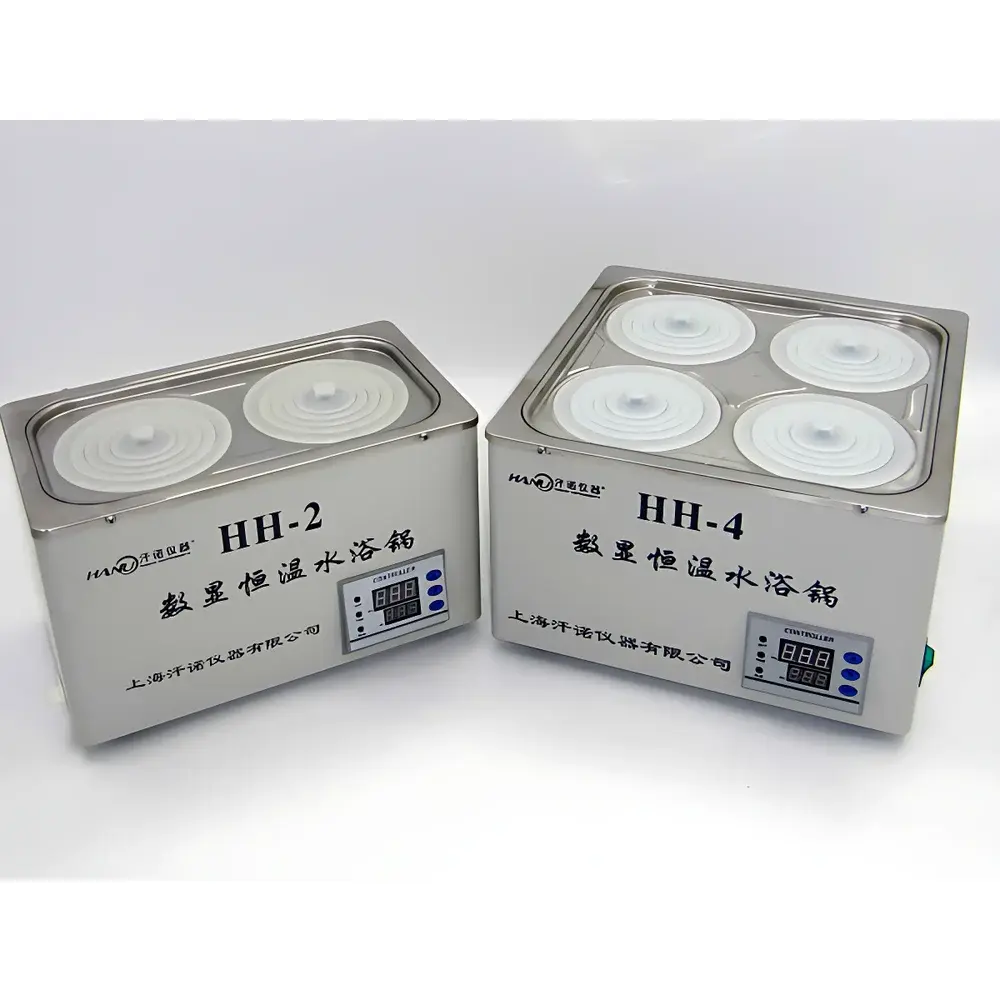
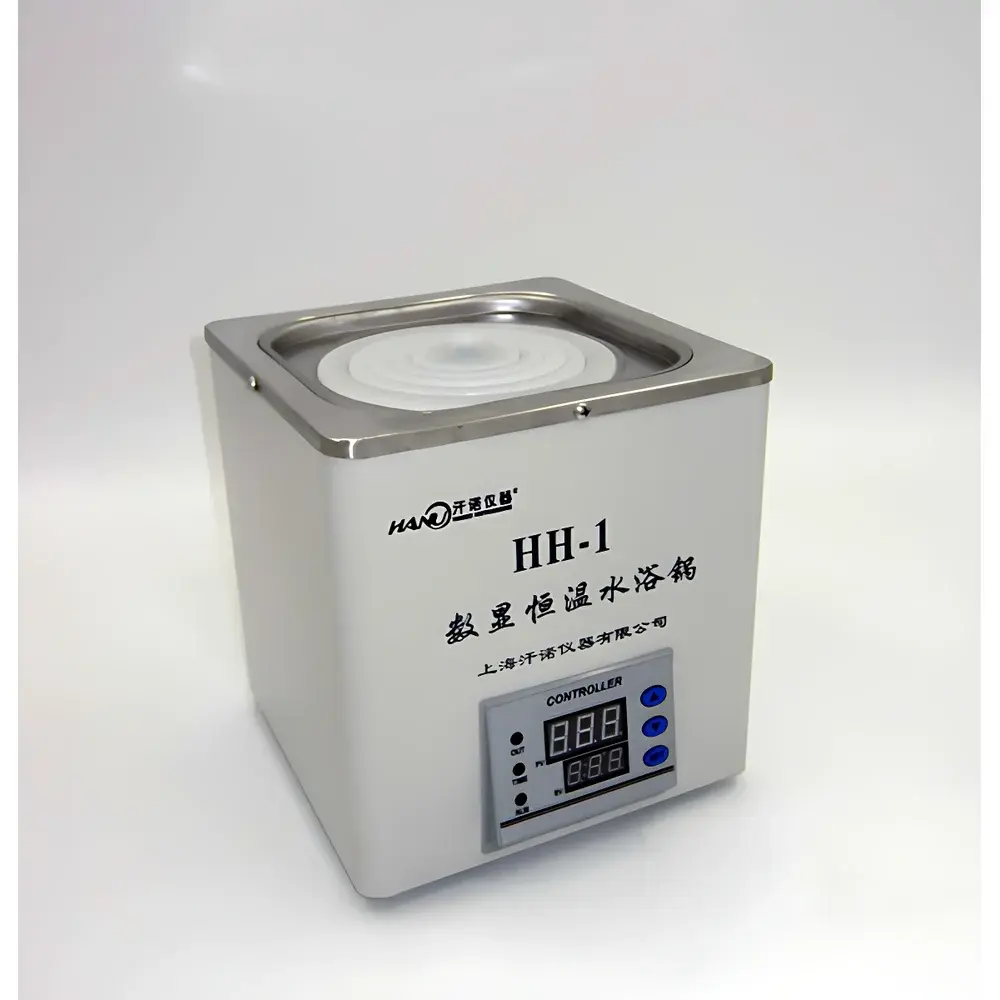
Hanuo HH-1S Digital Display Constant-Temperature Oil Bath
| Brand | Hanuo |
|---|---|
| Origin | Shanghai, China |
| Model | HH-1S |
| Temperature Range | Ambient to 300 °C |
| Working Chamber Dimensions | 160 mm × 160 mm × 130 mm |
| External Dimensions | 340 mm × 250 mm × 190 mm |
| Heating Power | 300 W |
| Construction | Stainless Steel Inner Bath, Powder-Coated Mild Steel Exterior |
| Control System | Microprocessor-Based PID Controller with LED Display |
| Compliance | Designed for general laboratory use per IEC 61010-1 safety requirements |
Overview
The Hanuo HH-1S Digital Display Constant-Temperature Oil Bath is a precision thermal immersion system engineered for stable, uniform heating of samples in oil or high-boiling-point heat-transfer media. Unlike water baths limited to 100 °C, this oil bath operates continuously from ambient temperature up to 300 °C—enabling applications requiring elevated thermal stability, such as solvent reflux, polymerization initiation, catalyst activation, and controlled thermal degradation studies. Its working principle relies on resistive heating elements embedded beneath a seamless stainless steel bath chamber, coupled with forced convection via internal circulation (passive thermal homogenization) and real-time feedback from a calibrated PT100 sensor. The microprocessor-based PID controller ensures ±0.5 °C temperature stability at setpoint across the full range, minimizing thermal drift during extended operation. Designed for benchtop integration in QC labs, R&D facilities, and teaching laboratories, the HH-1S meets fundamental electrical safety and thermal hazard mitigation standards outlined in IEC 61010-1 for laboratory equipment.
Key Features
- Stainless steel inner bath (AISI 304 grade) resistant to oxidation and chemical attack from common organic solvents and thermal oils (e.g., silicone oil, mineral oil, Dowtherm A)
- Digitally programmable PID temperature controller with 0.1 °C resolution and LED display for real-time monitoring and setpoint adjustment
- Over-temperature cut-off protection with independent mechanical thermostat (fail-safe secondary limit)
- Uniform thermal distribution achieved through optimized heater placement and bath geometry—validated by ASTM E145 Annex A3 thermal mapping methodology
- Low-profile footprint (340 mm × 250 mm) suitable for fume hood installation or shared benchtop environments
- No moving parts—eliminates maintenance associated with pumps or fans; silent, vibration-free operation critical for sensitive gravimetric or optical measurements
Sample Compatibility & Compliance
The HH-1S accommodates standard laboratory glassware including round-bottom flasks (up to 1 L), test tubes, reaction vials, and sample crucibles. Its open-bath configuration allows direct immersion of vessels without lid interference, supporting both static heating and gentle agitation via external stirrers. Compatible media include silicone oils (viscosity range: 10–1000 cSt), glycerol, and high-flash-point mineral oils (flash point > 250 °C). The unit complies with IEC 61010-1:2010 for electrical safety and is constructed to withstand repeated thermal cycling between ambient and 300 °C without warping or coating delamination. While not certified for explosion-proof or intrinsically safe environments, it is routinely deployed in GLP-compliant laboratories for non-hazardous thermal protocols under SOP-controlled conditions.
Software & Data Management
The HH-1S operates as a standalone analog-digital hybrid instrument with no onboard data logging or PC interface. Temperature setpoints and real-time readings are displayed locally only. For audit-trail compliance in regulated environments (e.g., pharmaceutical QC per USP or ISO/IEC 17025), users integrate the bath into validated workflows using external calibrated thermocouple loggers (e.g., Omega OM-DAQPRO-5300) connected to validated acquisition software. The device supports manual calibration verification per ISO/IEC 17025 Clause 6.5.2: users may insert a traceable reference thermometer (NIST-traceable Class A Pt100) into the bath fluid to confirm controller accuracy at multiple points (e.g., 100 °C, 200 °C, 250 °C) prior to critical runs.
Applications
- Controlled-temperature synthesis: Grignard reactions, Friedel-Crafts acylations, and esterification requiring precise thermal profiles above 100 °C
- Thermal stability testing of polymers, resins, and adhesives per ASTM D3826 and ISO 11357-3
- Drying and conditioning of hygroscopic standards and reference materials prior to gravimetric analysis
- Pre-heating of HPLC mobile phase reservoirs to reduce viscosity-induced backpressure fluctuations
- Calibration of thermocouples and RTDs using fixed-point oil baths per ISO/IEC 17025 Section 6.4
- Accelerated aging studies in material science and packaging validation (e.g., ASTM F1980)
FAQ
What is the maximum recommended operating temperature for continuous use?
The HH-1S is rated for continuous operation at 300 °C when filled with thermally stable silicone oil (e.g., Dow Corning PMX-200 series) and operated within a well-ventilated area.
Can the HH-1S be used with water instead of oil?
No—this unit is specifically designed for high-temperature oil media. Water must not be used above 100 °C due to vapor pressure risks and potential damage to the sealed heating assembly.
Is the temperature controller field-calibratable?
Yes—the PID controller accepts manual offset adjustment (±9.9 °C range) using the front-panel keys, enabling user-initiated compensation against a reference thermometer.
Does the HH-1S meet FDA 21 CFR Part 11 requirements?
No—it lacks electronic audit trail, user authentication, or electronic signature capability. It is intended for non-GMP research or non-critical preparatory steps where manual recordkeeping suffices.
What maintenance is required for long-term reliability?
Annual inspection of the thermal cutoff switch and visual verification of bath integrity (cracks, corrosion, seal degradation); oil medium should be replaced every 12–18 months depending on usage frequency and thermal cycling load.



