
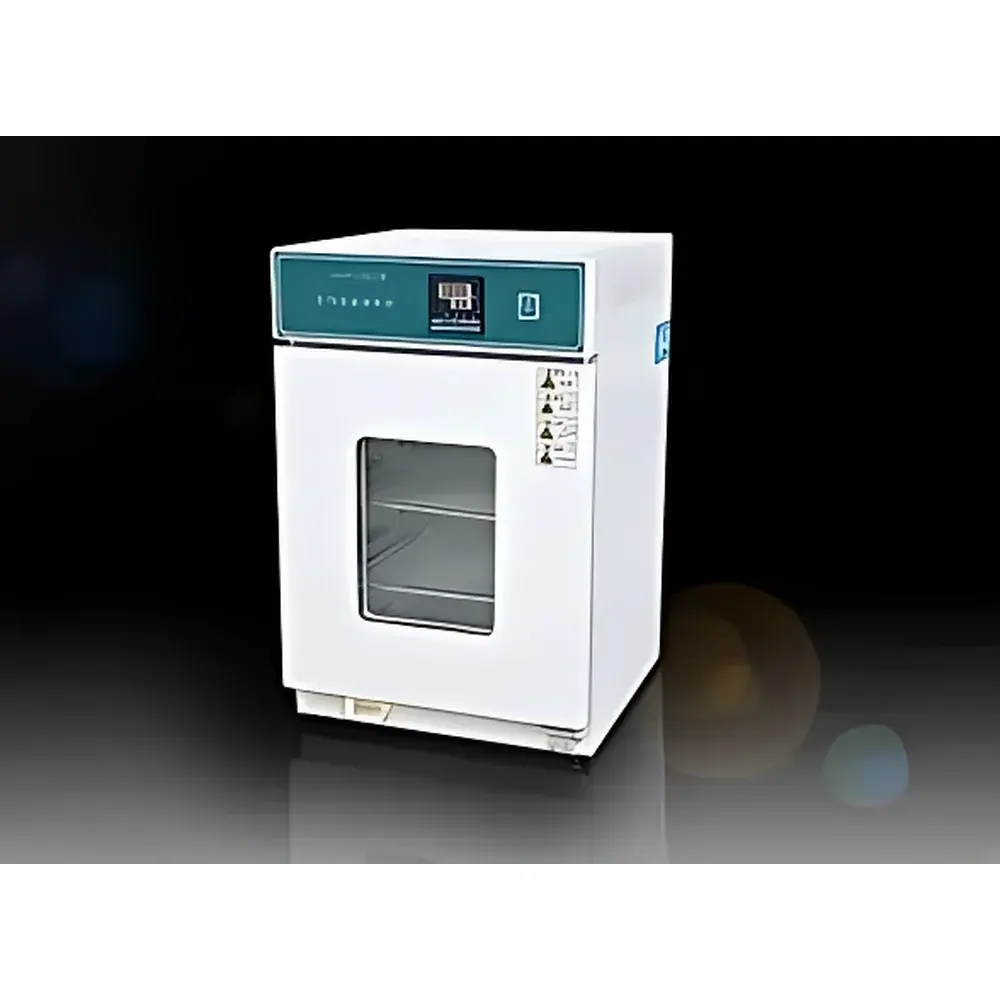
Hanuo DHP-500 Electrically Heated Constant-Temperature Incubator
| Brand | Hanuo |
|---|---|
| Origin | Shanghai, China |
| Model | DHP-500 |
| Temperature Range | Ambient +5°C to 65°C |
| Temperature Uniformity | ≤ ±0.5°C |
| Capacity | 150 L |
| Power Consumption | 500 W |
| Working Voltage | AC 220 V |
| Interior Dimensions (W×D×H) | 500 × 500 × 600 mm |
| Exterior Dimensions (W×D×H) | 585 × 585 × 875 mm |
| Net Weight | 44 kg |
| Construction | Painted steel exterior with optional stainless-steel interior chamber |
Overview
The Hanuo DHP-500 Electrically Heated Constant-Temperature Incubator is a precision-engineered benchtop incubation system designed for stable, reproducible thermal environments in life science laboratories. It operates on resistive heating principles with PID-controlled feedback regulation, ensuring minimal thermal overshoot and long-term setpoint stability. Unlike forced-air or CO₂-dependent models, the DHP-500 employs natural convection airflow architecture—optimized through internal baffle design and chamber geometry—to maintain uniform temperature distribution without introducing mechanical vibration or airflow-induced desiccation. This makes it particularly suitable for applications where sample integrity, microbial colony morphology, or enzymatic reaction kinetics must remain unaffected by turbulent air movement. The unit complies with general laboratory equipment safety standards per IEC 61010-1 and meets electromagnetic compatibility requirements under EN 61326-1 for use in non-clinical research settings.
Key Features
- PID digital temperature controller with high-resolution (0.1°C) display and real-time setpoint adjustment via front-panel keypad
- Dual-layer tempered glass observation window integrated into the door assembly, enabling non-invasive visual monitoring without compromising thermal integrity
- Magnetic door seal using high-elasticity silicone rubber gasket, engineered for >100,000-cycle durability and leak-tight closure at ambient and elevated temperatures
- Removable, adjustable stainless-steel or electropolished aluminum shelving (standard configuration includes two shelves; load capacity: 15 kg per shelf)
- Over-temperature protection circuit with independent mechanical cut-off switch (fail-safe redundancy beyond electronic control loop)
- Optional upgrade path to full 304 stainless-steel interior chamber—corrosion-resistant, autoclavable-compatible, and compliant with ISO 14644-1 Class 7 cleanroom handling protocols
Sample Compatibility & Compliance
The DHP-500 supports a broad range of biological and biochemical samples including Petri dishes, culture flasks (T25–T225), multi-well plates, test tubes, and environmental sampling vials. Its absence of humidity control excludes applications requiring hygrometric regulation (e.g., mammalian cell monolayer maintenance), but renders it ideal for bacterial propagation (e.g., E. coli, Bacillus subtilis), fungal isolation, seed germination assays, and enzyme activity studies conducted under defined dry-heat conditions. The incubator conforms to ASTM E1247-16 (Standard Practice for Characterizing Thermal Uniformity in Laboratory Ovens and Incubators) and supports GLP documentation workflows through traceable calibration certificate options (NIST-traceable RTD sensor available upon request). While not FDA 21 CFR Part 11 validated out-of-the-box, its logging-capable controller firmware allows integration into validated environments when paired with external data acquisition systems meeting ALCOA+ data integrity criteria.
Software & Data Management
The DHP-500 operates as a standalone instrument with embedded microcontroller-based logic; no proprietary software installation is required for basic operation. However, optional RS-485 Modbus RTU interface enables connection to SCADA platforms or centralized lab monitoring systems (e.g., LabVantage, Thermo Fisher SampleManager). Temperature logging intervals are configurable from 1 minute to 24 hours, with onboard memory retaining up to 30 days of time-stamped records (timestamp resolution: ±1 sec). Export is supported via USB-C port to CSV-formatted files compatible with Excel, MATLAB, or statistical process control (SPC) tools. Audit trail functionality—including operator ID tagging, parameter change logs, and alarm event timestamps—is available in firmware version 2.3+, supporting ISO/IEC 17025 accreditation requirements for testing laboratories.
Applications
- Bacterial growth curve analysis and antibiotic susceptibility testing (AST) per CLSI M07-A11 guidelines
- Thermal stability profiling of diagnostic reagents and lyophilized vaccines during accelerated aging studies
- Soil microbiology assays including MPN (Most Probable Number) enumeration and nitrification rate determination
- Quality control incubation for food safety testing (e.g., APC, coliforms, Listeria enrichment per ISO 6579)
- Plant tissue culture pre-incubation steps prior to sterile transfer under laminar flow hoods
- Material compatibility screening of packaging components exposed to elevated storage temperatures (ASTM D3045)
FAQ
Is the DHP-500 suitable for cell culture applications requiring CO₂ or humidity control?
No. This model provides only dry-heat temperature regulation and lacks gas blending, humidification, or CO₂ sensing capabilities. For mammalian or insect cell work, consider Hanuo’s CIC series CO₂ incubators.
Can the unit be calibrated internally without external equipment?
Yes—built-in offset calibration mode allows user-adjusted correction against a reference thermometer (±0.1°C resolution), documented in the operator manual Section 4.2.
What is the recommended recalibration interval for routine QC use?
Per ISO/IEC 17025, annual verification against NIST-traceable standards is advised; more frequent checks (quarterly) are recommended if used in regulated GMP environments.
Does the stainless-steel interior option affect thermal recovery time after door opening?
Thermal mass increases marginally (~8%), resulting in ~12% longer recovery to ±0.5°C deviation following a 30-second door opening at 37°C—verified per ASTM E1247 Annex B test protocol.
Is fan-assisted circulation available as an aftermarket retrofit?
No. Natural convection design is integral to structural integrity and thermal uniformity certification; forced-air modification voids factory warranty and regulatory compliance statements.





