
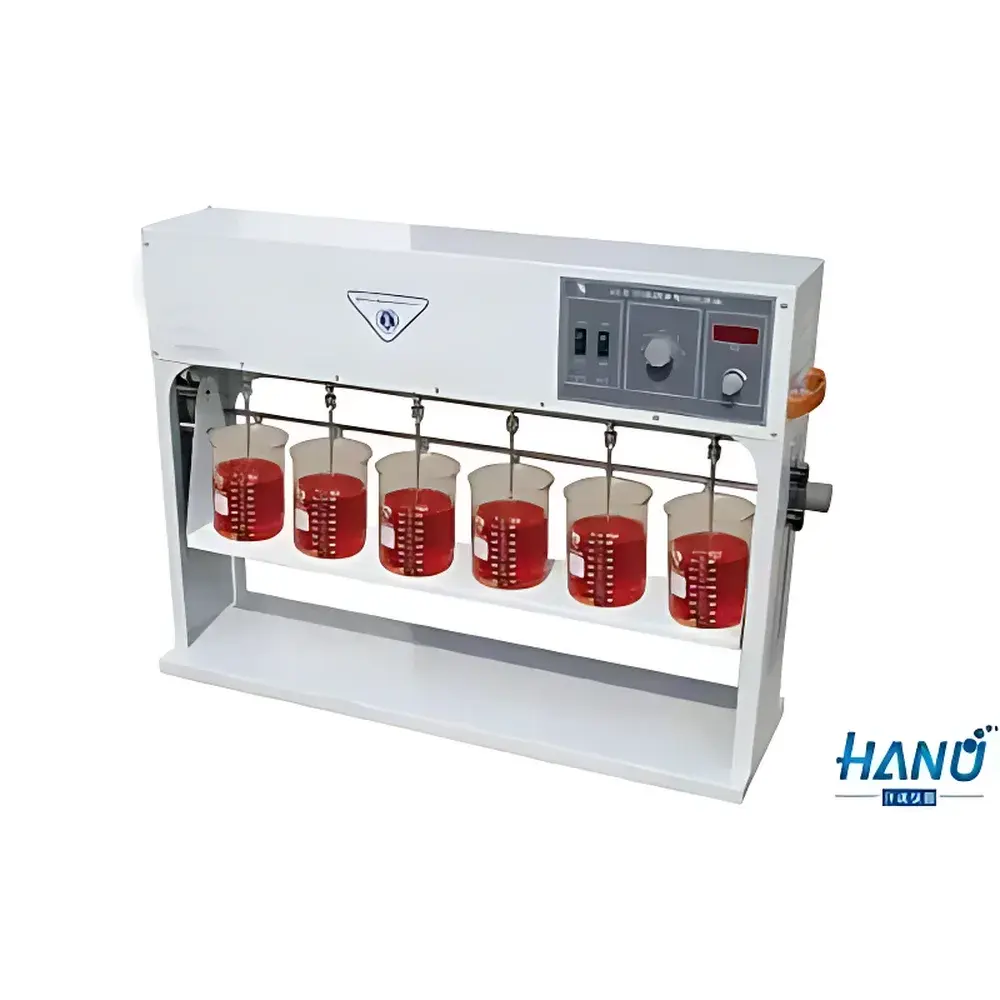
Hanuo JJ-4A Six-Station Digital Electric Stirrer
| Brand | Hanuo |
|---|---|
| Origin | Shanghai, China |
| Model | JJ-4A |
| Stirrer Type | Electric Multi-Position Stirrer |
| Max. Mixing Volume | 60 L (per station, total system capacity) |
| Speed Range | 0–3000 rpm (independent control mode) / 0–1100 rpm (synchronized mode) |
| Motor Power | 6 × 30 W (independent) or 140 W (synchronized) |
| Timer Range | 0–120 min |
| Vertical Adjustment Range | 20 cm |
| Display | Digital RPM readout per station (independent mode) or single display (synchronized mode) |
| Stirring Shaft Material | Stainless Steel (AISI 304) |
| Compliance | CE-marked for laboratory use under IEC 61010-1 |
Overview
The Hanuo JJ-4A Six-Station Digital Electric Stirrer is an engineered solution for high-throughput mixing and dispersion tasks in analytical, quality control, and research laboratories. Designed around a dual-mode architecture—supporting both independent and synchronized operation—it enables reproducible agitation across up to six sample vessels simultaneously. The device operates on the principle of direct-drive electromagnetic motor coupling, delivering consistent torque output across its full speed range without belt slippage or mechanical backlash. Its modular design accommodates standard laboratory glassware (e.g., beakers, Erlenmeyer flasks, and reaction vessels up to 10 L each), with a total system handling capacity of 60 L. The unit complies with IEC 61010-1 safety standards for electrical equipment used in laboratory environments and is CE-marked for use within the European Economic Area.
Key Features
- Dual operational modes: Independent control (six separate digital speed settings, each with real-time RPM feedback) and synchronized control (single speed setting applied uniformly across all six stations).
- High-resolution digital LED display showing actual rotational speed per station in independent mode; unified display in synchronized mode.
- Precision vertical adjustment mechanism allowing ±20 cm height positioning of the sample platform relative to the stirring shafts—critical for optimizing impeller submersion depth and shear profile consistency.
- Programmable timer function (0–120 minutes) with audible end-of-cycle alert and automatic motor shutdown for unattended operation.
- Six individually mounted 30 W brushless DC motors (independent configuration) or a consolidated 140 W motor assembly (synchronized configuration), both engineered for low thermal drift and extended service life under continuous duty cycles.
- Stainless steel (AISI 304) stirring rods supplied as standard—corrosion-resistant, autoclavable, and compatible with aqueous, mildly acidic, and alkaline media.
Sample Compatibility & Compliance
The JJ-4A accommodates common laboratory containers including borosilicate glass beakers (50 mL–10 L), polypropylene centrifuge bottles, and jacketed reactors. Its adjustable clamp system supports magnetic stir bars (when used with optional hotplate integration) and mechanical impellers (e.g., paddle, propeller, and anchor types) up to 80 mm diameter. The device meets IEC 61010-1 requirements for protection against electric shock, mechanical hazards, and abnormal temperature rise. While not certified for explosive atmospheres (ATEX/IECEx), it is suitable for general-purpose non-hazardous lab environments. No intrinsic calibration certificate is supplied; users are advised to verify rotational accuracy using traceable tachometric reference instruments prior to GLP/GMP-regulated applications.
Software & Data Management
The JJ-4A operates as a standalone benchtop instrument without embedded firmware or network connectivity. All parameter inputs—including speed setpoints, timer values, and mode selection—are executed via front-panel membrane switches and confirmed by local LED indicators. No data logging, USB export, or PC interface is provided. For laboratories requiring audit trails or electronic records, external validation protocols must be implemented—e.g., video recording of setup steps, manual logbook entries signed and dated per ISO/IEC 17025 or FDA 21 CFR Part 11 Annex 11 guidelines. Routine maintenance includes periodic verification of motor response linearity and display accuracy against NIST-traceable tachometers.
Applications
- Standardization of dissolution testing protocols across multiple USP Apparatus 2 vessels.
- Parallel preparation of calibration standards, buffer solutions, and reagent batches in QC labs.
- Kinetic studies requiring identical agitation conditions across replicate reaction systems (e.g., polymerization initiation, enzyme kinetics, colloidal stability assessment).
- Homogenization of suspensions and emulsions during formulation development in pharmaceutical and cosmetic R&D.
- Environmental sample digestion (EPA Method 3050B, 3051A) where uniform acid-matrix mixing across replicates is essential for inter-laboratory comparability.
FAQ
Can the JJ-4A be used with temperature-controlled vessels?
Yes—its 20 cm vertical travel allows compatibility with water-jacketed reactors and circulating baths, though no integrated heating or cooling functionality is included.
Is speed calibration traceable to national standards?
No factory calibration certificate is provided; users must perform in-house verification using a calibrated optical or contact tachometer.
What maintenance is required for long-term reliability?
Biannual inspection of motor mounts, cleaning of ventilation grilles, and verification of shaft concentricity using a dial indicator are recommended.
Does the unit support RS-232 or USB communication?
No—this is a manually operated instrument without digital communication interfaces.
Are replacement stirring rods available in custom geometries?
Hanuo supplies standard straight-shaft rods (300 mm length, 8 mm diameter); OEM custom impellers may be ordered separately with minimum batch quantities.



