
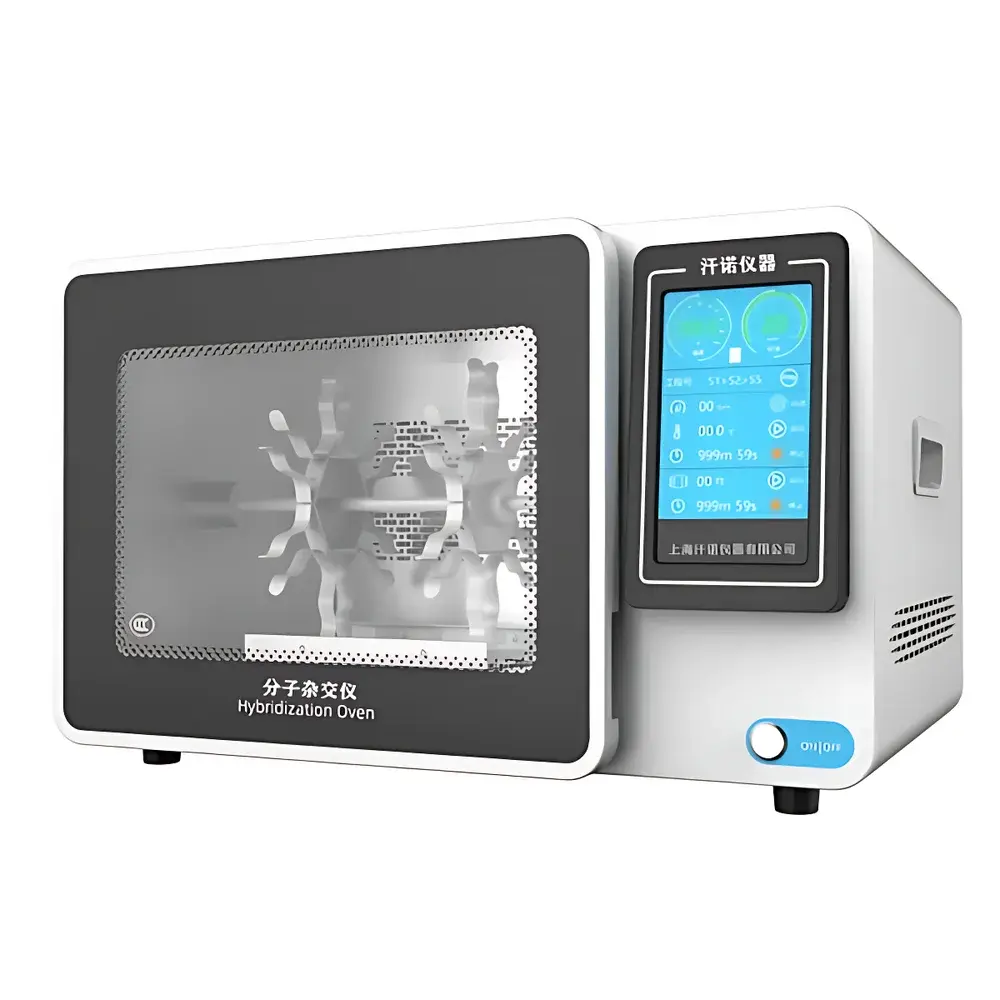
Hanuo LF-IIIN Nucleic Acid Molecular Hybridization Oven
| Brand | Hanuo |
|---|---|
| Model | LF-IIIN |
| Origin | Shanghai, China |
| Instrument Type | Nucleic Acid Molecular Hybridization Oven |
| Temperature Range | Ambient +5°C to 100°C |
| Temperature Uniformity | ±0.03°C |
| Rotational Speed | 0–50 rpm |
| Display | 7-inch TFT color touchscreen |
| Programming | 5-segment programmable protocol |
| Data Storage | Up to 50 user-defined protocols |
| Temperature Resolution | 0.1°C |
| Temp. Equilibration Time (at 37°C) | <20 min |
| Chamber Material | 304 stainless steel interior & rack |
| Door | Tempered glass with safety seal & door-open sensor |
| Safety | Automatic shutdown upon door opening |
| Optional | Modbus RTU communication interface |
Overview
The Hanuo LF-IIIN Nucleic Acid Molecular Hybridization Oven is an engineered platform designed for precise, reproducible nucleic acid hybridization under controlled thermal and mechanical conditions. It operates on the fundamental principle of nucleic acid annealing—where complementary single-stranded DNA or RNA probes hybridize to target sequences through Watson–Crick base pairing during a thermally regulated incubation process. Unlike passive water bath–based systems or static plastic bag hybridization, the LF-IIIN integrates active temperature control with programmable rotational mixing to ensure uniform probe distribution, consistent thermal exposure across all samples, and minimized edge effects. Its design conforms to standard molecular biology workflows requiring stringent thermal stability (e.g., Southern/Northern blotting, colony/plaque hybridization, microarray pre-hybridization, and in situ hybridization support), and supports both membrane-based and solution-phase hybridization protocols.
Key Features
- Forced-air convection heating system delivering rapid thermal response and exceptional spatial uniformity (±0.03°C) across the chamber volume—critical for high-fidelity hybridization kinetics.
- Stepper motor–driven vertical rotation mechanism with speed control from 0 to 50 rpm; eliminates belt-driven wear and ensures long-term mechanical reliability and torque consistency.
- 7-inch full-color TFT touchscreen interface with intuitive navigation, real-time temperature curve visualization, and dynamic door status indicator (open/closed).
- Five-segment programmable protocol capability: users can define independent time/temperature/speed profiles per segment—enabling complex gradient hybridizations, stepwise stringency washes, or multi-step enzyme-linked incubations.
- Integrated safety architecture: automatic motor and heater shutdown upon door opening, certified tempered glass door with silicone gasket seal, and 304 stainless steel chamber construction resistant to common laboratory reagents including formamide, SDS, and SSC buffers.
- Dual-mode operation: top rotor accommodates up to 12 standard hybridization tubes (Ø35 × 150/240/300 mm); optional bottom oscillating base (0–99 intensity levels) supports hybridization bags, microtiter plates, and blotting trays for heterogeneous sample formats.
- Data integrity support: onboard storage for up to 50 user protocols with timestamped execution logs; optional Modbus RTU interface enables integration into centralized lab automation systems compliant with ISO/IEC 17025 or GLP audit requirements.
Sample Compatibility & Compliance
The LF-IIIN accommodates a broad range of molecular biology consumables, including nylon and nitrocellulose membranes, glass- or polymer-coated slides, hybridization tubes (standard and low-profile), and sealed hybridization bags. Its chamber geometry and airflow pattern are optimized for even heat transfer to both high- and low-volume formats without condensation or localized overheating. The instrument meets China Compulsory Certification (CCC) standards for electrical safety and electromagnetic compatibility. While not FDA-cleared as a diagnostic device, its thermal accuracy (±0.5°C control precision), repeatability, and programmable documentation capabilities align with quality system expectations for research-use-only (RUO) applications governed by ISO 13485–influenced internal SOPs or CLIA-waived laboratory practices.
Software & Data Management
The embedded firmware provides non-volatile storage of 50 complete hybridization protocols, each comprising time, setpoint temperature, rotation speed, and segment sequencing. All executed runs generate timestamped records—including actual temperature traces captured at 1-second intervals—accessible via the touchscreen history menu. The optional Modbus RTU serial interface (RS-485) allows bidirectional communication with LIMS or SCADA platforms for automated run initiation, parameter logging, and electronic signature–enabled audit trail generation—supporting compliance with 21 CFR Part 11 Annex 11 principles where local regulatory policy permits.
Applications
- Membrane-based hybridization (Southern, Northern, dot, and slot blots)
- Colony and phage plaque lift screening
- Pre-hybridization and post-hybridization wash steps in FISH and comparative genomic hybridization (CGH)
- Antibody and enzyme incubation steps in ELISA and Western blot workflows
- Controlled denaturation and renaturation studies of nucleic acid secondary structures
- Temperature-dependent binding assays involving aptamers or synthetic oligonucleotides
FAQ
What is the maximum number of hybridization tubes the LF-IIIN can hold simultaneously?
The standard configuration supports either 6 or 12 tubes (Ø35 mm), depending on selected tube length (150 mm, 240 mm, or 300 mm). Tube holders are removable and reconfigurable.
Does the instrument support overnight hybridization protocols?
Yes—the total timer range extends to 999 minutes and 59 seconds per run, and multi-segment programming allows uninterrupted execution across extended durations.
Is calibration traceable to national standards?
Factory calibration uses NIST-traceable reference thermometers; users may perform field verification using calibrated PT100 probes inserted into designated ports (not included).
Can the LF-IIIN be integrated into a networked lab environment?
With the optional Modbus RTU module, it interfaces with industrial PLCs or custom middleware for centralized monitoring and remote parameter adjustment.
What maintenance is required for long-term operational stability?
No routine lubrication or consumable replacement is needed; periodic cleaning of the stainless steel chamber and door seal with 70% ethanol is recommended. The stepper motor and heating elements are rated for >50,000 hours MTBF.





