
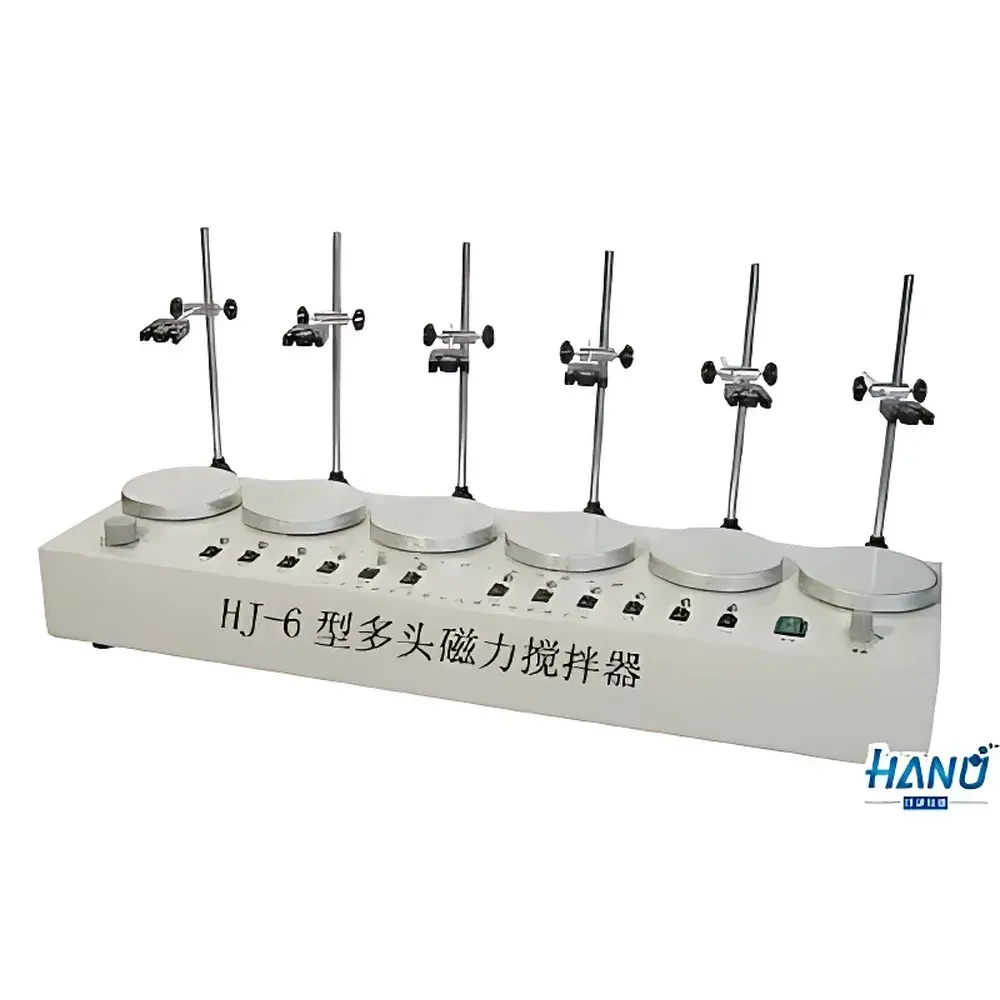
Hanuo HJ-6 Multi-Position Magnetic Stirrer
| Brand | Hanuo |
|---|---|
| Origin | Shanghai, China |
| Model | HJ-6 |
| Stirring Capacity | 6 × 1000 mL |
| Speed Range | 0–2400 rpm |
| Heating Power | 6 × 200 W |
| Type | Magnetic Stirrer (Heated, Non-Temperature-Controlled) |
| Category | Mixing & Dispersion Equipment |
Overview
The Hanuo HJ-6 Multi-Position Magnetic Stirrer is an engineered solution for high-throughput laboratory mixing applications requiring simultaneous, independent agitation of up to six samples. Designed around the principle of magnetic coupling—where a rotating permanent magnet or electromagnetic drive beneath the work surface induces rotation of PTFE-coated magnetic stir bars immersed in vessels—the HJ-6 delivers consistent torque transfer without mechanical shaft penetration, eliminating contamination risk and enabling sealed-vessel operation. Unlike single-station units, this six-position platform supports parallel processing under identical operational parameters, significantly improving reproducibility across replicate experiments in quality control, method development, and preparative chemistry workflows. Its robust aluminum alloy housing and thermally stable ceramic top plate ensure long-term dimensional integrity and resistance to chemical splashes and thermal cycling.
Key Features
- Six independently controllable stirring stations, each with dedicated speed adjustment and LED digital RPM display
- Wide speed range of 0–2400 rpm, supporting low-shear homogenization and high-viscosity dispersion via continuous analog control
- Integrated heating elements (200 W per station) provide rapid thermal ramping for temperature-assisted dissolution, reaction initiation, or solvent evaporation studies
- Ceramic-coated stainless steel top plate offers uniform heat distribution, corrosion resistance, and easy decontamination between runs
- Non-slip rubber feet and recessed vessel wells minimize lateral displacement during high-speed operation
- Overheat protection circuitry automatically disables heating if surface temperature exceeds safe operating limits (≥150 °C)
- Compact footprint (320 × 220 × 120 mm) optimizes bench space without compromising accessibility to all six positions
Sample Compatibility & Compliance
The HJ-6 accommodates standard laboratory glassware including beakers (50–1000 mL), Erlenmeyer flasks, and cylindrical reaction vessels with flat bottoms. Stir bar selection (lengths from 20–60 mm, diameters 5–10 mm) must align with vessel geometry and viscosity range to maintain vortex stability and avoid bar ejection. The unit complies with IEC 61010-1:2010 for electrical safety in laboratory equipment and meets EMC requirements per EN 61326-1:2013. While not certified for use in explosion-proof environments or under strict GMP/GLP audit conditions without additional validation documentation, its design supports traceable operation when integrated into SOP-driven workflows—including logging of speed setpoints and run duration via external data capture systems.
Software & Data Management
The HJ-6 operates as a standalone analog instrument with no embedded microprocessor or digital communication interface (e.g., RS-232, USB, or Ethernet). All adjustments are made manually via front-panel rotary dials with tactile feedback; speed values are displayed on six individual 3-digit LED readouts. For laboratories requiring electronic recordkeeping, integration with external environmental monitoring systems or LIMS is achievable using optional analog voltage output modules (0–10 V DC proportional to RPM) or time-lapse video documentation synchronized with experimental logs. Though lacking FDA 21 CFR Part 11-compliant audit trails natively, its simplicity ensures minimal validation burden during IQ/OQ/PQ protocols for routine QC mixing tasks.
Applications
- Parallel preparation of calibration standards and reference solutions in analytical chemistry labs
- Simultaneous pH adjustment and buffer equilibration across multiple sample batches
- Accelerated solid dissolution testing in pharmaceutical formulation development
- Homogenization of cell culture media, nutrient broths, and microbial growth substrates
- Pre-mixing of reagents prior to automated liquid handling or spectrophotometric analysis
- Supporting ASTM D2196 (viscosity of paints) and ISO 787-17 (dispersion stability of pigments) sample conditioning steps
FAQ
Does the HJ-6 support temperature feedback control or PID regulation?
No. The HJ-6 provides fixed-power resistive heating only; it lacks a temperature sensor, digital controller, or setpoint interface. For precise thermal management, consider the HJ-6A variant with integrated PT100 probe and ±0.5 °C digital temperature regulation.
Can the HJ-6 accommodate vessels larger than 1000 mL?
While physically possible, exceeding 1000 mL per station may compromise mixing efficiency due to reduced magnetic coupling strength and increased torque demand. Optimal performance is validated within the specified 6 × 1000 mL capacity.
Is the unit compatible with corrosive solvents such as concentrated acids or halogenated organics?
The ceramic-coated surface resists mild corrosion, but prolonged exposure to strong oxidizers (e.g., fuming nitric acid) or hydrofluoric acid will degrade the coating. Use chemically inert stir bars (e.g., PTFE/glass encapsulated) and verify compatibility with solvent-specific material safety data sheets.
What maintenance is required for long-term reliability?
Routine cleaning with isopropyl alcohol and lint-free wipes is sufficient. Annually inspect stir bar integrity, verify dial calibration against a tachometer, and confirm thermal cutoff functionality using a contact thermometer during full-power operation.



