
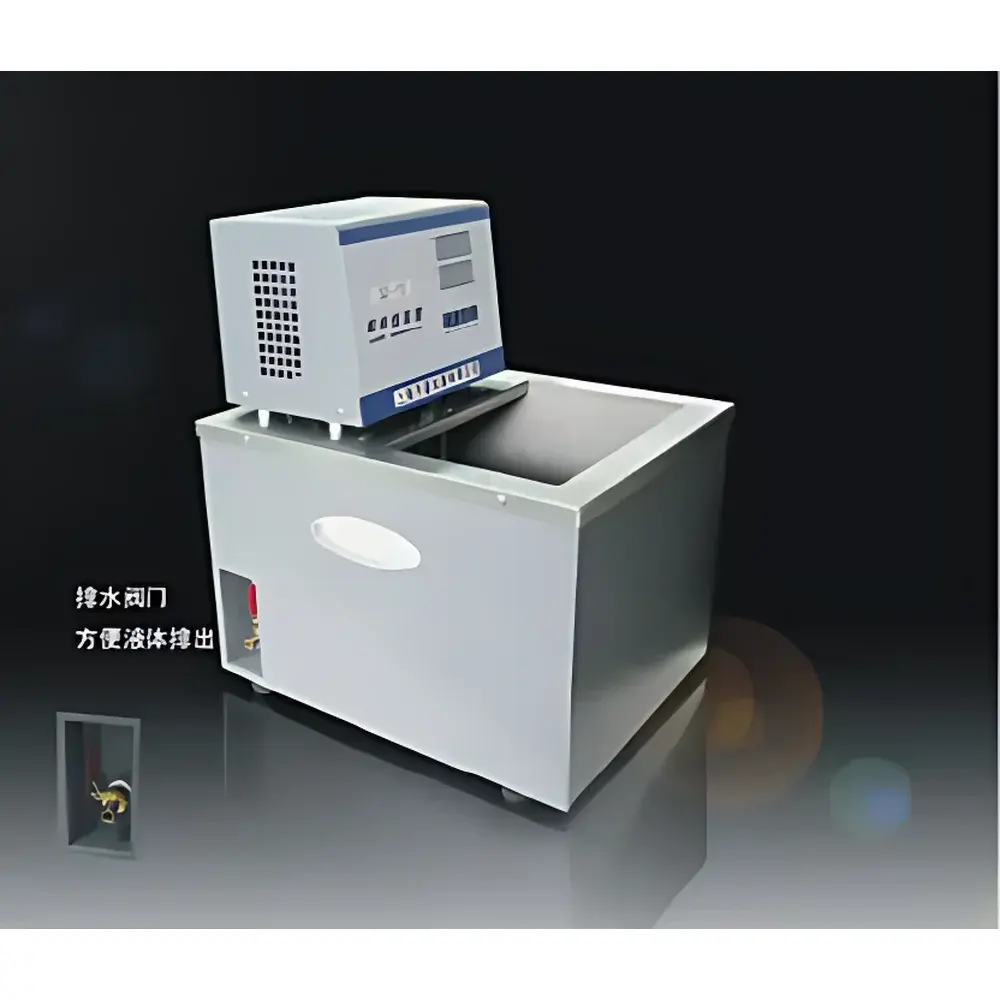
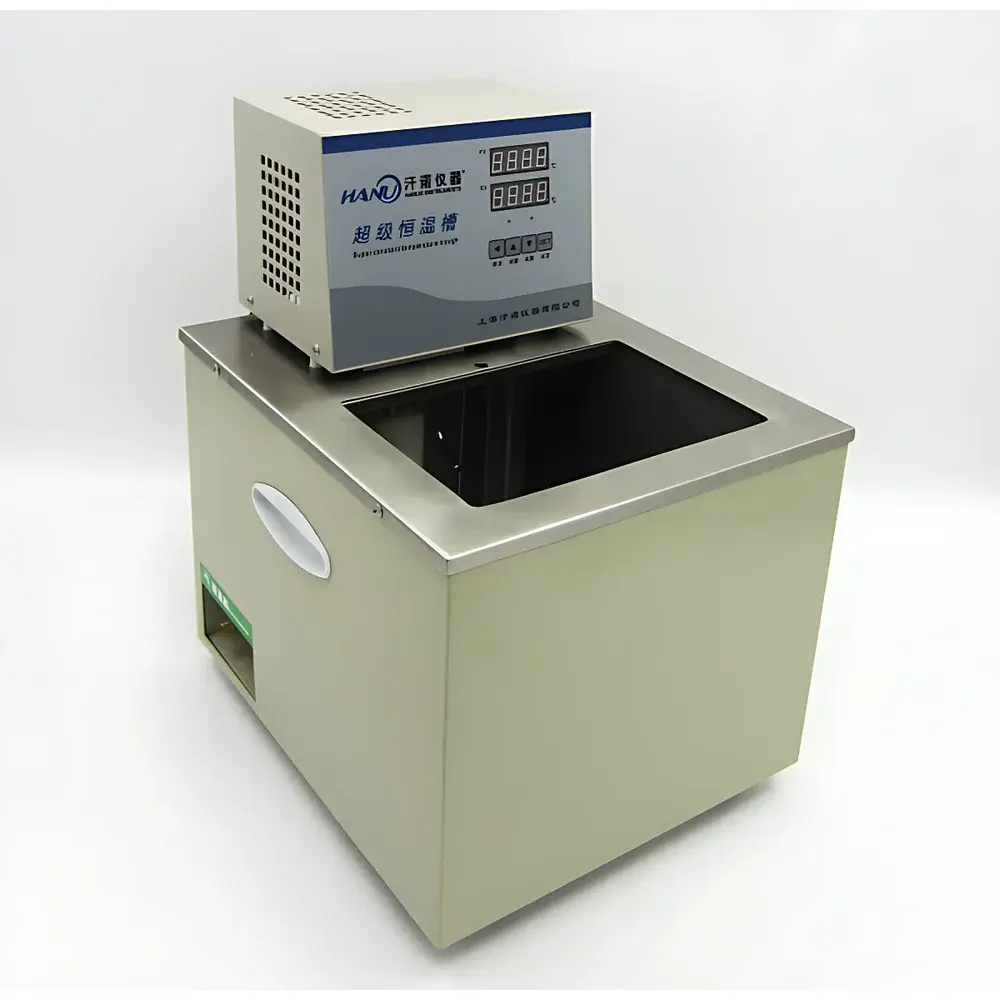
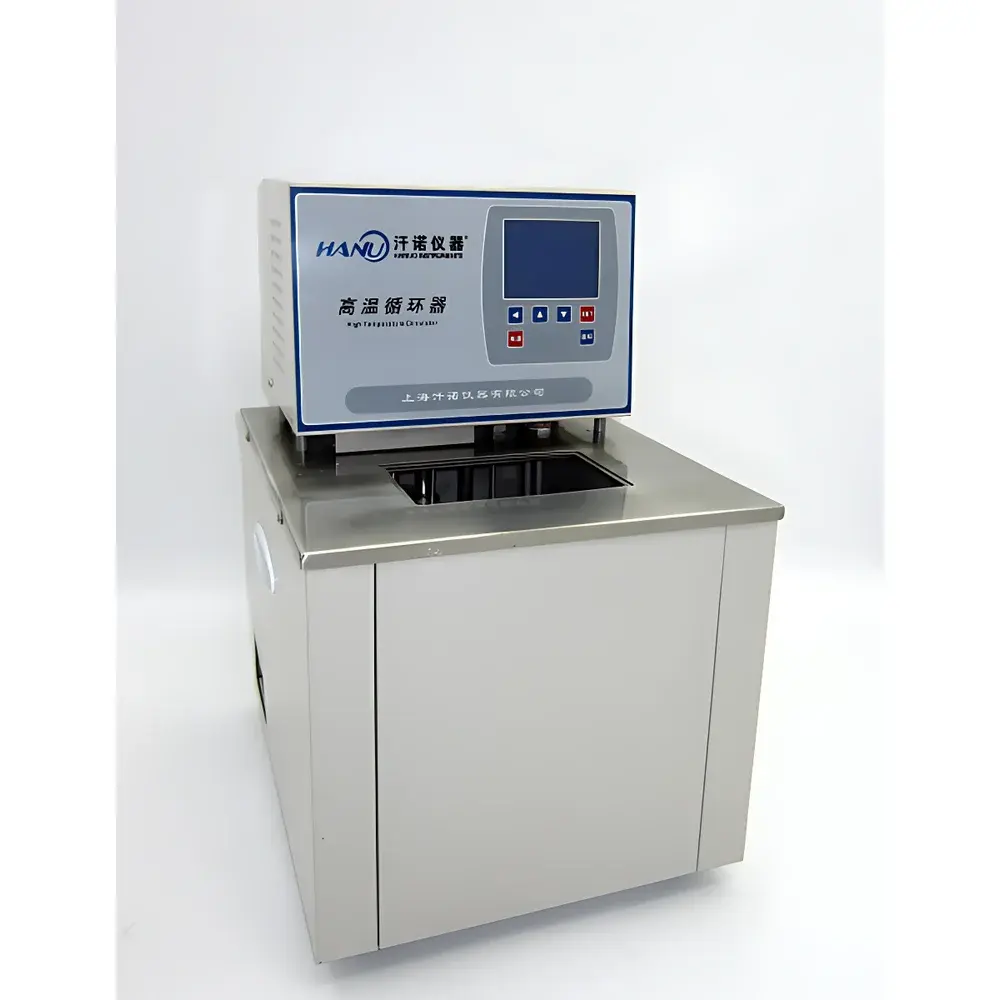
Hanuo SC-40 Precision Water & Oil Bath Circulator
| Brand | Hanuo |
|---|---|
| Origin | Shanghai, China |
| Model | SC-40 |
| Bath Volume | 40 L |
| Temperature Range | Ambient to 100 °C |
| Temperature Stability | ±0.05 °C |
| Circulation Type | Internal & External |
| Instrument Type | Constant-Temperature Bath Circulator |
Overview
The Hanuo SC-40 Precision Water & Oil Bath Circulator is an engineered thermal management system designed for laboratories requiring high-stability temperature control in both aqueous and organic media. Based on resistive heating and PID-controlled feedback regulation, the SC-40 maintains precise setpoint accuracy across a wide operational range (ambient to 100 °C), with demonstrated stability of ±0.05 °C under steady-state conditions. Its 40-liter working bath—measuring 490 × 420 × 200 mm (L × W × H)—is constructed from high-grade stainless steel (304) to ensure corrosion resistance and long-term dimensional integrity during prolonged exposure to water, glycerol, silicone oil, or other compatible heat-transfer fluids. Unlike basic immersion heaters, the SC-40 integrates a dual-mode circulation pump capable of internal recirculation (for uniform thermal distribution within the bath) and external flow delivery (for connecting to jacketed reactors, viscometers, or condenser coils). This architecture supports reproducible thermal conditioning essential for calibration, kinetic studies, enzyme assays, dissolution testing, and material property evaluation.
Key Features
- Stainless steel 304 bath tank with reinforced corners and seamless welds for mechanical durability and chemical compatibility
- PID digital temperature controller with real-time display, adjustable ramp rate, and over-temperature safety cutoff (adjustable limit up to 110 °C)
- Dual-function circulation pump: selectable internal-only or internal/external flow mode; external port rated for continuous operation at ≤1.2 bar backpressure
- Low-noise, brushless DC motor drive for pump operation—ensuring >10,000 hours MTBF and minimal vibration transfer to sensitive instrumentation
- Insulated lid with dual access ports (Ø60 mm and Ø30 mm) to accommodate probes, stirrers, or tubing while minimizing evaporative loss and ambient heat exchange
- Front-panel USB port for firmware updates and optional data logging via Hanuo’s proprietary PC software (v3.2+)
Sample Compatibility & Compliance
The SC-40 accommodates a broad spectrum of sample containers—including glass beakers (up to 5 L), stainless steel reactors, quartz cuvettes, and jacketed vessels—without compromising thermal homogeneity. Its open-bath geometry permits direct immersion of thermocouples, PT100 sensors, or optical probes for in-situ monitoring. The unit complies with IEC 61010-1:2010 for electrical safety in laboratory equipment and meets CE marking requirements for EMC (EN 61326-1) and low-voltage directive (2014/35/EU). While not certified to ISO/IEC 17025 for metrological traceability out-of-the-box, the SC-40 is routinely deployed in GLP-compliant environments for thermometer calibration per ASTM E77 and USP , provided users implement documented SOPs for verification, periodic recalibration (recommended annually), and audit-ready log retention.
Software & Data Management
Hanuo’s SC-Series Control Suite (Windows-compatible, v3.2.1) enables remote parameter setting, real-time temperature graphing, and automated protocol sequencing (e.g., hold-ramp-hold cycles). Data export is supported in CSV and XLSX formats, with timestamps aligned to system RTC (±2 s/year drift). Audit trail functionality records all user-initiated changes—including setpoint modifications, pump mode switching, and alarm acknowledgments—with operator ID tagging when integrated with domain-authenticated network login. The software satisfies FDA 21 CFR Part 11 requirements for electronic records when deployed with Windows Active Directory authentication and enabled digital signature modules.
Applications
- Calibration of liquid-in-glass thermometers, RTDs, and thermistors against NIST-traceable references
- Thermal preconditioning of polymer melts prior to rheological characterization (e.g., Brookfield or TA Instruments systems)
- Controlled-temperature enzymatic digestion in molecular biology workflows (e.g., restriction enzyme incubation at 37 °C or 50 °C)
- Accelerated stability testing of pharmaceutical formulations per ICH Q1A(R2) guidelines
- Heat transfer coefficient determination in fluid dynamics experiments using calibrated hot-wire anemometry
- Pre-heating and temperature equilibration of solvent baths for Soxhlet extraction or reflux setups
FAQ
Can the SC-40 operate with silicone oil or ethylene glycol? Why is oil compatibility important?
Yes—the SC-40’s heating element, pump seals, and bath structure are chemically rated for use with silicone oils (up to 100 °C) and aqueous glycol mixtures. Oil extends the effective upper temperature limit beyond water’s boiling point and reduces evaporation-related instability during long-duration experiments.
What is the maximum external flow rate achievable with the SC-40’s pump?
At zero backpressure, the external circulation delivers up to 12 L/min. Flow decreases linearly with increasing system resistance; typical jacketed reactor setups achieve 6–8 L/min at ≤0.8 bar pressure drop.
Does the SC-40 support RS-232 or Ethernet connectivity for LabVIEW integration?
No native serial or TCP/IP interface is included. Integration requires third-party USB-to-RS232 adapters and custom VISA drivers; Hanuo provides ASCII command documentation upon request.
Is the ±0.05 °C stability specification verified across the full 40 L volume?
Yes—stability is measured at three spatial points (center, front-left corner, rear-right corner) using calibrated Class A PT100 probes per ISO 17025-accredited methodology, with all readings remaining within ±0.05 °C of setpoint after 30 minutes of thermal equilibrium.
How often should the circulating fluid be replaced to maintain performance?
Deionized water should be refreshed every 2–3 months in continuous-use labs; silicone oil requires replacement only if discoloration, viscosity change, or particulate formation is observed—typically every 12–18 months under controlled lab conditions.



