
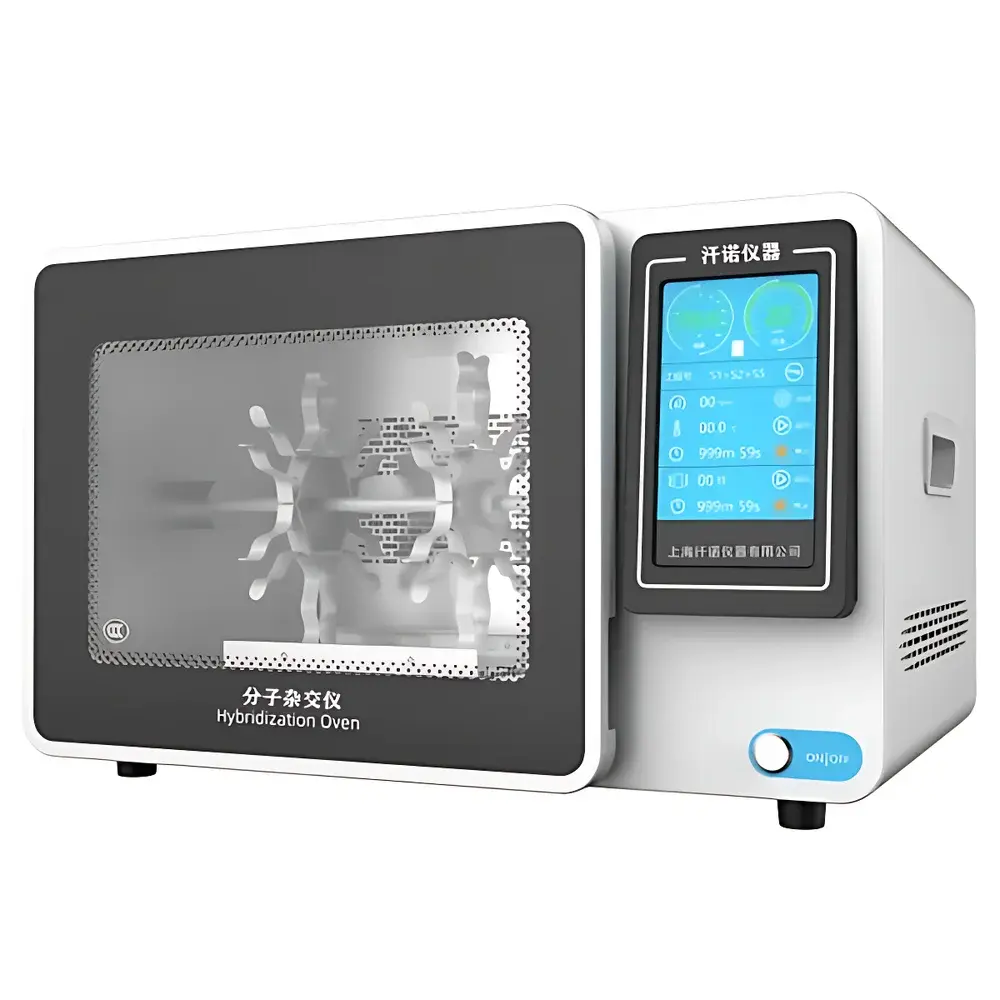
Hanuo LF-IN Temperature-Controlled Molecular Hybridization Oven
| Brand | Hanuo |
|---|---|
| Model | LF-IN |
| Instrument Type | Nucleic Acid Molecular Hybridization Oven |
| Temperature Range | Ambient +5°C to 100°C |
| Temperature Uniformity | ±0.03°C |
| Rotation Speed | 0–50 rpm |
| Display | 7-inch TFT true-color touchscreen |
| Temperature Resolution | 0.1°C |
| Temperature Equilibration Time (at 37°C) | <20 min |
| Programmable Segments | 5 |
| Data Storage Capacity | 50 protocols |
| Safety Features | Door-open auto-stop, 3C-certified tempered glass door with sealing gasket, corrosion-resistant 304 stainless steel chamber and rack |
| Power Supply | 220 VAC, 50 Hz |
| Max Power Consumption | <800 W |
| Optional | Modbus RS-485 communication interface |
Overview
The Hanuo LF-IN Temperature-Controlled Molecular Hybridization Oven is an engineered platform for precise, reproducible nucleic acid hybridization under tightly regulated thermal and mechanical conditions. It operates on the fundamental principle of nucleic acid annealing—where complementary single-stranded DNA or RNA probes hybridize to target sequences via Watson–Crick base pairing during controlled thermal denaturation and subsequent stepwise cooling (annealing). Unlike passive incubation methods such as water bath shakers or plastic bag-based hybridization, the LF-IN integrates forced-air convection heating with programmable vertical rotation to ensure uniform thermal distribution and consistent sample agitation across all reaction vessels. This dual-control architecture minimizes spatial temperature gradients and eliminates localized overheating or cold spots—critical for high-fidelity probe binding in applications ranging from Southern/Northern blotting to in situ hybridization assay development. Designed for compliance with standard molecular biology workflows, the instrument supports both manual and automated protocol execution without requiring external controllers or third-party software integration.
Key Features
- Forced-air convection heating system delivering ±0.03°C temperature uniformity across the entire chamber volume—validated per ISO/IEC 17025 calibration practices.
- Stepper motor-driven vertical rotation mechanism with speed control from 0 to 50 rpm; eliminates belt slippage and ensures long-term mechanical stability and positional repeatability.
- 7-inch TFT true-color capacitive touchscreen interface with real-time graphical temperature curve display, enabling visual verification of thermal ramping, hold phases, and equilibration dynamics.
- Five-segment programmable protocol engine supporting independent time/temperature/speed settings per segment—ideal for gradient hybridization, pre-hybridization blocking, and multi-step wash protocols.
- Corrosion-resistant 304 stainless steel interior chamber and sample rack, compatible with common hybridization buffers (e.g., SSC, SSPE, Denhardt’s solution) and organic solvents used in membrane stripping procedures.
- Integrated door-open safety interlock: automatic rotation and heating cessation upon lid actuation, conforming to IEC 61010-1 electrical safety requirements for laboratory equipment.
- Data logging capability storing up to 50 complete operational records—including start time, setpoints, actual temperature profiles, and user-defined notes—for internal audit and GLP documentation traceability.
Sample Compatibility & Compliance
The LF-IN accommodates standard hybridization tubes (Ø35 × 150 mm, Ø35 × 240 mm, Ø35 × 300 mm) with configurable mounting options for either 6 or 12 tubes per run. Its chamber geometry also permits placement of hybridization bags, microtiter plates (96-well), and nitrocellulose or nylon membranes mounted on support frames—enabling parallel processing of blotting membranes alongside solution-phase hybridizations. The unit complies with electromagnetic compatibility (EMC) standards EN 61326-1 and safety standard EN 61010-1. While not certified for clinical diagnostics under FDA 21 CFR Part 820, its design aligns with ISO 13485 quality management principles for research-use-only (RUO) instrumentation. All firmware and UI logic adhere to basic data integrity expectations defined in ALCOA+ guidelines when used in GxP-aligned academic or contract research environments.
Software & Data Management
Operation is fully self-contained within the embedded firmware—no PC dependency required. Protocol creation, execution, and recall occur directly via the touchscreen interface. Each saved method includes timestamped metadata: operator ID (manually entered), ambient conditions (if external sensor connected), and full thermal trajectory exportable as CSV via optional USB port (not included by default). The Modbus RTU (RS-485) interface—available as a factory-configurable option—enables integration into centralized lab automation systems for remote monitoring, event-triggered alerts, and synchronized scheduling with downstream imaging or detection platforms. Audit trail functionality meets minimum requirements for non-regulated research environments; however, full 21 CFR Part 11 compliance (e.g., electronic signatures, immutable logs) requires external LIMS-level validation and cannot be achieved solely through onboard firmware.
Applications
- Membrane-based nucleic acid hybridization (Southern, Northern, dot/slot blots) including pre-hybridization blocking, probe hybridization, and post-hybridization stringency washes.
- Fluorescent in situ hybridization (FISH) slide incubation under humidity-controlled conditions when paired with sealed hybridization chambers.
- Antibody-based enzymatic detection steps (e.g., alkaline phosphatase or horseradish peroxidase conjugates) requiring precise temperature and gentle agitation during incubation.
- Genomic library screening, colony/plaque lift hybridization, and cDNA array hybridization where low-background signal and high probe specificity are essential.
- Controlled denaturation-renaturation studies of nucleic acid secondary structures and protein–nucleic acid interaction assays requiring thermal ramping fidelity.
FAQ
What is the maximum number of hybridization tubes supported per run?
The LF-IN supports either 6 or 12 standard Ø35 mm tubes depending on configuration; tube length options include 150 mm, 240 mm, and 300 mm.
Does the instrument support humidity control?
No—humidity regulation is not integrated. For moisture-sensitive protocols (e.g., FISH), users must employ external humidified hybridization chambers placed inside the oven cavity.
Is the temperature calibration traceable to national standards?
Yes—factory calibration uses NIST-traceable reference thermometers; users may perform periodic verification using accredited PT100 probes per ISO/IEC 17025 procedures.
Can the rotation axis be inverted or tilted?
No—the rotation is strictly vertical-axis only, optimized for uniform mixing in upright cylindrical tubes.
What maintenance is required for long-term reliability?
Routine cleaning of the chamber interior and door seal with 70% ethanol; annual inspection of stepper motor coupling and airflow duct integrity recommended.




