
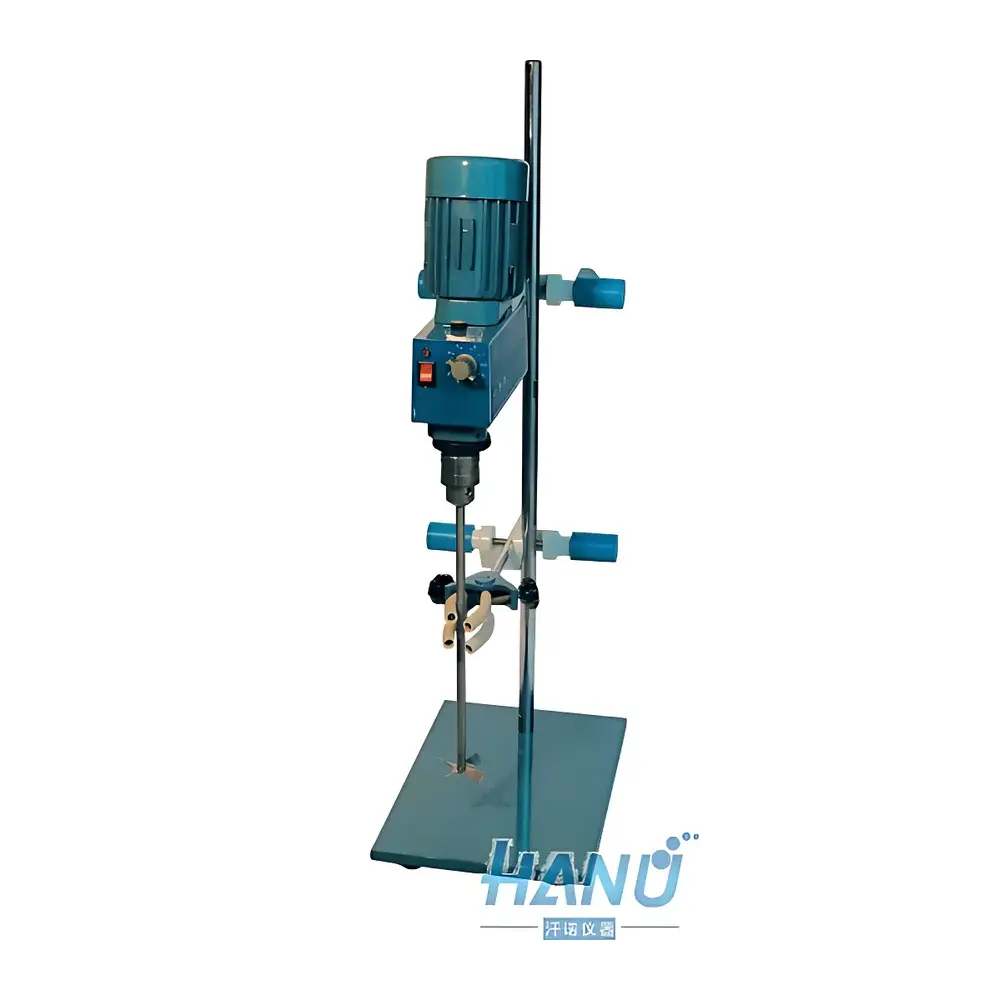
Hanuo JJ-1B Constant-Speed Heavy-Duty Electric Stirrer
| Brand | Hanuo |
|---|---|
| Origin | Shanghai, China |
| Model | JJ-1B |
| Stirrer Type | Electric Stirrer |
| Max. Mixing Volume | 20 L |
| Speed Range | Stage I: 60–500 rpm |
| Stage II | 240–2000 rpm |
| Motor Output Power | 90 W |
| Stirring Shaft Torque | 1850 g·cm |
| Chuck Capacity | 0.5–10 mm |
| Viscosity Range | 0–10,000 mPa·s |
| Input Voltage | 220–250 V AC |
| Temperature Control | None |
Overview
The Hanuo JJ-1B Constant-Speed Heavy-Duty Electric Stirrer is a robust, benchtop mechanical mixing device engineered for reliable, long-duration agitation of low- to high-viscosity liquid samples in academic, industrial, and quality control laboratories. It operates on the principle of direct-drive rotary motion transmitted via a rigid stainless-steel stirring shaft and interchangeable impellers—enabling consistent shear input without electronic speed feedback or closed-loop regulation. Unlike variable-speed or digitally controlled stirrers, the JJ-1B delivers fixed-speed operation across two discrete mechanical gear stages, ensuring mechanical stability and minimal drift during extended runs. Its cantilevered arm design isolates the motor housing from liquid splashes and prevents ingress of particulates or condensate, supporting safe operation with aqueous, organic, and mildly corrosive media. The unit is rated for continuous duty at ambient temperatures and features an enlarged heat-dissipating surface area to maintain thermal equilibrium under sustained load—critical for reproducible viscosity-sensitive protocols such as polymer dissolution, suspension homogenization, or reagent preparation.
Key Features
- Cantilevered structural design with vertical motor mounting—minimizes risk of liquid entry and enhances operator safety during vessel placement and removal.
- Two-stage mechanical gear transmission (Stage I: 60–500 rpm; Stage II: 240–2000 rpm) ensures precise speed selection without electronic variability or calibration drift.
- 90 W high-torque induction motor delivering 1850 g·cm nominal shaft torque—capable of driving standard paddle, propeller, or anchor impellers in volumes up to 20 L of water-equivalent medium.
- Universal keyed chuck (0.5–10 mm capacity) compatible with standardized stainless-steel stirring rods per ISO 8573-1 and ASTM D1200 specifications.
- 2-meter reinforced power cord with grounded IEC C13 connector—designed for flexible positioning within standard laboratory workbenches and fume hoods.
- No built-in temperature regulation; intended for use with external heating mantles, water baths, or jacketed vessels where thermal management is process-defined.
Sample Compatibility & Compliance
The JJ-1B is validated for use with Newtonian and moderately non-Newtonian fluids ranging from deionized water (1 mPa·s) to glycerol-based solutions (up to 10,000 mPa·s at 20 °C). It accommodates glass, stainless-steel, and polypropylene reaction vessels from 500 mL to 20 L capacity, provided mechanical stability is ensured via clamping to a universal stand. All wetted components—including the chuck, shaft, and optional impellers—are fabricated from AISI 304 stainless steel, conforming to ISO 8573-1 purity class 4 for compressed air systems and demonstrating resistance to corrosion in pH 2–12 environments per ASTM A967. The device meets CE marking requirements for electromagnetic compatibility (EN 61326-1) and low-voltage safety (EN 61010-1), and is suitable for GLP-compliant environments when operated within documented standard operating procedures.
Software & Data Management
The JJ-1B is a standalone electromechanical instrument with no embedded firmware, display interface, or digital connectivity. As such, it does not generate electronic records, support audit trails, or comply with FDA 21 CFR Part 11 requirements for electronic signatures. Speed selection is performed manually via dual-position toggle switch; no data logging, remote control, or PC integration is available. Users requiring traceable speed documentation must employ external tachometers calibrated per ISO/IEC 17025 or record settings manually in laboratory notebooks following institutional SOPs. For applications demanding regulatory-grade data integrity, Hanuo offers the JJ-1BA variant with digital RPM readout (not included in this model).
Applications
- Preparation of homogeneous aqueous and organic solutions in analytical chemistry workflows.
- Mixing of suspensions and colloidal dispersions in pharmaceutical formulation development (e.g., excipient blending prior to filtration or lyophilization).
- Agitation of culture media and buffer solutions in microbiology and cell biology labs.
- Stirring of coating slurries, pigment dispersions, and resin blends in materials science R&D.
- Supporting ASTM D2196 (viscosity of paints) and ISO 2557-2 (plasticizer homogeneity testing) sample conditioning steps.
- Educational demonstrations of fluid dynamics, mixing efficiency, and shear-dependent rheological behavior in undergraduate engineering laboratories.
FAQ
Is the JJ-1B compatible with sealed or pressurized vessels?
No. The cantilevered design requires unobstructed vertical access to the vessel opening; use only with open-top or loosely capped containers rated for atmospheric pressure.
Can I attach a custom impeller or magnetic coupling?
Yes—provided the impeller hub diameter and threading match the 0.5–10 mm chuck range and total assembly mass remains within the 1850 g·cm torque limit. Custom couplings must be mechanically balanced to prevent vibration-induced wear.
Does the unit include overload protection or thermal cutoff?
It features passive thermal dissipation only; no automatic shutdown circuitry is integrated. Continuous operation beyond rated load may accelerate bearing wear and reduce service life.
What maintenance is required for long-term reliability?
Biannual inspection of chuck jaw integrity, shaft runout (<0.1 mm), and gear train lubrication status is recommended. Clean exterior surfaces with isopropyl alcohol; avoid solvent contact with motor housing seals.
Is calibration required before use?
Speed calibration is not mandatory but advisable for critical applications; verify actual RPM using a handheld optical tachometer traceable to NIST standards prior to first use and annually thereafter.



