
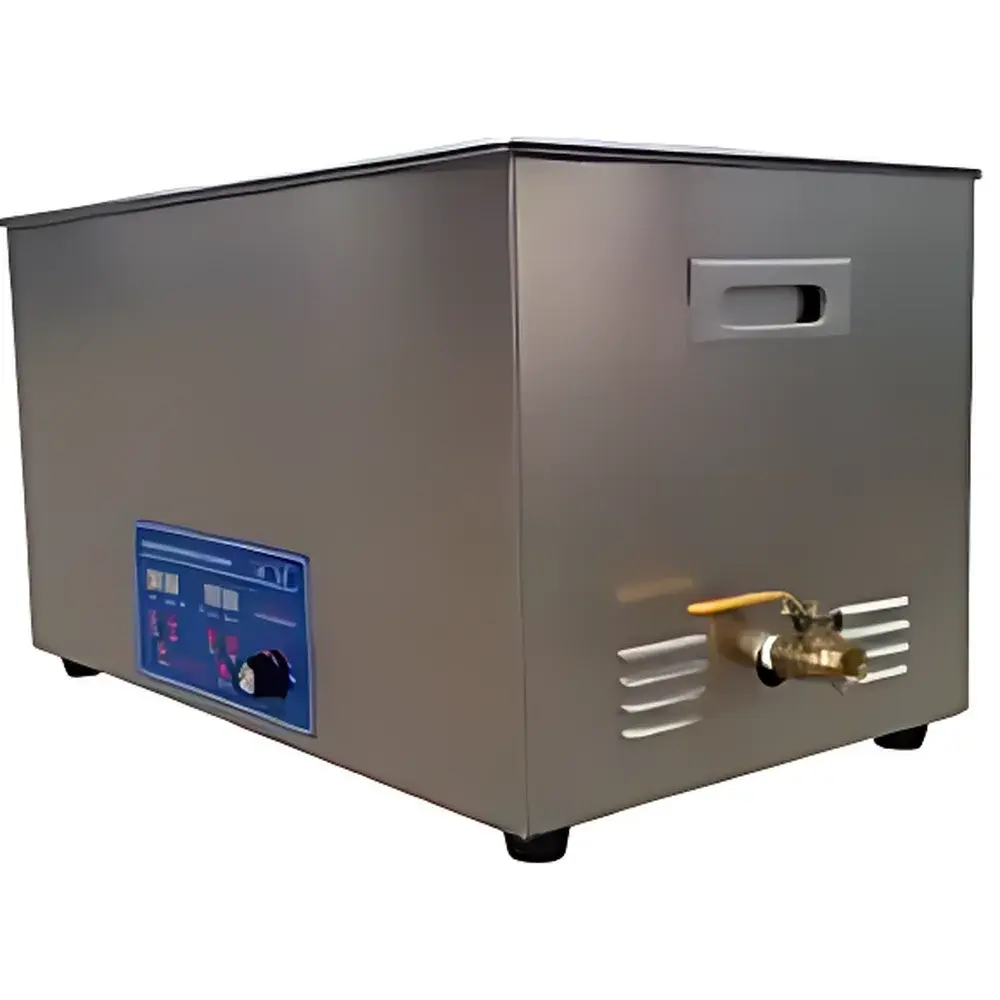
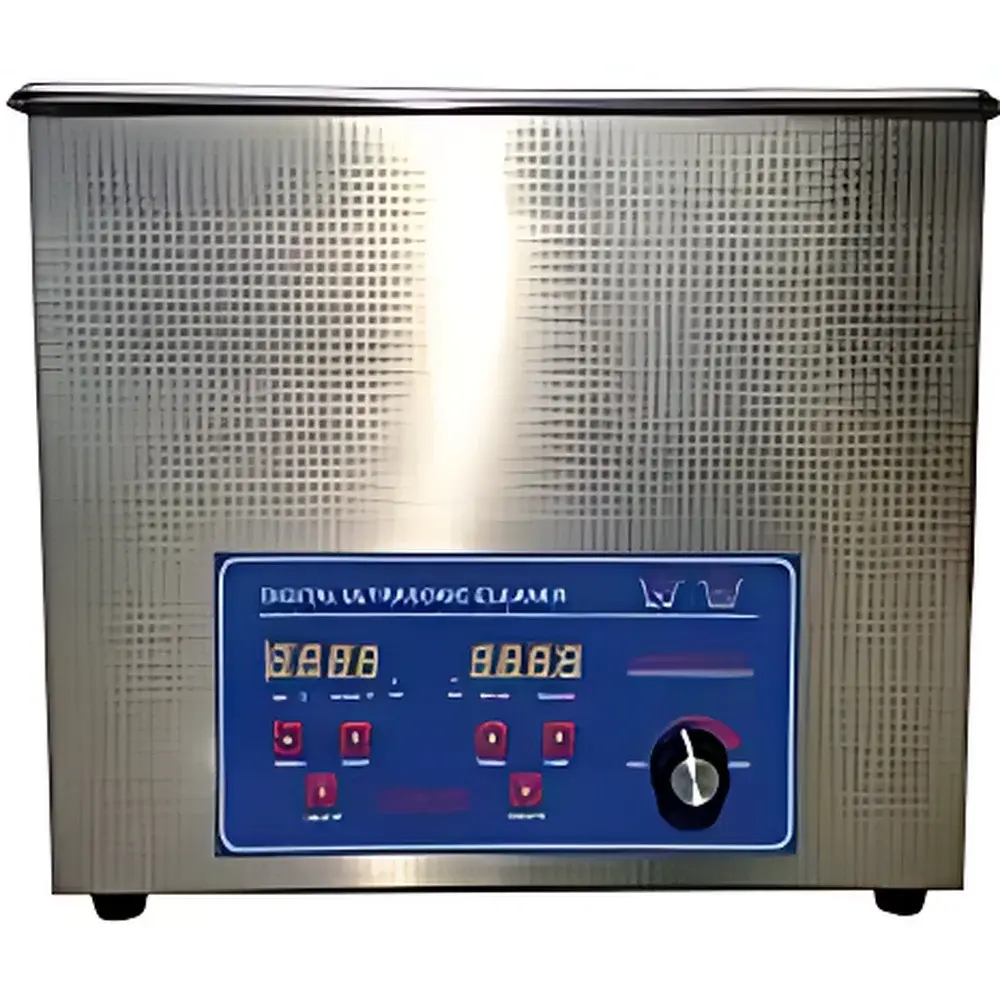
Hanuo HN-15AL Adjustable-Power Ultrasonic Cleaner
| Brand | Hanuo |
|---|---|
| Origin | Shanghai, China |
| Model | HN-15AL |
| Tank Capacity | 15 L |
| Ultrasonic Frequency | 40 kHz |
| Ultrasonic Power Output | 360 W |
| Power Adjustment Range | 40–100% |
| Heating Power | 400 W |
| Temperature Control Range | 20–80 °C |
| Timer Range | 0–30 min |
| Internal Tank Dimensions (L×W×H) | 330 × 300 × 150 mm |
| External Dimensions (L×W×H) | 360 × 330 × 280 mm |
| Drain Valve | Yes |
| Net Weight | 10.8 kg |
Overview
The Hanuo HN-15AL Adjustable-Power Ultrasonic Cleaner is an engineered solution for precision cleaning of delicate and complex components in regulated laboratory, clinical, and industrial environments. It operates on the principle of ultrasonic cavitation—generating high-frequency mechanical vibrations (40 kHz) in a liquid medium to produce microscopic implosive bubbles that dislodge contaminants from surfaces without physical contact or abrasive action. This non-destructive mechanism ensures consistent removal of particulate matter, organic residues, oils, fluxes, and biofilms from intricate geometries—including blind holes, crevices, and microstructures—where conventional washing methods fail. Designed for repeatable performance under GLP-compliant workflows, the unit integrates digital control logic with thermally stabilized transducer arrays to maintain acoustic output integrity across variable load conditions and extended operational cycles.
Key Features
- Digital power regulation (40–100% of nominal 360 W output), enabling optimization of cavitation intensity for sensitive substrates such as optical lenses, microfluidic devices, or coated surgical instruments
- Precise temperature control (20–80 °C) via integrated 400 W heating element with ±1.5 °C stability, supporting temperature-dependent cleaning protocols (e.g., enzymatic residue dissolution)
- Programmable timer (0–30 minutes) with automatic shutdown and audible end-of-cycle notification for unattended operation
- Stainless steel 304 tank (330 × 300 × 150 mm internal dimensions) with reinforced ultrasonic transducer mounting for long-term acoustic coupling integrity
- Integrated drain valve for controlled solution exchange—critical for multi-step cleaning sequences involving rinse, solvent, and deionized water baths
- Front-panel LED display with intuitive button interface; all settings stored in non-volatile memory to retain user preferences after power interruption
- Robust chassis design (360 × 330 × 280 mm external footprint) optimized for benchtop integration in ISO Class 5–7 cleanrooms and QC laboratories
Sample Compatibility & Compliance
The HN-15AL accommodates a broad range of sample types while preserving material integrity: printed circuit boards (PCBs), dental instruments, watch components, precision optics, MEMS sensors, endoscopic tools, jewelry, and calibration standards. Its 40 kHz frequency balances penetration depth and surface shear force—ideal for sub-100 µm feature cleaning without erosion of soft metals or polymer coatings. The unit complies with IEC 61000-6-3 (EMC emission limits) and meets UL/CSA safety requirements for Class I electrical equipment. When operated with validated cleaning solutions and documented parameters, it supports adherence to ASTM D2603 (ultrasonic cleaning efficacy testing), ISO 13485 (medical device manufacturing), and FDA 21 CFR Part 11–aligned data logging when paired with optional RS232/USB interface modules.
Software & Data Management
While the base HN-15AL operates via embedded firmware without PC connectivity, optional communication modules enable serial data export of operational logs—including start time, duration, set temperature, actual bath temperature (recorded at 10-second intervals), power level, and cycle completion status. These timestamped records support audit-ready documentation for GMP/GLP environments. Firmware updates are performed via USB flash drive, ensuring traceability of version history and validation status. All parameter changes are logged with user ID (if configured via external authentication system) and time stamp, satisfying ALCOA+ principles for electronic record integrity.
Applications
- Pre-analytical sample preparation in clinical labs: cleaning pipette tips, cuvettes, and electrophoresis combs to eliminate carryover contamination
- Electronics manufacturing: post-soldering flux removal from SMT assemblies prior to AOI inspection or conformal coating
- Dental clinics: sterilization-prep cleaning of orthodontic brackets, impression trays, and ultrasonic scaler tips
- Research institutions: substrate cleaning prior to thin-film deposition, AFM probe conditioning, or cell culture vessel reconditioning
- Quality control labs: cleaning reference standards (e.g., NIST-traceable gauge blocks) to restore certified dimensional accuracy
- Museums and conservation labs: gentle particulate removal from archival documents, coin collections, and engraved metal artifacts
FAQ
What cleaning solutions are compatible with the HN-15AL?
Aqueous alkaline, neutral, or mild acidic formulations are recommended. Avoid halogenated solvents, strong oxidizers (e.g., undiluted peracetic acid), and solutions with flash points below 60 °C unless used in dedicated explosion-proof enclosures.
Can the unit be used for degassing solvents?
Yes—operating at reduced power (40–60%) and ambient temperature for 2–5 minutes effectively removes dissolved air from HPLC mobile phases, spectroscopy-grade solvents, and resin precursors.
Is calibration required for routine operation?
No factory calibration is needed for standard cleaning tasks. However, users performing critical residue analysis should verify acoustic output annually using calibrated hydrophone measurements per ASTM E1000, and validate temperature uniformity across the tank volume per ISO/IEC 17025 guidelines.
Does the drain valve support connection to lab waste systems?
The standard 1/4″ NPT brass valve permits direct attachment to rigid PVC or stainless steel tubing; chemical compatibility with effluent must be verified prior to permanent installation.
How does power adjustment affect cavitation distribution?
Reducing power proportionally lowers bubble collapse energy and spatial density but maintains uniform distribution across the tank floor due to fixed transducer placement and resonant mode tuning—verified by aluminum foil erosion mapping per ASTM E1754.



