
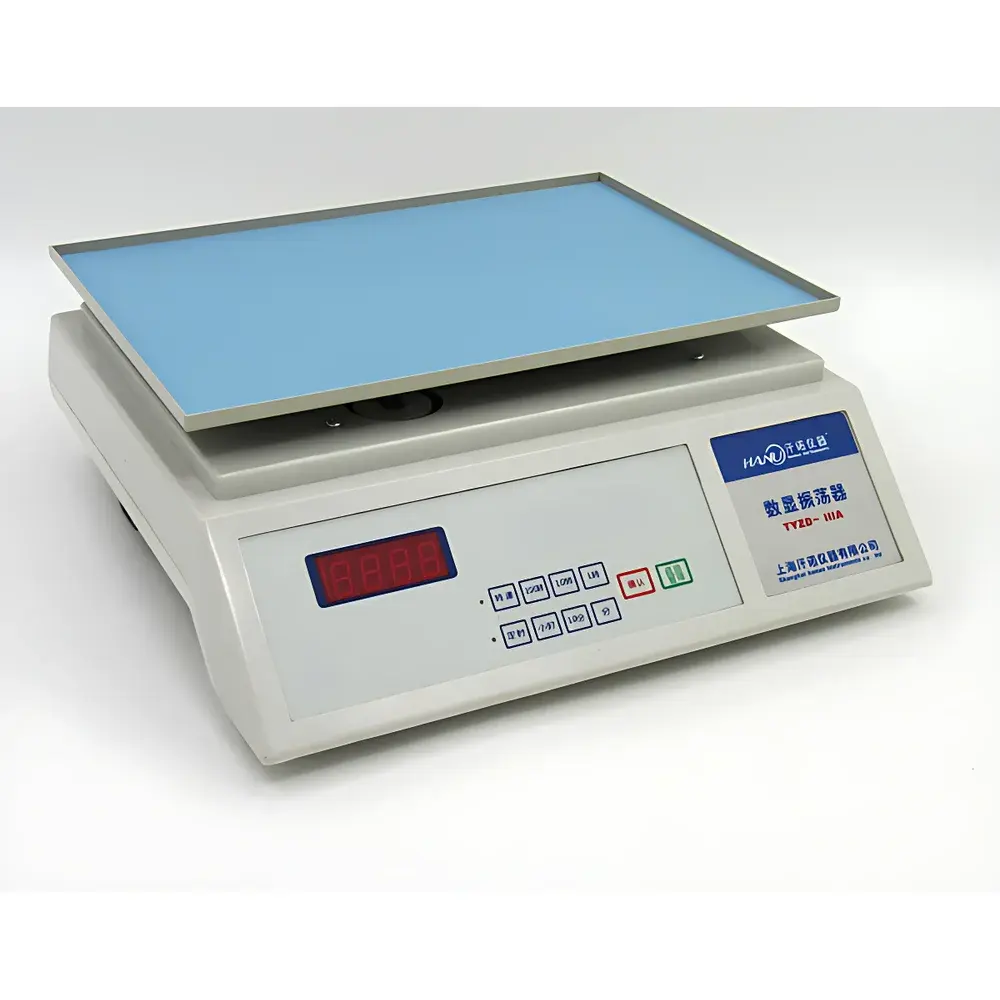
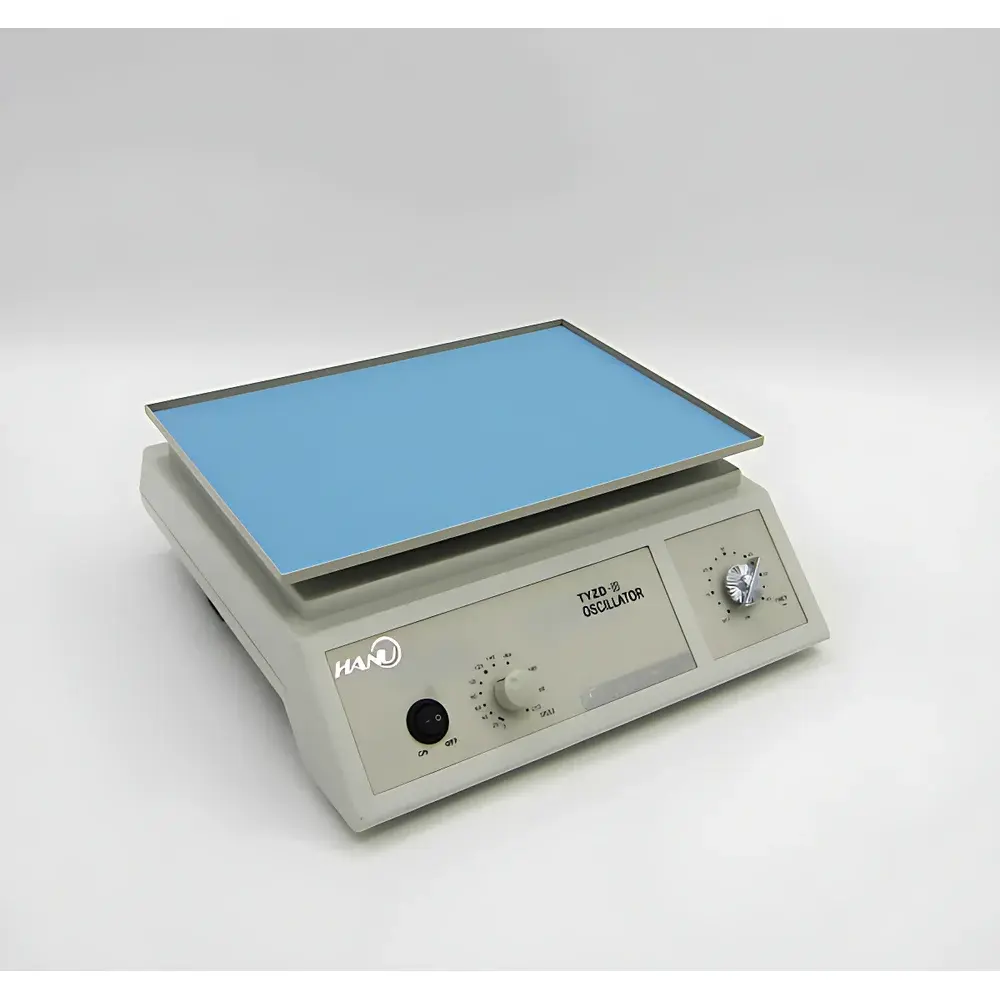
Hanuo TYZD-IIIA Digital Syphilis Rotary Shaker
| Brand | Hanuo |
|---|---|
| Origin | Shanghai, China |
| Manufacturer Type | Authorized Distributor |
| Product Category | Domestic |
| Model | TYZD-IIIA (Digital Display) |
| Instrument Type | Specialized Rotary Shaker for Serological Assays |
| Timer Range | 0–24 h (countdown mode |
| Oscillation Speed | 10–210 rpm (adjustable) |
| Orbit Diameter | 22 mm |
| Platform Quantity | 1 |
| Input Voltage | AC 220 V, 50/60 Hz |
| Power Consumption | 15 W |
| Fuse Rating | 2 A |
| Platform Dimensions | 314 × 218 mm |
| Display | Real-time digital readout of speed and remaining time |
Overview
The Hanuo TYZD-IIIA Digital Syphilis Rotary Shaker is a precision-engineered, benchtop rotary shaker specifically designed for standardized serological assay workflows—particularly the RPR (Rapid Plasma Reagin) test and related complement fixation or latex agglutination assays used in syphilis screening and confirmation. Unlike general-purpose orbital or reciprocating shakers, the TYZD-IIIA implements a fixed-axis, eccentric rotary motion with a 22 mm orbit diameter to ensure uniform, low-shear mixing of small-volume serum samples on diagnostic cards or in microtiter wells. Its mechanical architecture prioritizes stability at low-to-moderate speeds (10–210 rpm), minimizing sample splashing while maximizing reagent–antigen interaction kinetics. The device operates without temperature control (non-thermostatic), aligning with CLSI EP12-A2 and WHO guidelines for manual RPR performance, where ambient-temperature incubation and agitation are specified for optimal flocculent precipitation development.
Key Features
- Digital real-time display showing both current rotational speed (rpm) and remaining timer duration—enabling precise protocol adherence during multi-step serological testing.
- Adjustable speed range (10–210 rpm) calibrated for reproducible mixing across diverse assay formats, including card-based RPR, latex particle suspensions, and complement-binding reaction mixtures.
- Stable single-platform design (314 × 218 mm working surface) with non-slip silicone mat compatibility—optimized for secure placement of RPR test cards, glass slides, or 96-well plates with adhesive covers.
- 24-hour countdown timer with “0” setting for continuous operation—supporting extended incubation-agitation protocols per CDC-recommended RPR SOPs.
- Low-power (15 W), energy-efficient motor with thermal protection and 2 A fuse—designed for uninterrupted daily use in clinical laboratories and blood bank quality control environments.
- Robust aluminum-alloy housing and balanced eccentric drive mechanism—ensuring minimal vibration transmission and long-term mechanical reproducibility under routine QC/QA loads.
Sample Compatibility & Compliance
The TYZD-IIIA accommodates standard RPR test cards (e.g., BD Macro-Vue™, Omega Diagnostics RPR Card), latex reagent vials (1–2 mL), and shallow-format microplates used in manual complement fixation assays. It is compatible with all major RPR kit manufacturers’ instructions for use (IFUs), including those requiring defined agitation durations and speeds per CLIA-waived or moderate-complexity testing classifications. While not certified as an IVD device under EU IVDR or FDA 510(k), the unit meets electrical safety requirements per GB 4793.1–2007 (equivalent to IEC 61010-1) and supports laboratory compliance with ISO 15189:2022 clause 5.3.2 (equipment verification) when validated per local SOPs. Its non-thermostatic design conforms to USP and CLSI MM12-A recommendations for ambient-temperature serological shaking.
Software & Data Management
As a standalone electromechanical instrument, the TYZD-IIIA does not incorporate embedded software, network connectivity, or data logging capabilities. All operational parameters—including speed, timer setting, and runtime—are set manually via front-panel controls and displayed on an LED screen. This analog-digital hybrid interface ensures deterministic behavior, eliminating firmware-related variability—a critical requirement in regulated clinical labs where audit trails must reflect direct user input rather than automated system logs. For GLP/GMP environments, users may document settings and run times manually in lab notebooks or integrate usage records into LIMS via external timestamps. No FDA 21 CFR Part 11 electronic signature functionality is provided or required, consistent with its classification as ancillary equipment under CLIA §493.1253.
Applications
- RPR slide and card agglutination testing in syphilis serology screening programs.
- Latex fixation assays for Treponema pallidum antibody detection.
- Complement fixation test (CFT) sample mixing prior to centrifugation and interpretation.
- Homogenization of low-viscosity biological suspensions in clinical chemistry and immunology QC procedures.
- Controlled agitation of ELISA pre-incubation steps where temperature control is managed separately.
- Supporting proficiency testing (PT) and inter-laboratory comparison studies requiring standardized mixing conditions.
FAQ
Is the TYZD-IIIA compliant with CLIA or CAP requirements for syphilis testing?
Yes—when operated within its specified speed and timing parameters and included in a validated laboratory SOP, it fulfills the mechanical agitation requirements outlined in CLIA regulations and CAP checklist MICRO.40520.
Can this shaker be used for applications beyond syphilis testing?
It is suitable for any low-shear, ambient-temperature mixing task involving small-volume liquid-phase immunoassays, though its 22 mm orbit and speed range are optimized for RPR-grade sensitivity.
Does the unit include calibration documentation or traceable certification?
No factory calibration certificate is supplied; however, speed accuracy can be verified using a handheld tachometer per ISO/IEC 17025 internal verification protocols.
What maintenance is required?
Annual inspection of motor coupling integrity and cleaning of platform surface with 70% ethanol; no lubrication or firmware updates are necessary.
Is the power supply compatible with international voltages?
The unit is configured for AC 220 V, 50/60 Hz only; use with step-down transformers is not recommended due to potential waveform distortion affecting motor torque consistency.
Related Products




