
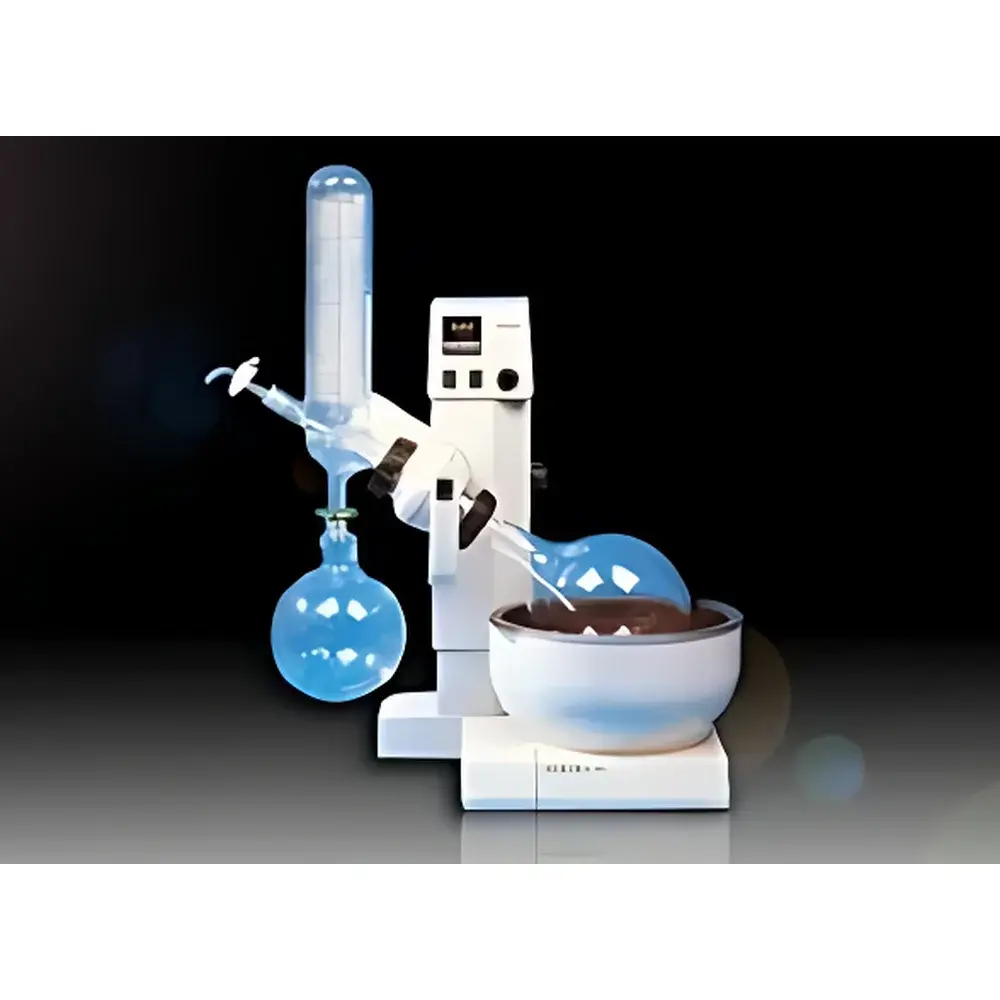
Hanuo RE-2000A Benchtop Rotary Evaporator
| Brand | Hanuo |
|---|---|
| Origin | Shanghai, China |
| Model | RE-2000A |
| Capacity | 2 L |
| Ultimate Vacuum | 0.098 MPa (≈740 mmHg) |
| Rotational Speed | 20–200 rpm (digital display, stepless adjustment) |
| Bath Temperature Range | Ambient to 90 °C (digital PID control, water bath) |
| Heating Bath | PTFE-coated stainless steel, 1.4 kW |
| Overall Power | 1.5 kW |
| Voltage | 220 V AC |
| Condenser | Vertical double-loop reflux condenser with ground-glass joints, large-diameter vapor duct |
| Lift Mechanism | Rocker-type mechanical升降 (0–150 mm vertical travel) |
| Flask Mounting | Ring-nut coupling (clockwise auto-lock, counterclockwise quick-release) |
Overview
The Hanuo RE-2000A is a benchtop rotary evaporator engineered for reproducible, scalable solvent removal under reduced pressure. It operates on the principle of thin-film evaporation: a motor-driven rotation of the sample flask (up to 2 L capacity) in a temperature-controlled water bath generates a uniform, high-surface-area liquid film along the inner wall. Simultaneous application of vacuum (down to 0.098 MPa) lowers the boiling point of solvents, enabling gentle, efficient volatilization—particularly critical for thermolabile compounds such as peptides, natural extracts, and labile pharmaceutical intermediates. The system integrates precise digital temperature regulation of the heating bath (ambient to 90 °C), stepless rotational speed control (20–200 rpm), and a vertically oriented, high-efficiency dual-loop condenser with oversized vapor pathways to maximize condensate recovery and minimize bumping or foaming. Designed for routine use in analytical chemistry, natural product isolation, and QC laboratories, the RE-2000A conforms to standard operational safety and ergonomics expectations for Class I laboratory evaporation equipment.
Key Features
- Robust rocker-type lift mechanism providing smooth, tool-free vertical adjustment (0–150 mm range) for optimal flask immersion depth and safe distillation setup.
- PTFE-coated stainless steel heating bath with fully enclosed 1.4 kW heating element, ensuring uniform thermal distribution and corrosion resistance against aqueous and mildly acidic/alkaline media.
- Digital PID temperature controller with real-time water bath temperature readout (±0.5 °C typical stability at setpoint), eliminating manual thermostat calibration.
- Stepless DC motor drive with digital RPM display (20–200 rpm), delivering consistent torque across the full speed range and minimizing mechanical vibration during rotation.
- Quick-coupling ring-nut flask mount: clockwise rotation secures the evaporation flask automatically; counterclockwise disengagement allows rapid flask exchange without tools or alignment steps.
- Vertical double-loop reflux condenser fabricated from borosilicate glass (3.3), featuring precision-ground ball-and-socket joints and a large-diameter vapor duct to reduce flow resistance and improve condensation efficiency under high-load conditions.
Sample Compatibility & Compliance
The RE-2000A accommodates standard ISO-K (29/32) and NS 29/32 ground-glass joints, supporting common 1 L and 2 L round-bottom flasks, receiving flasks, and optional chiller interfaces. Its design enables handling of low-boiling solvents (e.g., diethyl ether, dichloromethane, ethyl acetate), moderately volatile organics (e.g., toluene, hexane), and aqueous solutions up to 90 °C bath temperature. While not certified to specific regulatory standards (e.g., UL, CE, or FDA 21 CFR Part 11), the unit complies with general IEC 61010-1 safety requirements for laboratory electrical equipment. Users implementing this instrument in GxP environments must validate temperature accuracy, vacuum stability, and rotational repeatability per internal SOPs aligned with ISO/IEC 17025 or USP guidelines.
Software & Data Management
The RE-2000A is a standalone analog-digital hybrid instrument with no embedded microprocessor or data logging capability. All operational parameters—bath temperature and rotational speed—are displayed locally via LED digits and controlled manually via front-panel buttons and dials. No USB, RS-232, or Ethernet interface is provided. For laboratories requiring audit-trail functionality or integration into LIMS workflows, external data loggers (e.g., calibrated thermocouple + tachometer inputs) may be employed to record time-stamped bath temperature and RPM values. Documentation of calibration intervals, maintenance logs, and performance verification tests remains the responsibility of the end-user per GLP/GMP documentation practices.
Applications
- Concentration of heat-sensitive biological samples—including enzyme fractions, plant extracts, and oligonucleotide solutions—without thermal degradation.
- Removal of residual solvents following column chromatography or solid-phase extraction (SPE) procedures.
- Recovery and recycling of high-purity organic solvents in synthetic chemistry workflows.
- Preparative-scale drying of crystalline products prior to lyophilization or packaging.
- Routine solvent exchange (e.g., DMSO → PBS) in formulation development labs.
- Distillation of low-volatility compounds when paired with a secondary cold trap or external vacuum controller.
FAQ
What is the maximum recommended operating temperature for the water bath?
The heating bath is rated for continuous operation up to 90 °C. Although the display reads up to 99 °C, sustained use above 90 °C risks accelerated PTFE coating degradation and increased vapor pressure that may compromise vacuum integrity.
Can the RE-2000A be used with a circulating chiller?
Yes—the condenser inlet/outlet ports accept standard 10 mm ID tubing. A chiller capable of delivering coolant at ≤10 °C is recommended for optimal condensation efficiency with low-boiling solvents.
Is the vacuum gauge included with the unit?
No. The RE-2000A does not include an integrated vacuum sensor or gauge. Users must connect an external vacuum gauge or controller compatible with the system’s 1/4″ NPT vacuum port.
What maintenance is required for long-term reliability?
Monthly inspection of ground-glass joints for scoring or residue buildup; biannual lubrication of the rocker pivot points with silicone grease; annual verification of bath temperature accuracy using a traceable NIST-calibrated thermometer.
Does the unit support inert gas purging?
Not natively. However, a three-way stopcock or inert gas adapter can be installed between the vacuum line and condenser outlet to enable nitrogen or argon sparging during evaporation of air-sensitive materials.
Related Products



