
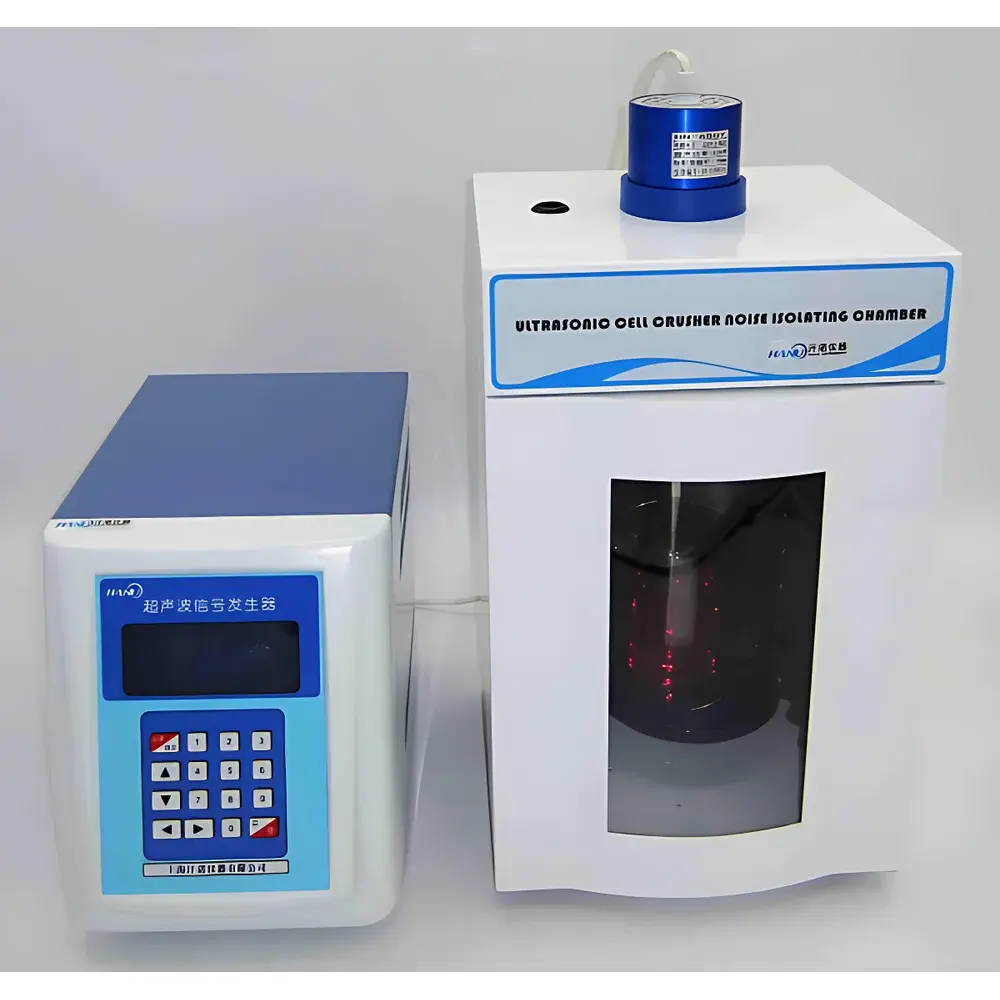
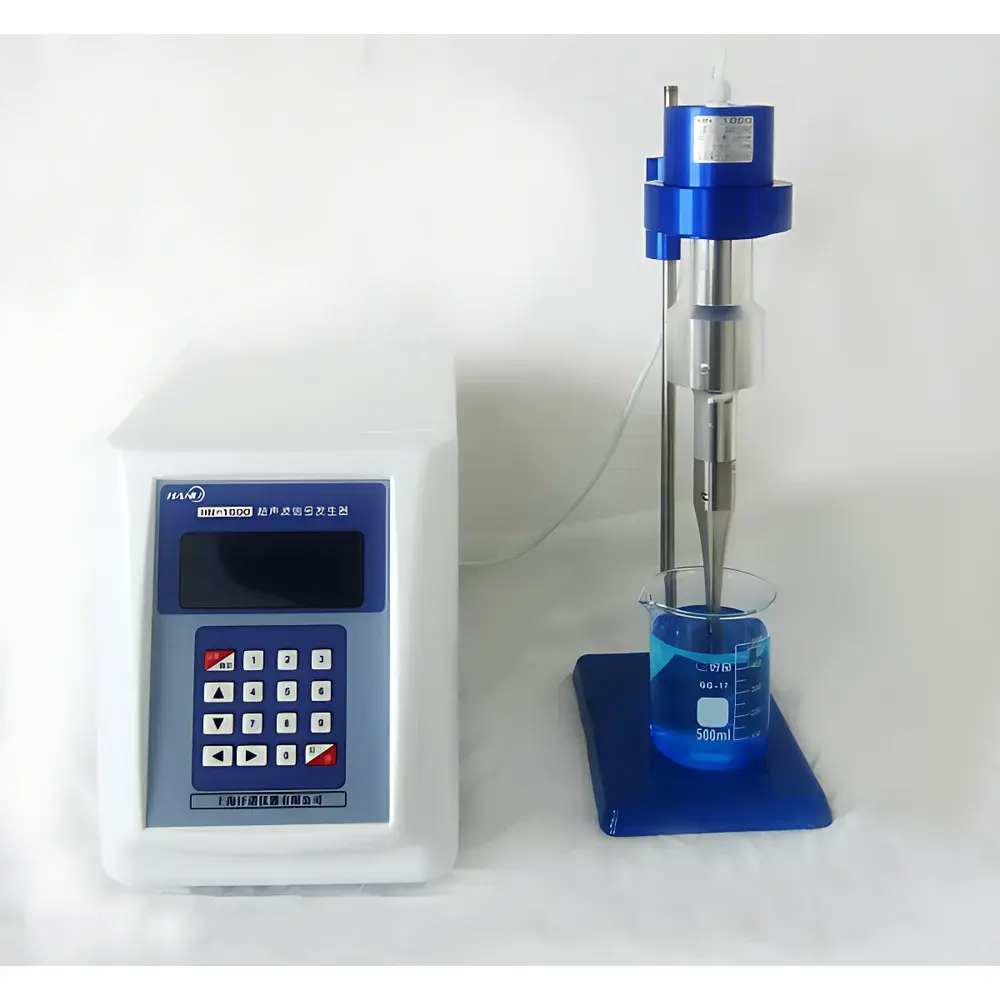
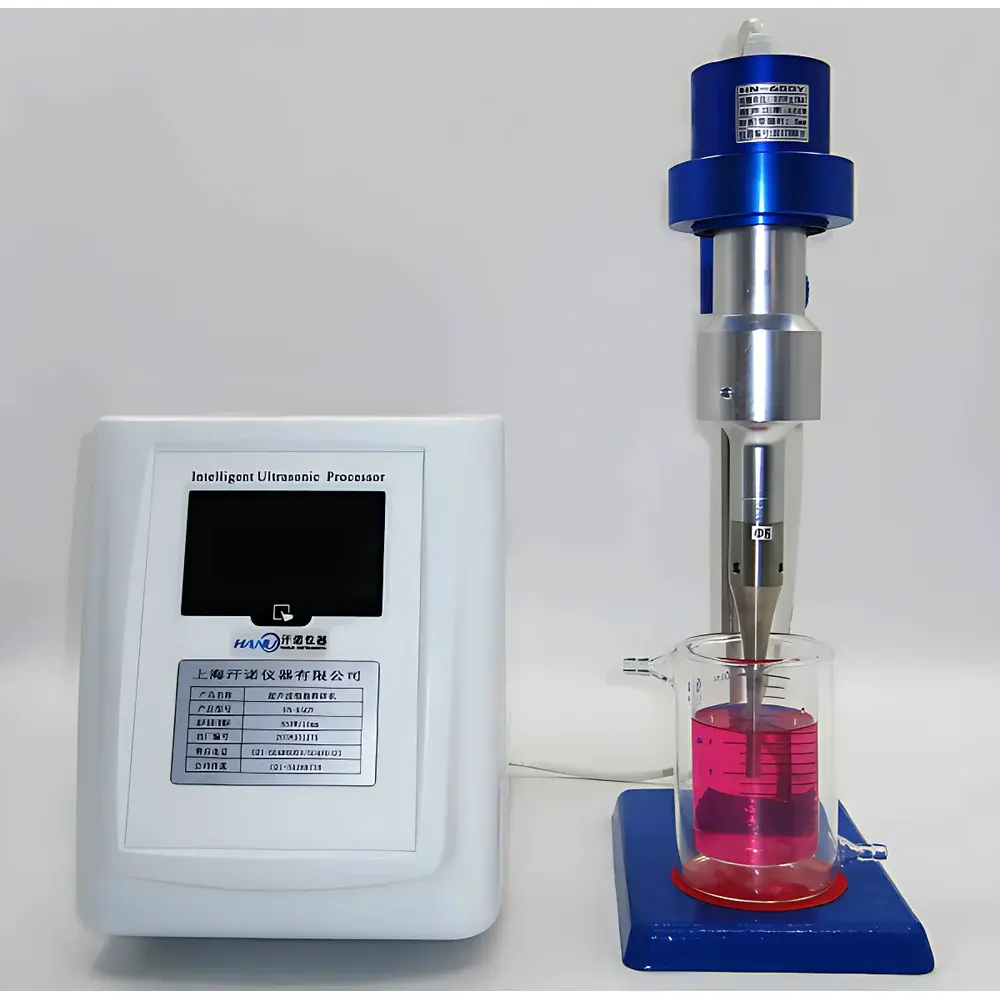
Hanuo HN92-IIDL Temperature-Controlled Ultrasonic Cell Disruptor
| Brand | Hanuo |
|---|---|
| Origin | Shanghai, China |
| Manufacturer Type | Authorized Distributor |
| Product Category | Domestic |
| Model | HN92-IIDL |
| Instrument Type | Ultrasonic Cell Disruptor |
| Ultrasonic Power Output | 900 W (adjustable, 20–900 W range) |
| Operating Frequency | 20–25 kHz |
| Temperature Control Range | 0–90 °C |
| Sample Volume Capacity | 0.2–600 mL |
| Probe Diameter Options | Φ6 mm or Φ10 mm |
| Integrated Overtemperature Protection | Yes (triggers at ≥90 °C) |
| Display | LCD (upgraded large-screen interface) |
| Probe Material | Medical-grade titanium alloy (Ti-6Al-4V) |
| Amplitude Stability | Auto-compensated under variable load conditions |
| Duty Cycle & Pulse Mode | Programmable on/off intervals |
| Acoustic Enclosure | Sound-dampened chamber with certified acoustic insulation (≥35 dB attenuation at 25 kHz) |
Overview
The Hanuo HN92-IIDL Temperature-Controlled Ultrasonic Cell Disruptor is a precision-engineered laboratory instrument designed for controlled mechanical lysis of biological cells and subcellular structures via high-intensity ultrasonic cavitation. Operating on the principle of acoustic cavitation—where rapid pressure fluctuations in a liquid medium generate transient microbubbles that collapse violently—the system delivers localized shear forces sufficient to disrupt membranes, homogenize tissues, emulsify suspensions, and disperse nanoparticles. Unlike non-temperature-regulated systems, the HN92-IIDL integrates real-time Peltier-based temperature monitoring and feedback-controlled cooling/heating to maintain sample integrity during prolonged sonication. This capability is critical for heat-sensitive biomolecules such as enzymes, antibodies, nucleic acids, and recombinant proteins, where thermal denaturation must be minimized to preserve structural and functional fidelity.
Key Features
- Intelligent Thermal Management: Built-in Pt100 temperature sensor and PID-controlled thermoelectric module enable precise regulation across 0–90 °C, with automatic shutdown if setpoint deviation exceeds ±2 °C or if sample temperature reaches 90 °C (hardware-limited safety cutoff).
- Programmable Sonication Parameters: Independent control over total duration (1 s–99 h 59 min), pulse duty cycle (1–99% ON/OFF ratio), and ultrasonic power (20–900 W in 1 W increments), supporting reproducible method development per ISO/IEC 17025-compliant workflows.
- Load-Adaptive Amplitude Stabilization: Digital amplitude compensation ensures consistent probe tip displacement (±0.5 µm repeatability) regardless of sample viscosity, volume, or container geometry—critical for inter-batch comparability in QC/QA environments.
- Titanium Alloy Sonotrode System: Standard Φ6 mm and optional Φ10 mm probes fabricated from ASTM F136-certified Ti-6Al-4V alloy, offering superior fatigue resistance, corrosion immunity in aqueous buffers, and acoustic transmission efficiency (>92% at 22 kHz).
- Acoustically Optimized Enclosure: Dual-layer anechoic chamber lined with melamine formaldehyde foam and mass-loaded vinyl achieves >35 dB insertion loss at fundamental frequency (22 kHz), meeting OSHA 1910.95 noise exposure guidelines for continuous operator use.
- High-Resolution LCD Interface: 5.7-inch backlit TFT display with intuitive menu navigation, real-time parameter visualization (power, temp, time, amplitude), and method storage for up to 100 user-defined protocols.
Sample Compatibility & Compliance
The HN92-IIDL accommodates a broad spectrum of sample matrices—including bacterial cultures (E. coli, Bacillus spp.), yeast (S. cerevisiae), mammalian cell lines (HEK293, CHO), plant tissues, viral lysates, and nanosuspensions—within volumes ranging from microliter-scale microcentrifuge tubes (0.2 mL) to 600 mL jacketed reactors. All wetted components comply with USP Class VI biocompatibility standards. The instrument supports GLP/GMP-aligned operation through audit-trail-capable parameter logging (timestamped, user-ID tagged), and its thermal control architecture aligns with FDA 21 CFR Part 11 requirements when paired with validated third-party data acquisition software. It meets CE marking directives (2014/30/EU EMC, 2014/35/EU LVD) and conforms to IEC 61000-6-3 emission limits.
Software & Data Management
While the HN92-IIDL operates autonomously via its embedded microcontroller, it features an RS-232/USB-C interface for external command integration and raw data export (CSV format). Optional PC software enables remote scheduling, multi-step protocol sequencing, real-time graphing of temperature/power profiles, and automated report generation compliant with ISO 15197 and CLSI EP21-A protocols. All logged events—including start/stop timestamps, temperature excursions, power deviations, and safety interlock activations—are stored with SHA-256 checksum verification to ensure data integrity and traceability.
Applications
- Preparative isolation of intracellular proteins, organelles, and inclusion bodies from prokaryotic and eukaryotic expression systems
- Shearing of chromatin for ChIP-seq and ATAC-seq library preparation
- Dispersion and deagglomeration of metal oxide nanoparticles (e.g., TiO₂, ZnO) and carbon nanotubes in aqueous and organic media
- Rapid extraction of metabolites, alkaloids, and polyphenols from botanical matrices under controlled thermal conditions
- Cell membrane permeabilization for transfection enhancement and drug delivery studies
- Homogenization of tissue biopsies prior to RNA/DNA extraction (RNase-free compatible with appropriate cleaning protocols)
FAQ
What is the maximum recommended continuous sonication time per cycle?
Continuous operation is limited to 5 minutes per cycle; subsequent cycles require ≥2-minute cooling intervals to prevent transducer overheating and maintain amplitude stability.
Can the HN92-IIDL be used with corrosive solvents such as chloroform or DMSO?
Titanium alloy probes are chemically resistant to most aqueous buffers and polar organic solvents; however, prolonged exposure to halogenated hydrocarbons (e.g., chloroform) or strong oxidizers requires post-use rinsing with ethanol/water and visual inspection for surface pitting.
Is calibration traceable to NIST standards?
Power output calibration is performed using a NIST-traceable calorimetric standard (ASTM E2982-15); temperature sensor calibration follows ISO/IEC 17025-accredited procedures with annual verification.
Does the system support external temperature probes for reactor vessels?
Yes—the rear-panel analog input accepts industry-standard PT100 or thermocouple signals (Type K/J), enabling closed-loop control of jacketed reactors or circulating chillers.
What maintenance is required for long-term reliability?
Monthly inspection of probe threads and gasket integrity, quarterly ultrasonic horn wear assessment via profilometry, and annual transducer impedance testing using an LCR meter per IEC 60601-2-37 Annex DD guidelines.






