
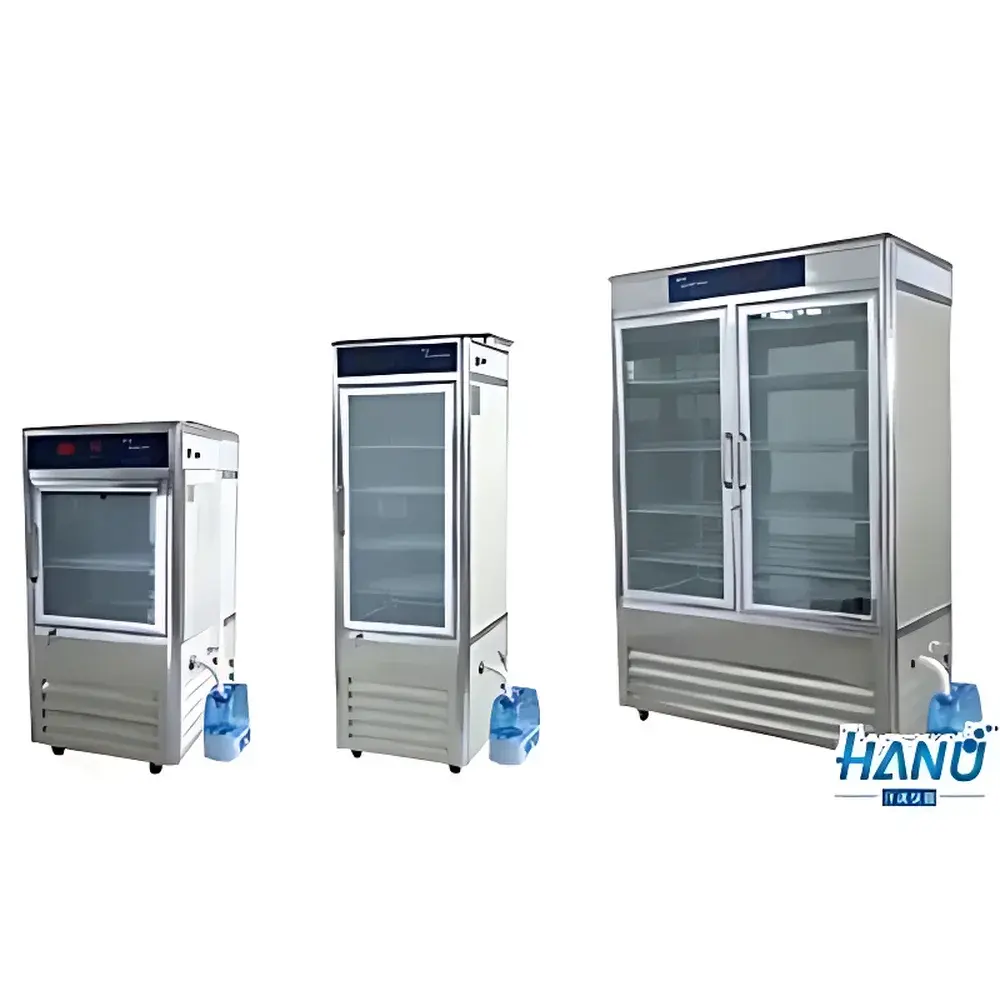
Hanuo HWS-80 Temperature and Humidity Controlled Incubator
| Brand | Hanuo |
|---|---|
| Origin | Shanghai, China |
| Model | HWS-80 |
| Capacity | 80 L |
| Temperature Range (with humidification) | 0–50 °C |
| Temperature Uniformity | ±0.5 °C |
| Humidity Range | 30–95 %RH |
| Humidity Control Accuracy | ±2 %RH |
| Construction | Stainless steel interior, triple-pane insulated glass door, single-door configuration |
| Humidification Method | Ultrasonic humidifier |
| Cooling System | Hermetically sealed compressor with delayed start and high/low pressure protection |
| Air Circulation | Forced convection via stainless steel ducted airflow system |
| Safety Features | Over-temperature protection, sensor fault detection, door lock mechanism |
Overview
The Hanuo HWS-80 Temperature and Humidity Controlled Incubator is an engineered environmental simulation platform designed for precise, long-term maintenance of biological samples under tightly regulated thermal and hygroscopic conditions. Based on the principle of active dual-loop control—where independent PID-regulated heating, refrigeration, and ultrasonic humidification subsystems operate in parallel—the HWS-80 delivers stable, reproducible setpoint adherence across its full operational envelope. This architecture enables consistent performance required for critical life science workflows including BOD incubation per ISO 5815-1, seed germination studies aligned with ISTA protocols, microbial growth profiling under controlled water activity (aw), and stability testing of pharmaceutical intermediates per ICH Q1A(R2) guidelines. Its 80 L working volume accommodates standard multi-tier shelving configurations while maintaining uniformity within ±0.5 °C spatially and ±2 %RH temporally—parameters validated using NIST-traceable calibrated probes placed at nine standardized locations per ASTM E2739.
Key Features
- Ultrasonic humidification system delivering rapid, particle-free moisture generation without mineral deposition or localized condensation—ensuring long-term reliability and minimal maintenance.
- Dual-stage thermal management: a hermetically sealed refrigeration compressor with pressure-sensing safeguards and programmable start delay minimizes thermal shock during cycling; combined with precision resistive heating elements for sub-degree resolution control.
- Forced-air circulation via a corrosion-resistant stainless steel ducting network ensures laminar, turbulence-minimized airflow—critical for minimizing thermal gradients and preventing sample desiccation at shelf edges.
- Triple-pane insulated observation window with low-emissivity coating reduces radiant heat loss by >40% versus conventional double-glazed designs, improving energy efficiency and external surface temperature stability.
- Integrated safety architecture includes real-time monitoring of PT100 temperature sensors and capacitive humidity transducers, automatic shutdown upon sensor deviation >±1.5 °C or >±5 %RH, and mechanical door locking compliant with GLP laboratory access control requirements.
Sample Compatibility & Compliance
The HWS-80 supports a broad spectrum of sample formats—including Petri dishes, multi-well plates, culture flasks (T25–T175), glass jars, and sealed environmental chambers—without compromising chamber integrity or control fidelity. Its stainless steel interior (AISI 304 grade) resists corrosion from repeated sterilization cycles and common disinfectants (e.g., 70% ethanol, hydrogen peroxide vapor). The unit conforms to IEC 61010-1:2010 for electrical safety in laboratory equipment and meets EN 60068-2 environmental stress testing standards for operational reliability. While not certified for medical device manufacturing, its design aligns with FDA 21 CFR Part 11 data integrity principles when paired with optional RS485/Modbus-enabled logging systems supporting audit trail generation and user-level access controls.
Software & Data Management
The HWS-80 operates via an embedded microcontroller with a 4.3-inch TFT LCD interface supporting dual-language (English/Chinese) menus, real-time graphing of temperature/humidity trends, and event-triggered alarm logging. Optional PC connectivity via USB or RS485 enables integration into centralized lab information management systems (LIMS). When configured with Hanuo’s optional DataBridge™ software (v3.2+), users gain CSV export capability, configurable alarm thresholds, time-stamped calibration history tracking, and electronic signature support for 21 CFR Part 11 compliance—facilitating audit readiness for GxP environments. All logged parameters are stored internally for ≥30 days at 1-minute intervals, with non-volatile memory retention during power interruption.
Applications
- Biochemical oxygen demand (BOD) measurement per APHA Standard Methods 5210B and ISO 5815-1, where strict 20.0 ± 0.5 °C and 95 ± 2 %RH conditions are mandated for five-day incubation.
- Plant tissue culture and seed viability assays requiring stratification protocols with dynamic temperature-humidity ramps (e.g., cold-moist treatment at 4 °C / 90 %RH followed by warm-dry transition).
- Microbial challenge testing of packaging materials under accelerated aging conditions (e.g., 40 °C / 75 %RH per ASTM D4332).
- Stability assessment of diagnostic reagents, lyophilized enzymes, and antibody conjugates where humidity-induced degradation pathways must be isolated.
- Environmental simulation for aquatic toxicology studies involving benthic organisms sensitive to combined thermal and hygric stressors.
FAQ
What is the recommended calibration interval for the HWS-80?
Annual calibration using traceable reference standards is advised; internal sensor verification can be performed quarterly using a portable hygrothermograph meeting ISO 17025 accreditation.
Can the HWS-80 operate continuously at 50 °C and 95 %RH?
Yes—its reinforced ultrasonic humidifier and enhanced condenser cooling capacity enable sustained operation at maximum setpoints without performance degradation or compressor overload.
Is remote monitoring supported out-of-the-box?
Basic status readout (current temp/RH, setpoint, alarm state) is available via Modbus RTU over RS485; full telemetry requires optional DataBridge™ software and compatible gateway hardware.
Does the unit include validation documentation?
Factory-installed IQ/OQ documentation is provided; PQ protocols must be executed on-site per user-defined acceptance criteria and local regulatory expectations.
What is the typical recovery time after door opening?
From ambient (25 °C / 50 %RH) to 37 °C / 95 %RH, recovery to ±0.5 °C / ±2 %RH is achieved within ≤12 minutes following a 30-second door opening, verified per ASTM E2739 Annex A3.




