
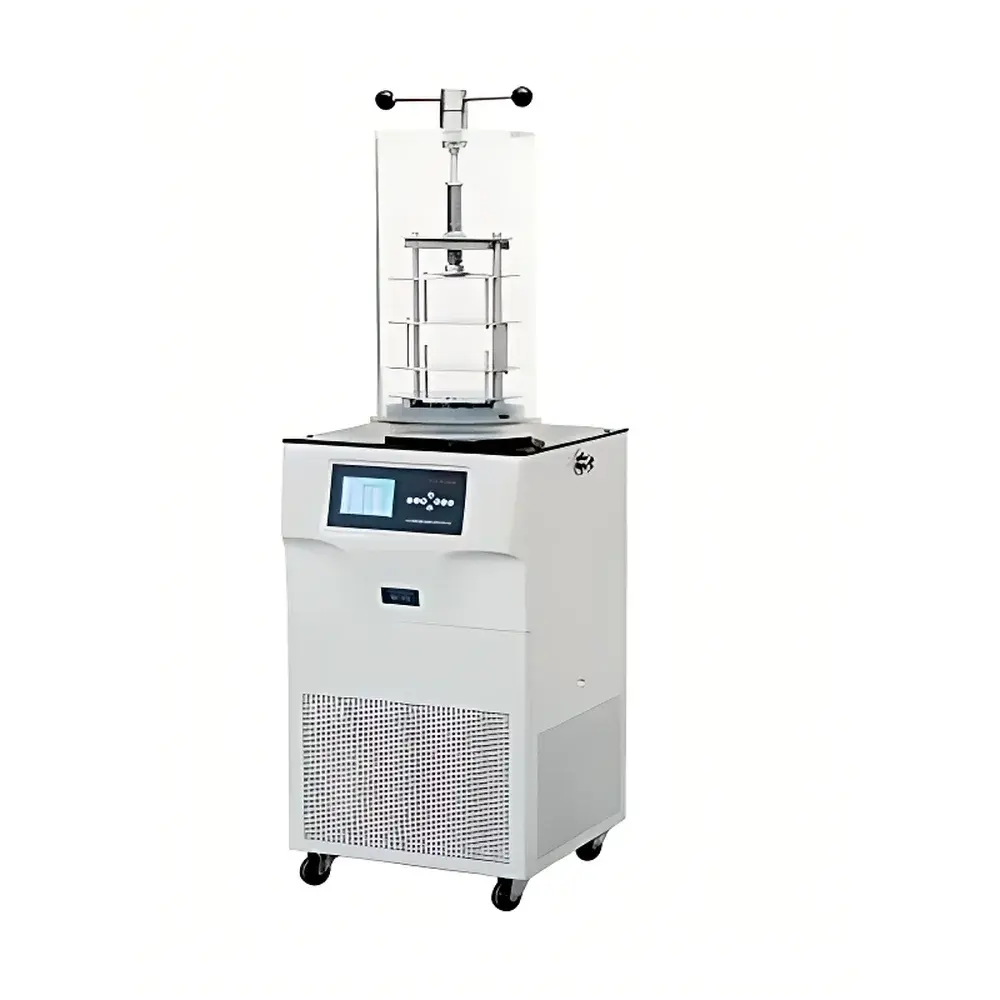
Hanuo FD-2A Benchtop Freeze Dryer with Shelf Heating
| Brand | Hanuo |
|---|---|
| Origin | Shanghai, China |
| Model | FD-2A |
| Instrument Type | Stoppering-Compatible Benchtop Freeze Dryer |
| Application | Laboratory-Scale Lyophilization |
| Lyophilization Area | 0.18 m² |
| Ultimate Vacuum | < 13 Pa |
| Condenser Temperature | ≤ −70 °C (down to −80 °C) |
| Ice Capacity | 6 kg/24 h |
| Shelf Heating | Electric Resistance Heating |
| Display | Backlit LCD with Programmable Curve Memory |
| Sample Tray | Φ240 mm × 4 layers |
| Tray Volume Capacity | 1.8 L |
| Condenser Dimensions | Φ280 × 420 mm |
| Power Supply | 220 V, 50 Hz, 1800 W |
| Unit Dimensions | 540 × 640 × 920 mm (W × D × H) |
Overview
The Hanuo FD-2A is a benchtop freeze dryer engineered for precise, reproducible lyophilization of thermolabile biological and pharmaceutical samples in research laboratories and pilot-scale development environments. It operates on the principle of sublimation under deep vacuum—where frozen water transitions directly from solid to vapor without passing through the liquid phase—preserving structural integrity, activity, and stability of sensitive compounds such as monoclonal antibodies, plasmid DNA, live attenuated vaccines, and enzyme preparations. Unlike ambient-pressure drying methods, freeze drying minimizes denaturation, oxidation, and aggregation risks. The FD-2A integrates electrically heated shelves to enable controlled primary and secondary drying stages, supporting both isothermal and ramped temperature protocols. Its compact footprint (540 × 640 × 920 mm), combined with a 0.18 m² drying area and four-tier Φ240 mm sample tray configuration, makes it suitable for batch processing up to 1.8 L of aqueous solution per cycle—ideal for formulation screening, stability studies, and small-batch GMP-aligned preparation.
Key Features
- Shelf heating system with independent PID control, enabling programmable temperature ramps (−50 °C to +60 °C range) and hold steps during primary and secondary drying
- High-efficiency dual-stage rotary vane vacuum pump integrated into the main unit, achieving ultimate vacuum ≤ 13 Pa—sufficient for low-residual moisture (< 1.5% w/w) in final dried cakes
- Cryogenic condenser operating at ≤ −70 °C (capable of transient −80 °C), fabricated from stainless steel 304 with optimized fin geometry for uniform ice deposition and high capture efficiency
- Backlit graphical LCD interface with real-time monitoring of shelf temperature, condenser temperature, chamber pressure, and elapsed time; supports storage of ≥ 10 user-defined lyophilization cycles
- Structural compliance with IEC 61010-1 safety standards; electrical insulation and grounding meet EN 61326-1 for laboratory electromagnetic compatibility
- Modular design allows optional integration of silicone oil-based shelf heating upgrade kits and external vacuum gauge ports for validation-grade pressure measurement
Sample Compatibility & Compliance
The FD-2A accommodates standard glassware including serum vials (10–50 mL), scintillation vials, and flat-bottomed Petri dishes placed on Φ240 mm stainless-steel trays. Its stoppering-compatible chamber enables manual or semi-automated rubber stopper insertion post-drying—a prerequisite for sterile product handling in pre-GMP workflows. While not certified for full cGMP production, the system supports documentation practices aligned with FDA 21 CFR Part 11 when paired with validated external data loggers and electronic signature-capable software (e.g., via optional RS-485 or USB export). It meets ISO 22071:2017 requirements for lyophilizer qualification elements—including thermal mapping capability across all four shelf levels—and is routinely employed in laboratories adhering to USP , ICH Q5C, and ASTM F2476-21 test protocols for residual moisture analysis and cake morphology assessment.
Software & Data Management
The embedded controller records time-stamped process parameters at user-selectable intervals (1–60 s resolution) and stores them internally in non-volatile memory. Data export is supported via USB flash drive in CSV format for traceability and offline analysis in MATLAB, Python (Pandas), or commercial statistical packages. Optional PC-based software (Hanuo LyoView™, sold separately) provides remote monitoring, alarm logging, deviation flagging, and automated report generation compliant with ALCOA+ principles (Attributable, Legible, Contemporaneous, Original, Accurate, Complete, Consistent, Enduring, Available). Audit trails include operator ID, parameter changes, and emergency stop events—enabling retrospective review during internal quality audits or regulatory inspections.
Applications
- Stability testing of biologics under accelerated and real-time conditions per ICH Q1A(R2)
- Pre-formulation studies involving buffer screening, excipient selection, and collapse temperature (Tc) determination via manometric temperature measurement (MTM)
- Production of reference standards for analytical method validation (e.g., HPLC, SEC-MALS)
- Drying of microbial cultures, probiotic powders, and diagnostic reagents requiring long-term ambient storage
- Preparation of calibration materials for mass spectrometry and ELISA assay development
- Teaching laboratories demonstrating phase behavior, heat/mass transfer kinetics, and vacuum thermodynamics
FAQ
What is the maximum sample volume capacity per batch?
Up to 1.8 L of aqueous solution distributed across four Φ240 mm trays—assuming typical fill depth of 10 mm and 5% solids content.
Does the FD-2A support automatic pressure rise tests (PRT) for endpoint detection?
No; PRT functionality requires optional add-on modules and external pressure transducers calibrated to ±0.1 Pa. Manual interpretation of pressure stabilization trends is supported via real-time graph display.
Can the system be validated for use in GLP-regulated studies?
Yes—when operated with documented IQ/OQ protocols, calibrated external sensors, and controlled environmental conditions (e.g., ISO Class 7 cleanroom or laminar flow hood), the FD-2A fulfills core performance criteria for GLP-compliant lyophilization.
Is the condenser defrost cycle automated?
Defrost is semi-automated: users initiate warm-up via menu command; condenser temperature rises to +25 °C over ~45 minutes, followed by manual drain valve operation.
What maintenance intervals are recommended for the vacuum pump?
Oil change every 500 operating hours; inlet filter cleaning every 100 hours; annual inspection of pump vanes and seals by authorized service technician.



