
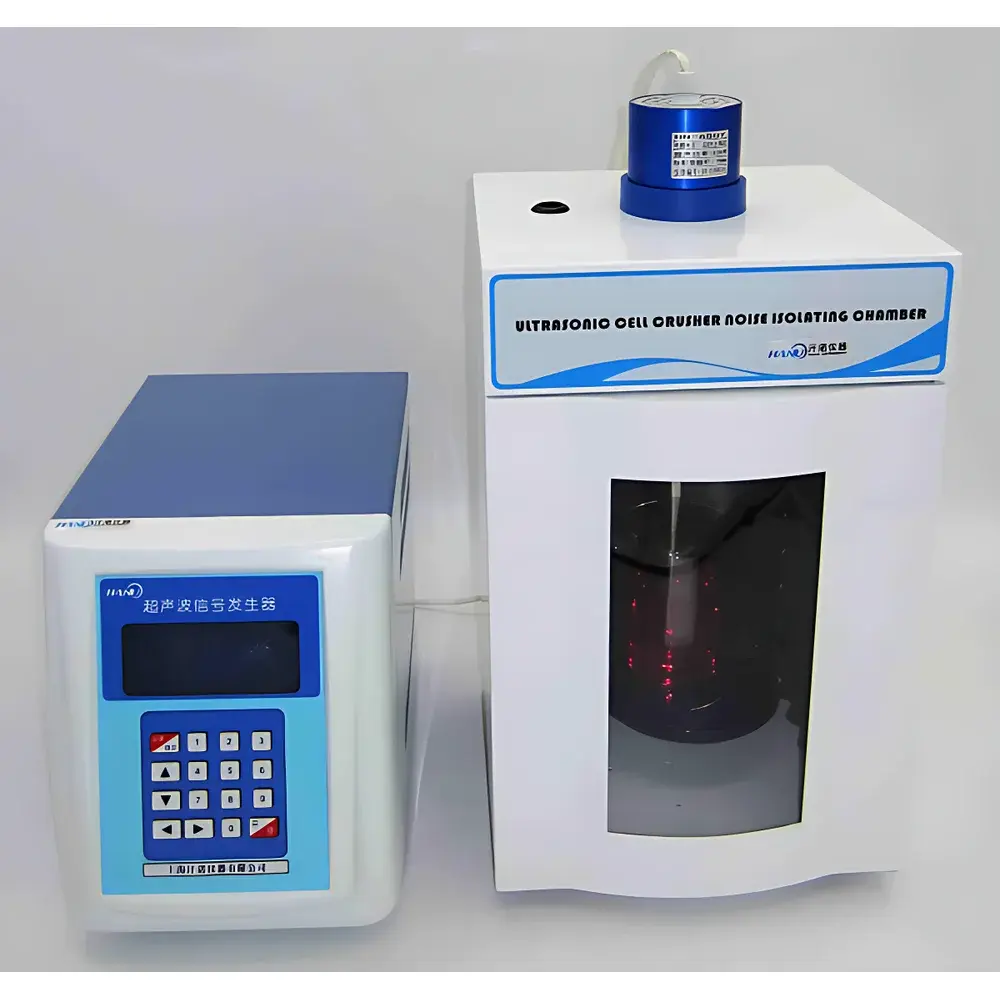
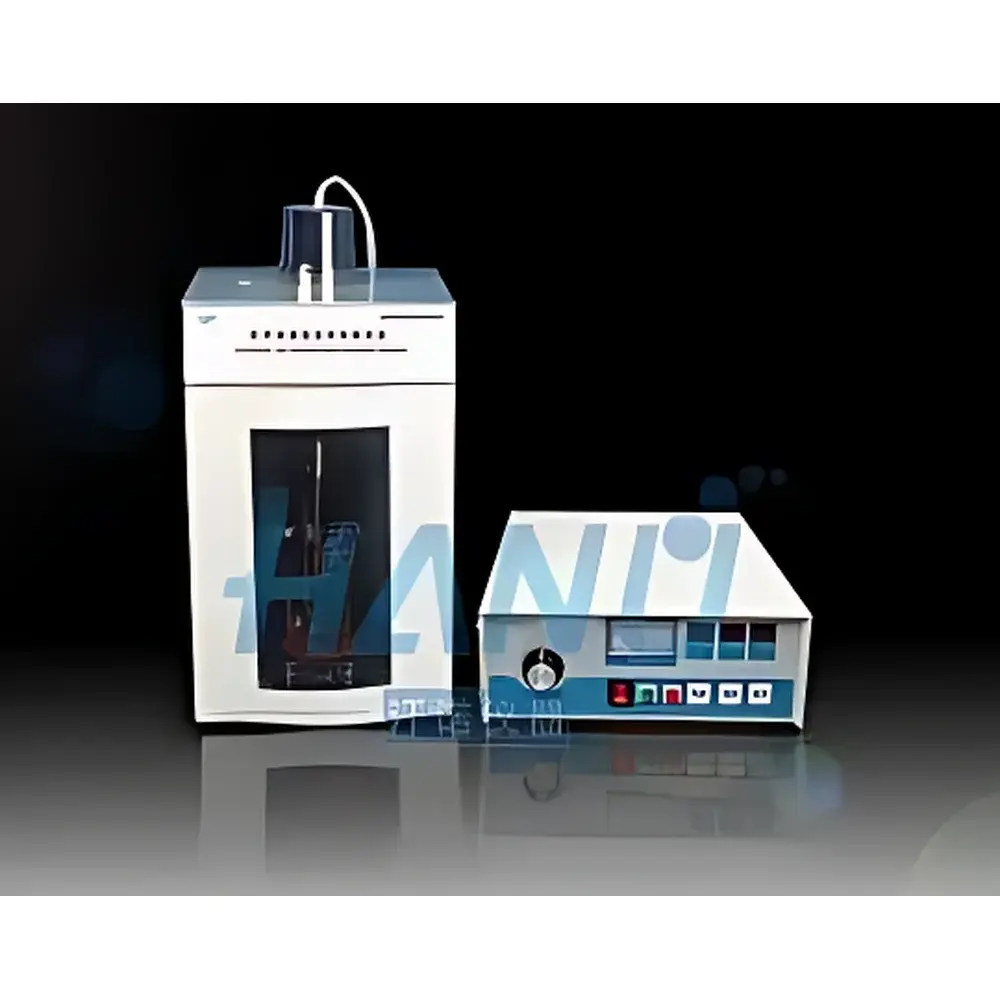
Hanuo HN96-II Ultrasonic Cell Disruptor
| Brand | Hanuo |
|---|---|
| Origin | Shanghai, China |
| Manufacturer Type | Authorized Distributor |
| Product Category | Domestic |
| Model | HN96-II |
| Instrument Type | Ultrasonic Cell Disruptor |
| Ultrasonic Power | 10–150 W |
| Operating Frequency | 20–25 kHz |
| Temperature Range | Ambient to 90 °C |
| Sample Volume Capacity | 0.2–150 mL |
| Number of Samples per Run | 1 |
| Standard Probe Diameter | Φ6 mm |
| Optional Probe Diameters | Φ2, Φ3, Φ8, Φ10 mm |
| Duty Cycle | 1–99.9% |
| Integrated Temperature Monitoring & Control | Yes |
| Probe Material | Titanium Alloy (Ti-6Al-4V) |
| Microprocessor-Controlled Operation | Yes |
| Adjustable Amplitude with Load Compensation | Yes |
Overview
The Hanuo HN96-II Ultrasonic Cell Disruptor is a benchtop sonication system engineered for controlled, reproducible lysis of biological cells and subcellular structures through acoustic cavitation. Operating within a stable frequency range of 20–25 kHz, the instrument generates high-intensity ultrasonic waves that propagate through liquid media, inducing transient microcavitation—formation, growth, and violent collapse of microscopic vapor bubbles. This process delivers localized shear forces, pressure differentials exceeding 1000 atm, and temperatures up to 5000 K at bubble collapse sites, effectively disrupting membranes, solubilizing inclusion bodies, and fragmenting genomic DNA or organelles without significant thermal denaturation when operated under pulsed mode and temperature monitoring.
Key Features
- Titanium alloy (Ti-6Al-4V) probe construction ensures corrosion resistance, mechanical durability, and consistent acoustic impedance matching across repeated sterilization cycles and extended operation.
- Microprocessor-controlled amplitude regulation maintains constant vibrational output regardless of load variation or probe wear—critical for inter-run reproducibility in quantitative extraction protocols.
- Adjustable duty cycle (1–99.9%) and programmable on/off intervals enable precise control over energy delivery, minimizing sample overheating and preserving labile biomolecules such as enzymes, antibodies, and RNA.
- Integrated PT100 temperature sensor and real-time feedback loop actively monitor sample temperature; user-defined upper limits trigger automatic power reduction or pause to prevent thermal degradation.
- Digitally adjustable power output (10–150 W) with linear scaling allows fine-tuned optimization for diverse sample matrices—from soft mammalian cells (e.g., HEK293, CHO) to resilient Gram-positive bacteria (e.g., Bacillus subtilis) and yeast cell walls.
- Acoustically damped enclosure lined with multi-layer composite sound-absorbing material reduces ambient noise to ≤55 dB(A) at 1 m distance, meeting ISO 7779-compliant laboratory safety standards.
Sample Compatibility & Compliance
The HN96-II accommodates sample volumes from 0.2 mL (microcentrifuge tubes with Φ2 mm probe) to 150 mL (beakers or jacketed vessels with Φ6 mm probe). It supports standard biosafety level 1 and 2 workflows and is routinely deployed in GLP-aligned laboratories for protein extraction, chromatin shearing (ChIP-seq prep), nanoparticle dispersion, and pharmaceutical excipient homogenization. While not certified to IEC 61000-4 electromagnetic compatibility standards out-of-box, the unit complies with CE marking requirements for laboratory equipment (2014/30/EU EMC Directive and 2014/35/EU LVD). Documentation includes traceable calibration records for power output verification and probe displacement amplitude validation using laser vibrometry.
Software & Data Management
The embedded firmware logs all operational parameters—including time-stamped power setpoint, actual delivered wattage (measured via integrated current/voltage sensing), duty cycle, temperature history, and total sonication duration—into non-volatile memory. Data export is supported via USB 2.0 interface in CSV format for integration into LIMS or ELN systems. Audit trail functionality meets FDA 21 CFR Part 11 requirements for electronic records when used with validated third-party data capture software. No cloud connectivity or remote access capabilities are included, ensuring full data sovereignty and alignment with institutional IT security policies.
Applications
- Cell lysis for recombinant protein purification from E. coli, insect, or mammalian expression systems
- Preparation of native or crosslinked chromatin fragments for epigenetic studies (ATAC-seq, CUT&RUN)
- Disruption of biofilms and microbial aggregates in environmental microbiology
- Homogenization of plant tissues for metabolite extraction and transcriptome analysis
- Nanoparticle deagglomeration and stabilization in colloidal suspension formulations
- Accelerated solvent extraction of alkaloids, flavonoids, and terpenoids from botanical matrices
- Emulsification of oil-in-water systems for vaccine adjuvant development
FAQ
What probe sizes are included with the HN96-II, and how do they affect processing efficiency?
The system ships with a standard Φ6 mm titanium probe optimized for 1–50 mL samples. Smaller probes (Φ2, Φ3 mm) increase power density for low-volume, high-sensitivity applications (e.g., single-cell lysates); larger optional probes (Φ8, Φ10 mm) improve throughput for viscous or particulate-laden suspensions.
Can the HN96-II be used for continuous-flow processing?
No—it is designed exclusively for batch-mode sonication. Continuous flow requires dedicated ultrasonic flow cells (e.g., Sonics VCX750 with inline reactor), which are not compatible with this platform.
Is the temperature sensor calibrated, and what is its accuracy specification?
Yes—the PT100 sensor is factory-calibrated to ±0.5 °C across 0–90 °C and includes a certificate of calibration traceable to NIST standards.
How often does the titanium probe require replacement or recalibration?
Under normal use (≤4 h/day, aqueous buffers), probe tip erosion is negligible over 2+ years. Amplitude calibration is recommended annually using a reference hydrophone or laser Doppler vibrometer per ISO 18593:2017.
Does the unit support external triggering or synchronization with other lab instruments?
No discrete TTL or analog I/O ports are provided; however, the USB data stream can be synchronized with time-series acquisition software (e.g., LabVIEW, Python-based PySerial) via timestamped event logging.



