
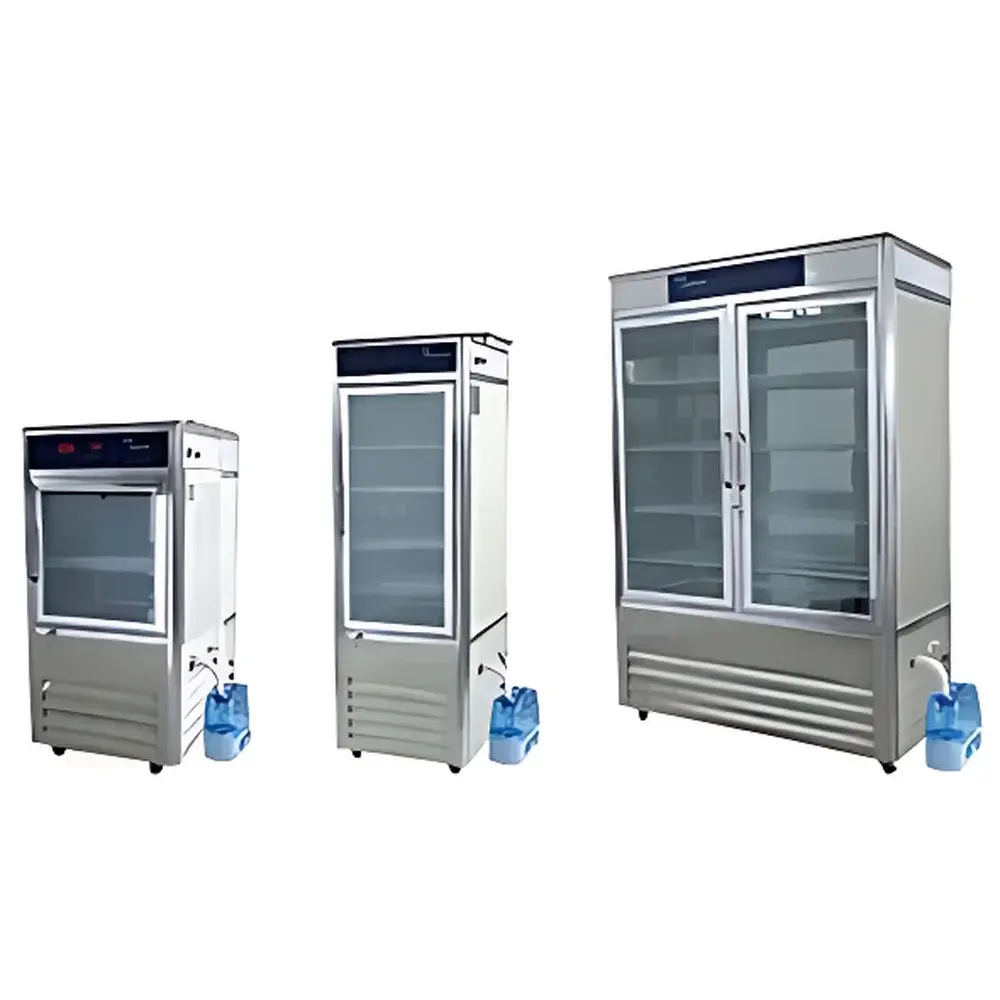
Hanuo PRX-150A Intelligent Plant Growth Chamber
| Brand | Hanuo |
|---|---|
| Model | PRX-150A |
| Capacity | 150 L |
| Temperature Range | 0–50 °C |
| Temperature Uniformity | ±0.5 °C |
| Humidity Range | 30–95 %RH |
| Humidity Control Accuracy | ±2 %RH |
| Illumination Intensity | 0–3000 lx (5-level adjustable) |
| Refrigeration | Imported Compressor |
| Control System | Programmable Microprocessor with Touch Interface |
| Power Failure Recovery | Yes |
| Safety Protection | Dual Over-Temperature & Sensor Fault Protection |
| Construction | Stainless Steel Interior, Aluminum Alloy Frame, Triple-Layer Insulated Glass Door |
Overview
The Hanuo PRX-150A Intelligent Plant Growth Chamber is a precision-engineered environmental simulation system designed for controlled plant physiology, photobiology, and developmental biology research. It operates on a dual-mode thermoelectric and compressor-based cooling architecture combined with ultrasonic humidification and programmable LED or fluorescent lighting systems to replicate natural diurnal cycles with high fidelity. Unlike standard incubators, this chamber integrates independent control of temperature, relative humidity, and photosynthetically active radiation (PAR)-compatible illumination—enabling reproducible studies of germination kinetics, photomorphogenesis, stress response phenotyping, and long-term growth under defined abiotic conditions. Its chamber volume of 150 L provides sufficient spatial homogeneity while maintaining tight parameter stability—critical for longitudinal experiments requiring statistical rigor across biological replicates.
Key Features
- Imported high-efficiency refrigeration compressor ensures stable sub-ambient operation down to 0 °C and rapid thermal recovery after door opening.
- Microprocessor-based controller with capacitive touch interface supports up to 30 programmable time–parameter profiles per day, including independent day/night setpoints for temperature, humidity, and light intensity (5-step dimming).
- Ultrasonic humidification system delivers uniform moisture distribution without condensation pooling; integrated humidity sensor feedback enables closed-loop RH regulation within ±2 %RH accuracy.
- Forced-air circulation via low-turbulence axial fans and optimized duct geometry achieves ≤±0.5 °C temperature uniformity throughout the working chamber (per ISO 15278:2016 test protocol).
- Dual-layer safety architecture includes primary PID-controlled over-temperature cutoff and secondary independent thermal fuse in the air duct—compliant with IEC 61010-1 Class II requirements.
- Stainless steel interior (AISI 304), corrosion-resistant aluminum alloy frame, and triple-pane insulated glass door minimize thermal leakage and UV degradation.
- Power failure memory function retains all active programs and current operational state; automatic resumption occurs upon grid recovery without manual reconfiguration.
Sample Compatibility & Compliance
The PRX-150A accommodates standard growth vessels—including petri dishes, Magenta boxes, multi-well plates, hydroponic trays, and small potted specimens—within its uniformly conditioned workspace. Its modular lighting configuration allows integration of full-spectrum white LEDs or narrow-band red/blue arrays (optional), supporting both photoperiodic and spectral quality studies. The unit meets structural and electrical safety requirements per IEC 61010-1 and EMC Directive 2014/30/EU. While not certified for GMP production environments, its logging-capable control system supports GLP-compliant documentation when paired with validated external data acquisition software. Humidity and temperature profiles are traceable to NIST-traceable reference standards during factory calibration.
Software & Data Management
The embedded controller logs timestamped temperature, humidity, and illumination data at user-selectable intervals (1–60 min) to internal flash memory (≥30 days retention). Export is supported via USB 2.0 port in CSV format for post-hoc analysis in MATLAB, R, or Python. Optional Ethernet connectivity (PRX-150A-E variant) enables remote monitoring and alarm notification via SNMP or Modbus TCP. Audit trails—including parameter changes, door openings, and fault events—are recorded with operator ID tagging when used with optional network authentication module. Data integrity complies with ALCOA+ principles when exported and archived under institutional SOPs.
Applications
- Seed germination assays under controlled thermo-hygrometric stress gradients (e.g., drought simulation via stepwise RH reduction).
- Photoperiod manipulation studies in model species (Arabidopsis, rice, maize) to characterize flowering time regulators.
- Insect rearing (Drosophila, Tribolium) requiring precise circadian entrainment and developmental staging.
- Microbial culture under variable light conditions (e.g., cyanobacterial phototaxis or fungal sporulation kinetics).
- BOD5 incubation per ASTM D5210-19, where temperature stability and oxygen diffusion uniformity are critical.
- Tissue culture initiation and callus proliferation under defined spectral irradiance (when equipped with PAR-optimized lamps).
FAQ
Does the PRX-150A support CO₂ concentration control?
No—this model is configured exclusively for temperature, humidity, and illumination regulation. CO₂-enriched variants (PRX-150A-CO₂) are available as custom configurations with mass flow controllers and infrared sensors.
What is the maximum ambient operating temperature for reliable performance?
The chamber maintains specified performance at ambient temperatures up to 30 °C and relative humidity ≤70 %RH. Above these limits, cooling capacity and humidity control range may be reduced.
Can third-party sensors be integrated into the control loop?
Yes—the RS-485 interface supports Modbus RTU communication, enabling integration of external CO₂, PAR, or soil moisture sensors for hybrid environmental control schemes.
Is validation documentation provided with the unit?
Each shipment includes a Factory Calibration Certificate (traceable to national standards) and IQ/OQ templates aligned with ISO/IEC 17025 guidelines. PQ execution requires site-specific protocol development.
What maintenance intervals are recommended?
Compressor oil inspection every 24 months; ultrasonic humidifier tank cleaning weekly; HEPA filter replacement every 6 months (if installed); annual verification of temperature/humidity sensor drift against reference probes.





