
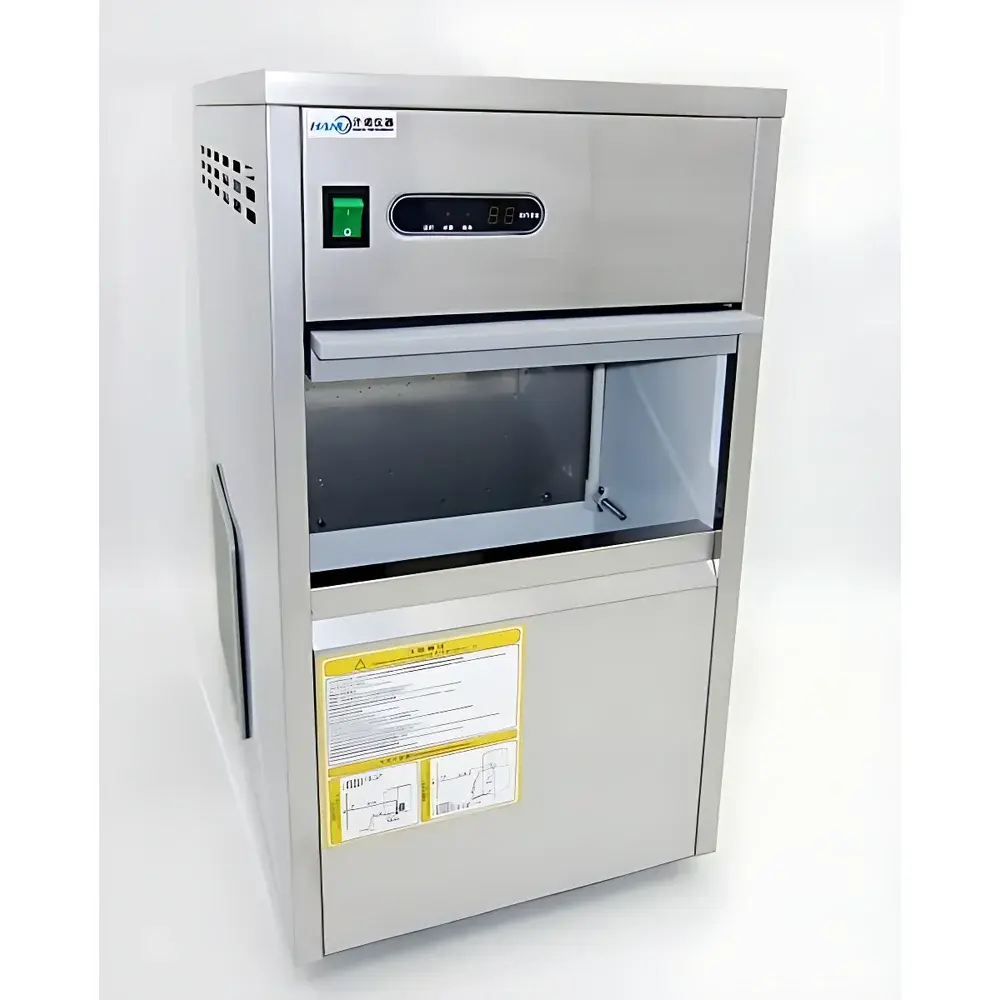
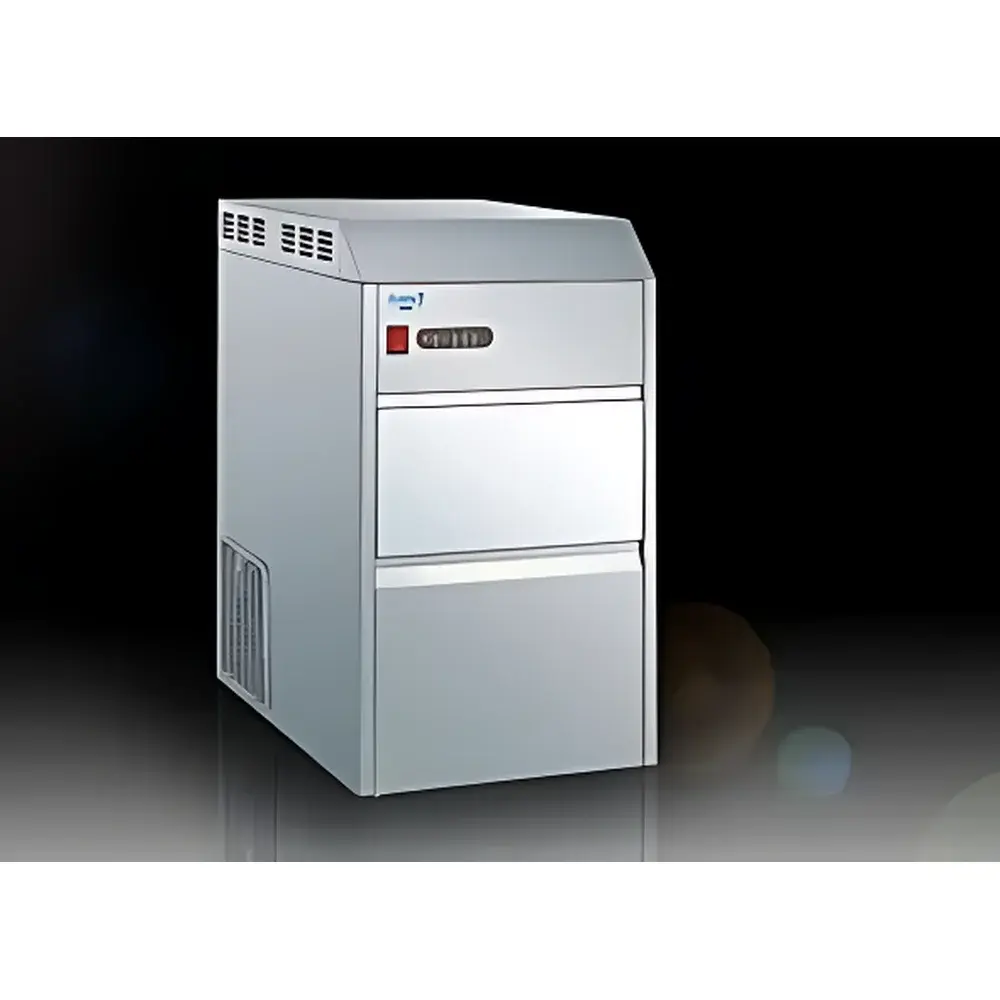
Hanuo FM50 Laboratory Flake Ice Machine
| Brand | Hanuo |
|---|---|
| Origin | Shanghai, China |
| Model | FM50 |
| Ice Type | Flake Ice |
| Ice Production Capacity | 40 kg/24h |
| Storage Capacity | 10 kg |
| Cooling Method | Air-Cooled |
| Ice Making Principle | Dual-Spiral Extrusion |
| Construction Material | Stainless Steel (304) |
| Power Input | 285 W |
| Dimensions (W×D×H) | 380 × 544 × 723 mm |
| Net Weight | 45 kg |
| Insulation | CFC-Free Polyurethane Foam |
| Control System | Microprocessor-Based Programmable Logic Controller (PLC) |
| Safety Features | Full Auto-Shutdown for Ice Full, Low Water, Overcooling, and Fault Conditions |
Overview
The Hanuo FM50 Laboratory Flake Ice Machine is an air-cooled, microprocessor-controlled refrigeration system engineered for consistent, on-demand production of irregular, fine-textured flake ice—optimized for rapid thermal transfer in sensitive laboratory applications. Unlike cubed or nugget ice systems, the FM50 employs a dual-spiral extrusion mechanism operating within a stainless-steel evaporator drum, where refrigerant-cooled surfaces freeze a thin water film; mechanical shearing via counter-rotating augers then fractures the ice into sub-millimeter, non-uniform flakes with high surface-area-to-volume ratio. This morphology enables deep penetration into narrow sample gaps, uniform temperature equilibration across biological specimens, reagent containers, or chromatography columns, and minimal mechanical stress during cryopreservation workflows. Designed for continuous duty in ISO Class 5–8 cleanrooms and GLP-compliant laboratories, the unit operates without water recirculation losses—eliminating residual water retention and eliminating manual defrost cycles.
Key Features
- Stainless-steel (AISI 304) housing and internal components ensure corrosion resistance against saline, acidic, or chlorinated water sources commonly used in biomedical and analytical labs.
- Integrated air-cooled condensing system with low-noise axial fans and optimized fin-tube heat exchanger—requires no external water supply or drain line, suitable for benchtop or under-bench installation.
- Dual-stage gearmotor drive reduces operational noise to ≤58 dB(A) at 1 m distance, meeting stringent acoustic requirements for quiet laboratory environments.
- CFC-free polyurethane foam insulation (λ ≈ 0.022 W/m·K) provides thermal resistance equivalent to R-19 (US) or U-value ≤0.28 W/m²·K, minimizing standby energy consumption.
- Microprocessor-based PLC controller with real-time monitoring of evaporator temperature, compressor run-time, ice thickness, and ambient intake air conditions—enabling predictive maintenance alerts.
- Self-draining water reservoir with float-switch actuated fill cycle ensures zero residual water after each batch, preventing microbial stagnation and biofilm formation per CLSI GP35-A4 guidelines.
- Automatic ice level detection via infrared sensor triggers immediate shutdown upon bin saturation, preserving ice quality and preventing compaction-induced fusion.
Sample Compatibility & Compliance
The FM50 produces flake ice with particle dimensions ranging from 1.2–2.8 mm in length and <0.8 mm in thickness—ideal for embedding tissue samples prior to cryosectioning (per ASTM F2622-21), cooling NMR probe housings, stabilizing enzymatic reaction mixtures, or maintaining cold-chain integrity during sample transport. All wetted surfaces comply with FDA 21 CFR §177.1520 (food-contact polymers) and EU Regulation (EC) No. 1935/2004. Electrical design conforms to IEC 61010-1:2010 (Safety Requirements for Electrical Equipment for Measurement, Control, and Laboratory Use). The control firmware supports audit-trail logging compatible with 21 CFR Part 11 Annex 11 requirements when integrated with validated LIMS platforms.
Software & Data Management
While the FM50 operates as a standalone appliance, its embedded controller logs timestamped event data—including compressor start/stop cycles, ice harvest frequency, fault codes, and ambient temperature excursions—for up to 30 days. Data export is supported via RS-485 Modbus RTU interface (optional USB-to-serial adapter), enabling integration into centralized facility monitoring systems (e.g., Siemens Desigo, Schneider EcoStruxure). Firmware updates are performed offline using FAT32-formatted USB drives; all configuration parameters retain factory defaults unless explicitly modified by authorized personnel per ISO/IEC 17025 clause 7.6.
Applications
- Cryopreservation of primary cell cultures and stem cell suspensions prior to controlled-rate freezing.
- Temperature stabilization of HPLC autosampler trays and GC injection ports during extended sequence runs.
- Rapid chilling of centrifuged plasma, serum, or CSF specimens pre-analytical processing (CAP checklist GEN.40520).
- On-site ice generation for field-deployable environmental sampling kits requiring trace-metal-free cooling media.
- Supporting ISO 15197:2013 glucose meter verification protocols where precise 0–4°C thermal conditioning of calibration standards is required.
FAQ
What is the recommended water quality specification for optimal flake ice clarity and equipment longevity?
Deionized or reverse-osmosis water (conductivity <5 µS/cm, total hardness <1 ppm CaCO₃) is strongly advised to prevent scale buildup on the evaporator drum and maintain consistent ice morphology.
Does the FM50 require periodic descaling or chemical maintenance?
No—provided feed water meets the above specification, the unit requires only quarterly visual inspection of the air intake filter and annual verification of refrigerant charge pressure per manufacturer service bulletin HB-FM50-Rev.3.
Can the FM50 be installed in a temperature-controlled room below 10°C?
Operation is rated for ambient temperatures between 10–32°C; sub-10°C environments may trigger false low-ambient fault codes and reduce compressor efficiency due to insufficient condensing head pressure.
Is remote monitoring or alarm notification available out-of-the-box?
Standard configuration includes dry-contact relay outputs for “Ice Full”, “Fault”, and “Power On” states—enabling connection to building management systems or local audible/visual alarms. Ethernet or Wi-Fi connectivity requires third-party IoT gateway integration.
How does flake ice compare to crushed or cubed ice for laboratory cold-chain applications?
Flake ice achieves 3–5× faster thermal transfer versus cubes of equivalent mass due to absence of interstitial air pockets and higher conformal contact area—critical for minimizing thermal gradients in multi-well plates or capillary electrophoresis cartridges.



