
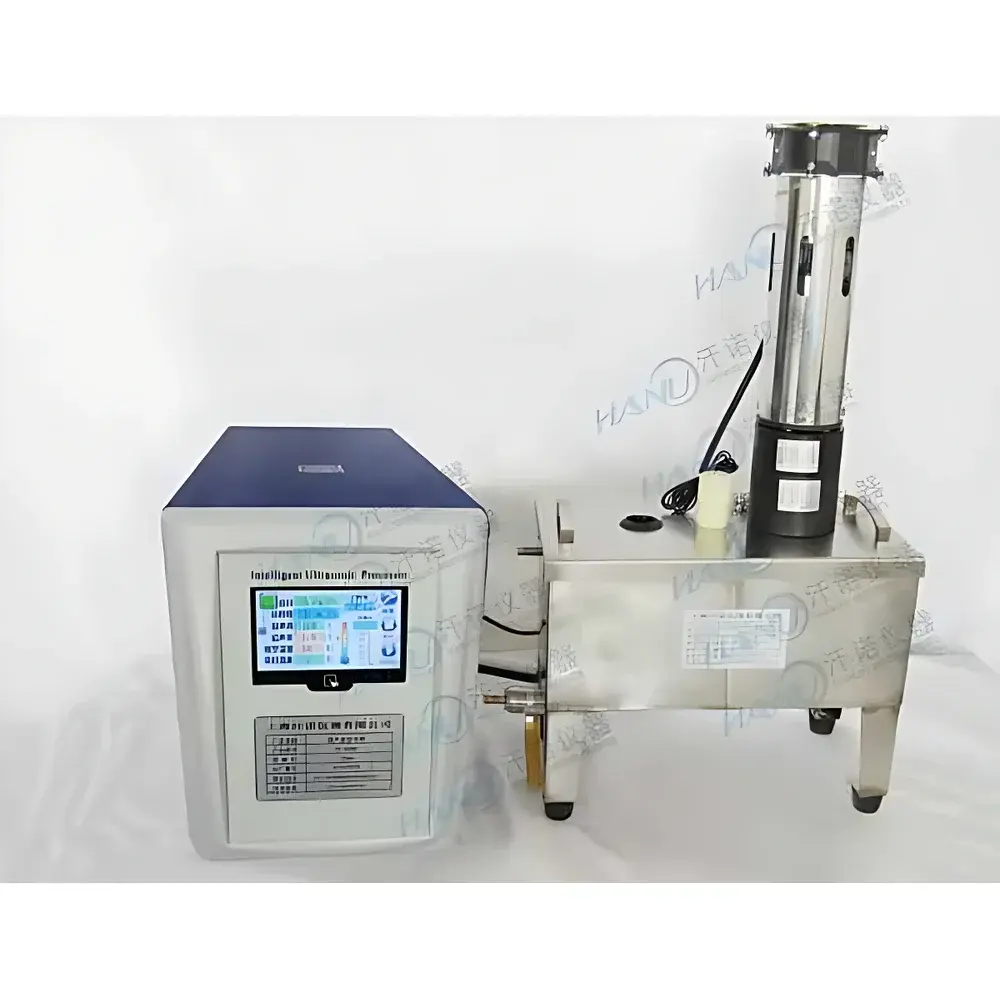
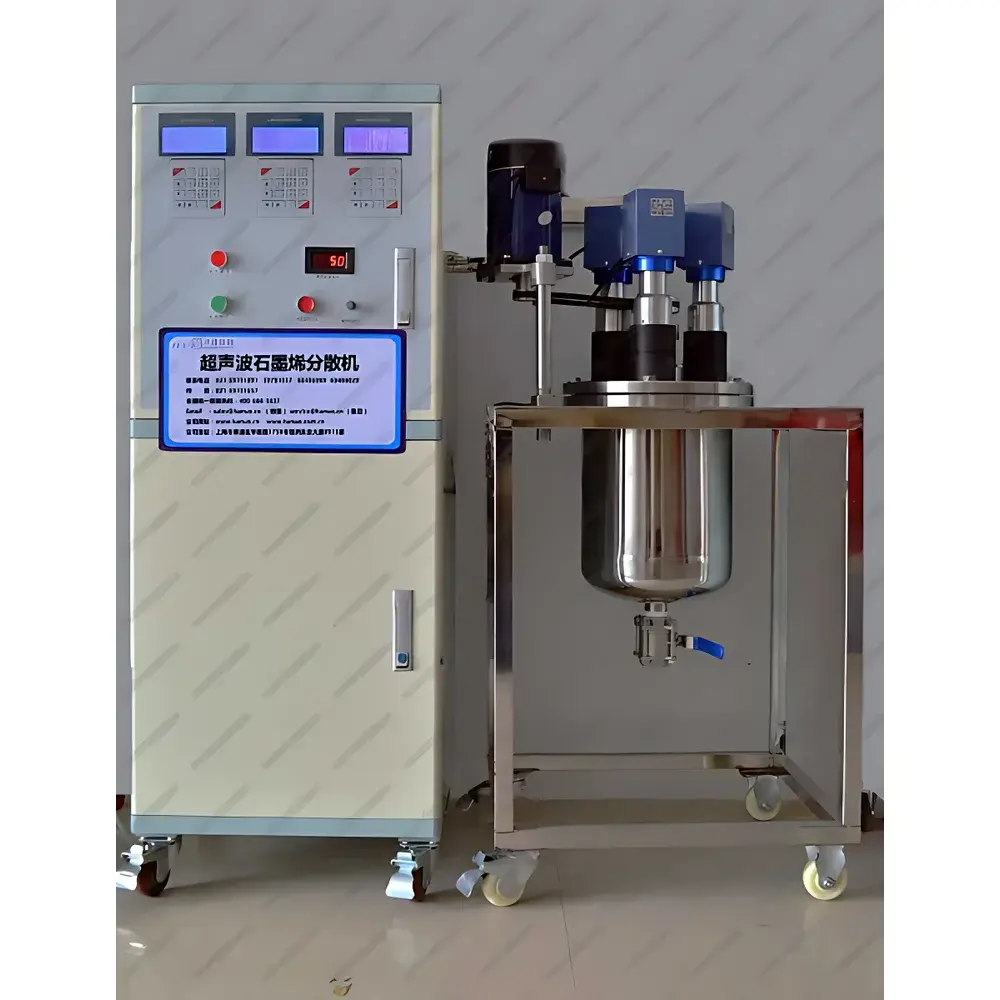
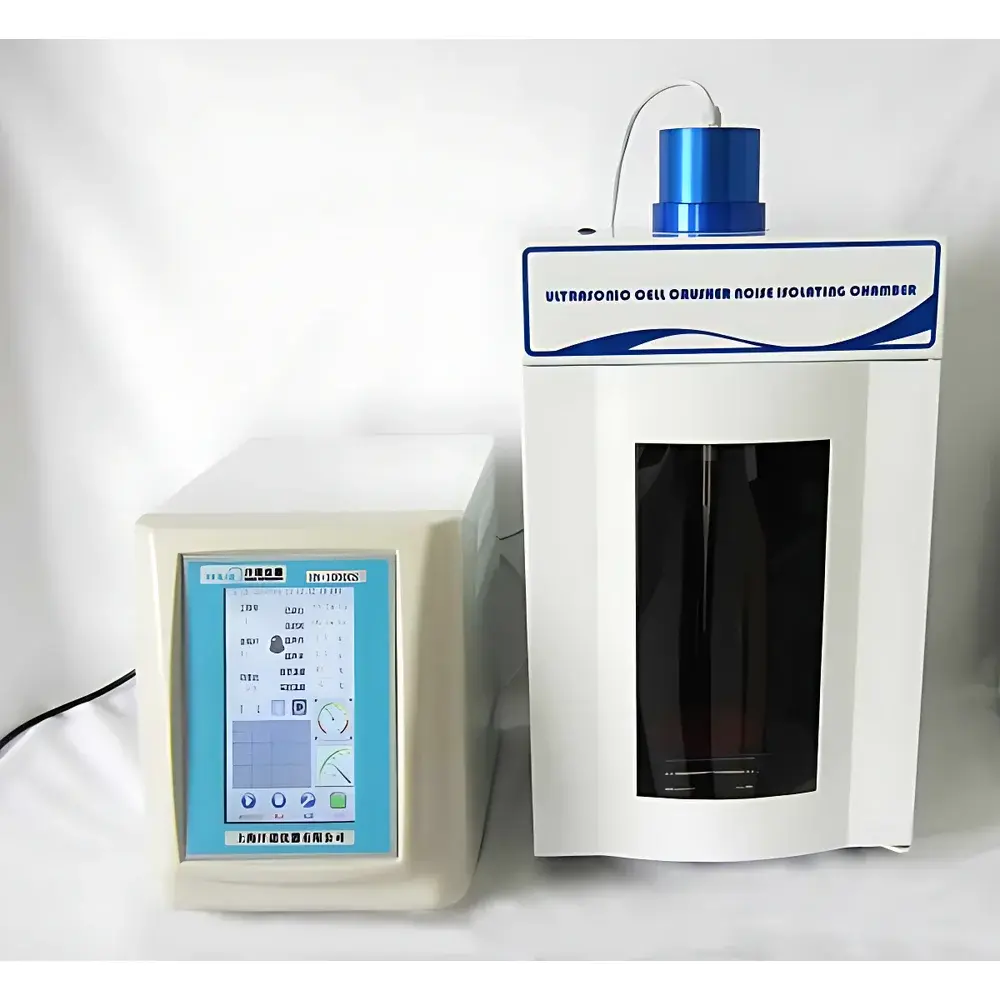
Hanuo Hannuo-6000 High-Power Continuous-Flow Ultrasonic Cell Disruptor
| Brand | Hanuo |
|---|---|
| Origin | Shanghai, China |
| Model | Hannuo-6000 |
| Instrument Type | Ultrasonic Cell Disruptor |
| Ultrasonic Output Power | 6000 W |
| Operating Frequency | 19 kHz (frequency-tracking) |
| Sample Volume Capacity | 5 L (continuous flow) |
| Temperature Control Range | 0–100 °C |
| Pulse Duration | 0.1–99.9 s (ultrasonic/on–off interval) |
| Total Process Time | 0–99 h 59 min 59 s |
| Display | 4.3-inch TFT touchscreen |
| Protection | Overload, overtemperature, and fault auto-detection |
| Power Supply | AC 220 V ±5%, 50 Hz (110 V optional) |
Overview
The Hanuo Hannuo-6000 is a high-power, continuous-flow ultrasonic cell disruptor engineered for industrial-scale bioprocessing applications. It operates on the principle of acoustic cavitation—generating intense localized pressure differentials in liquid media via high-intensity ultrasonic waves at 19 kHz. This induces transient microbubble formation, growth, and violent collapse, delivering mechanical shear forces sufficient to rupture cellular membranes, disintegrate aggregates, and accelerate mass transfer. Unlike batch-mode sonicators, the Hannuo-6000 supports true continuous processing with integrated temperature monitoring and active thermal management—critical for preserving labile biomolecules during large-volume lysis (e.g., microbial fermentation broths, mammalian cell suspensions, or plant tissue homogenates). Its robust architecture enables reproducible disruption across diverse biological matrices while maintaining compliance with foundational process control expectations in GLP and early-stage GMP environments.
Key Features
- 6000 W nominal ultrasonic output power with real-time frequency tracking—ensures stable energy delivery despite load variations or temperature-induced impedance shifts
- Continuous-flow processing capability up to 5 L per cycle, compatible with external recirculation loops or inline reactor integration
- Programmable pulse modulation: ultrasonic-on duration adjustable from 0.1 to 99.9 seconds, with independent off-interval control for thermal mitigation and reduced sample degradation
- Integrated digital temperature monitoring and closed-loop control (0–100 °C), with configurable alarm thresholds and automatic shutdown upon deviation
- 4.3-inch TFT touchscreen interface supporting intuitive parameter entry, real-time display of power, temperature, elapsed time, and duty cycle
- Comprehensive safety architecture including overload protection, overtemperature cutoff, and self-diagnostic error reporting with audible/visual alerts
- Modular transducer assembly with interchangeable titanium alloy probes (Φ20 mm to Φ50 mm) and optional accessories: double-jacketed borosilicate glass vessels (500–2000 mL), 304 stainless steel dispersion tanks, and jacketed reaction vessels with coolant circulation ports
Sample Compatibility & Compliance
The Hannuo-6000 accommodates a broad spectrum of biological samples—including Gram-positive and Gram-negative bacterial cultures, yeast, spores, algal biomass, mammalian cells, and plant tissues—without requiring chemical lysis reagents. Its mechanical disruption mechanism avoids protease activation or nucleic acid shearing commonly observed with enzymatic or detergent-based methods. The system supports standard operating procedures aligned with ISO 13485–informed equipment qualification frameworks and facilitates audit-ready documentation when paired with external data loggers. While not certified to FDA 21 CFR Part 11 out-of-the-box, its programmable protocols, password-protected parameter locking, and 20-step program memory provide foundational traceability for internal SOP adherence and laboratory accreditation (e.g., ISO/IEC 17025).
Software & Data Management
The device embeds firmware-level process logging: each run stores timestamped values for setpoint temperature, actual temperature, applied power (% of max), total runtime, and pulse configuration. All 20 user-defined programs retain full parameter definitions—including probe geometry selection, cooling mode, and alarm thresholds—with individual password protection. Data export is supported via USB interface for post-processing in Excel or LIMS-compatible formats. Optional integration with SCADA or PLC systems is feasible through analog 4–20 mA output signals (temperature and power feedback) and digital I/O triggers (start/stop, fault status). No proprietary cloud platform is required; raw logs remain fully accessible and editable offline.
Applications
- High-yield intracellular protein extraction from E. coli and Bacillus strains in upstream biomanufacturing
- Preparation of subcellular fractions (e.g., organelles, membrane vesicles) under controlled thermal conditions
- Nanoparticle dispersion and stabilization in drug delivery formulation development
- Enzyme activation studies requiring precise kinetic control of mechanical stress application
- Cell lysis validation for QC release testing in vaccine production workflows
- Accelerated solvent-free extraction of secondary metabolites from botanical materials
- Surface functionalization of biomaterial scaffolds via ultrasonically enhanced coating deposition
FAQ
What is the maximum recommended flow rate for continuous operation?
The Hannuo-6000 is optimized for recirculating flows between 0.5–3 L/min depending on viscosity and particle load; optimal cavitation efficiency is maintained below 500 cP.
Can this unit be integrated into an automated bioreactor control system?
Yes—via 4–20 mA analog outputs for temperature and power feedback, plus discrete digital inputs for remote start/stop and fault acknowledgment.
Is probe sterilization supported?
Titanium alloy probes (ASTM F136 compliant) withstand repeated autoclaving (121 °C, 20 min); glass and stainless steel accessories are also autoclavable or clean-in-place (CIP) compatible.
Does the system meet electromagnetic compatibility (EMC) standards for laboratory use?
It complies with IEC 61326-1:2013 Class A emission limits and basic immunity requirements for industrial environments; CE marking applies to the EU market.
How is calibration verified?
Power output is validated using calibrated calorimetric measurement per ASTM E2272; temperature sensors are NIST-traceable RTDs with ±0.5 °C accuracy across the operational range.




