
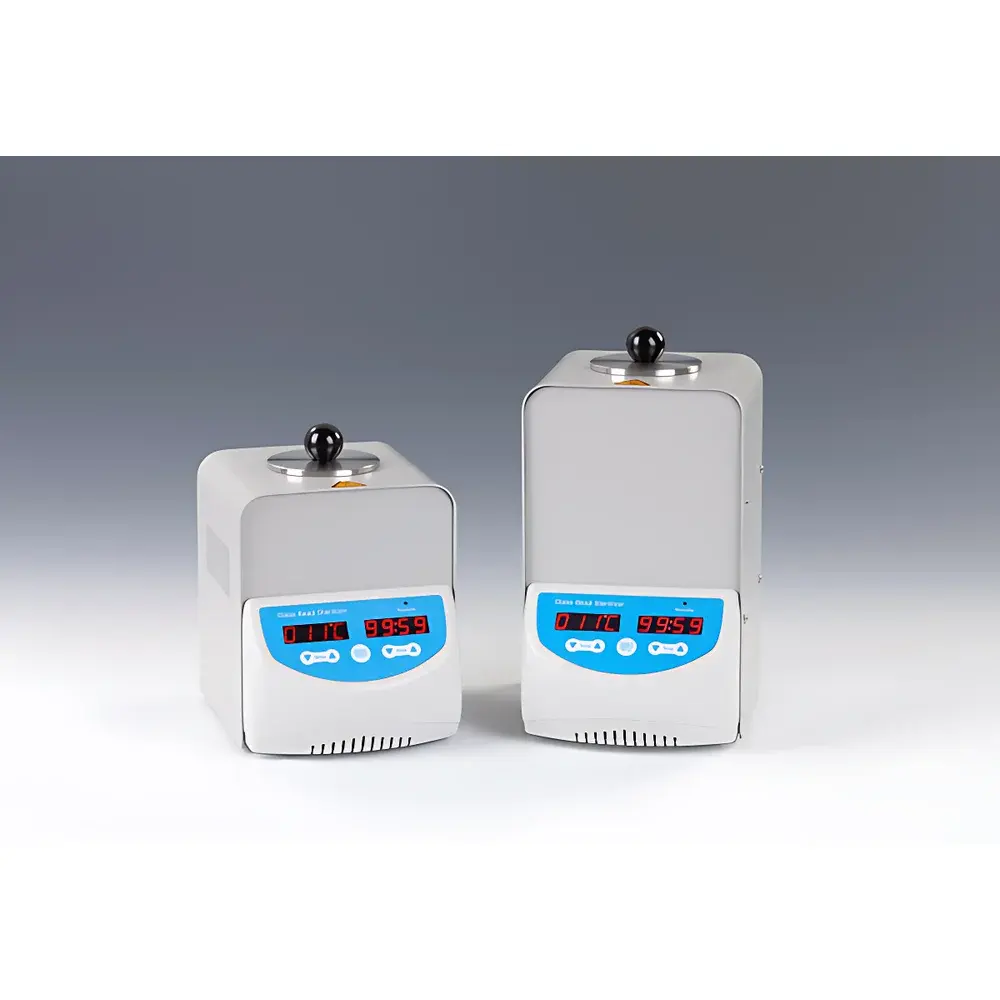
Hanuo GS300 Series Rapid Glass Bead Sterilizer
| Brand | Hanuo |
|---|---|
| Origin | Shanghai, China |
| Model | GS300-L / GS300-H |
| Temperature Range | 100–300 °C |
| Temperature Control Accuracy | ±5 °C |
| Display Resolution | 1 °C |
| Heating Time (to 300 °C) | ≤25 min |
| Power Rating | 120 W (GS300-L) / 250 W (GS300-H) |
| Chamber Dimensions | Φ40 mm × 80 mm (L) / Φ40 mm × 140 mm (H) |
| Glass Bead Capacity | 150 g / 300 g |
| External Dimensions | 176 × 135 × 189.5 mm (L) / 176 × 135 × 249.5 mm (H) |
| Net Weight | 2.5 kg / 3.3 kg |
| Voltage | AC 220 V, 50–60 Hz |
Overview
The Hanuo GS300 Series Rapid Glass Bead Sterilizer is a compact, dry-heat sterilization device engineered for rapid, non-contact microbial decontamination of small, heat-stable instruments. Unlike steam-based autoclaves or chemical immersion methods, this unit operates on the principle of conductive thermal transfer: high-purity glass beads (3.0 mm diameter) are heated to and maintained at precise elevated temperatures (100–300 °C), enabling instantaneous thermal inactivation of vegetative bacteria, fungi, and bacterial endospores upon instrument insertion. With sterilization efficacy validated at ≥300 °C for ≥10 seconds—per standard microbiological practice—the GS300 delivers repeatable, residue-free sterilization without moisture, pressure, or volatile agents. It is designed specifically for routine use in biosafety level 1 and 2 laboratories, tissue culture facilities, microbiology teaching labs, and clinical research settings where speed, simplicity, and sterility assurance for metallic and borosilicate glass tools are critical.
Key Features
- Real-time digital temperature display with 1 °C resolution and ±5 °C control accuracy across the full 100–300 °C operating range
- Stainless steel inner chamber (304 grade) with optimized thermal mass and uniform bead distribution geometry for stable thermal equilibrium
- High-efficiency heating element coupled with PID-based temperature regulation and dual-stage overtemperature protection (mechanical + electronic)
- Two configurations available: GS300-L (150 g bead capacity, 80 mm depth) and GS300-H (300 g bead capacity, 140 mm depth), supporting varied instrument lengths
- Compact footprint (176 × 135 mm base) and low power draw (120–250 W), suitable for benchtop deployment in space-constrained environments
- Pre-loaded with ASTM F2101-compliant soda-lime glass beads (3.0 mm nominal diameter, low alkali leach rate, certified non-pyrogenic)
Sample Compatibility & Compliance
The GS300 is validated for sterilizing solid, dry, non-porous instruments including stainless steel forceps, scalpels, needles, inoculating loops and needles, microtome blades, and borosilicate glass capillaries. It is not intended for plastics, coated tools, liquids, or wrapped items. The device complies with ISO 13485 design controls for medical device accessories and meets functional requirements outlined in USP Sterility Tests and CLSI M22-A3 for dry-heat sterilization validation protocols. All units undergo factory calibration traceable to NIST-certified reference thermometers. No regulatory submission (e.g., FDA 510(k)) is required, as the GS300 is classified as a Class I laboratory support device under IEC 61010-1:2010 for electrical safety and EN 61326-1:2013 for electromagnetic compatibility.
Software & Data Management
The GS300 operates via embedded firmware with no external software dependency. Temperature setpoint, real-time chamber reading, and elapsed run time are displayed on a backlit LCD interface. While the device does not feature data logging or USB/RS232 connectivity, its thermal stability profile (≤±2 °C deviation during steady-state operation at 300 °C) supports manual logbook documentation per GLP/GMP Annex 11 expectations. Users may integrate sterilization cycles into laboratory SOPs using timestamped operator logs, aligning with audit requirements for traceability in regulated QC/QA workflows.
Applications
- Routine sterilization of inoculating loops and needles between microbial streaks in bacteriology and mycology
- Decontamination of microsurgical instruments in animal surgery suites without compromising edge integrity
- Pre-sterilization of glass Pasteur pipettes and capillary tubes prior to flame-sealing or puller use
- Emergency sterilization in field-deployable labs where autoclave infrastructure is unavailable
- Teaching lab demonstrations of thermal death time kinetics and spore resistance thresholds
FAQ
What types of instruments can be safely sterilized in the GS300?
Only dry, solid, non-porous instruments made from stainless steel, nickel-chromium alloys, or borosilicate glass. Avoid aluminum, zinc-coated, or polymer-handled tools.
How often should the glass beads be replaced?
Beads should be inspected weekly for discoloration, cracking, or fusion; replacement is recommended every 6 months under daily use or after 500 sterilization cycles.
Is preheating required before use?
Yes—allow ≥25 minutes for chamber stabilization at target temperature. A built-in audible alert signals readiness at setpoint.
Can the GS300 be used for sterilizing biological samples?
No—this device is strictly for instrument surface decontamination. It is not designed for sample sterilization or material modification.
Does the unit meet FDA or CE requirements for clinical use?
It carries CE marking per IEC 61010-1 and is suitable for research-use-only (RUO) applications in clinical labs; formal clinical deployment requires institutional risk assessment per ISO 14971.



