
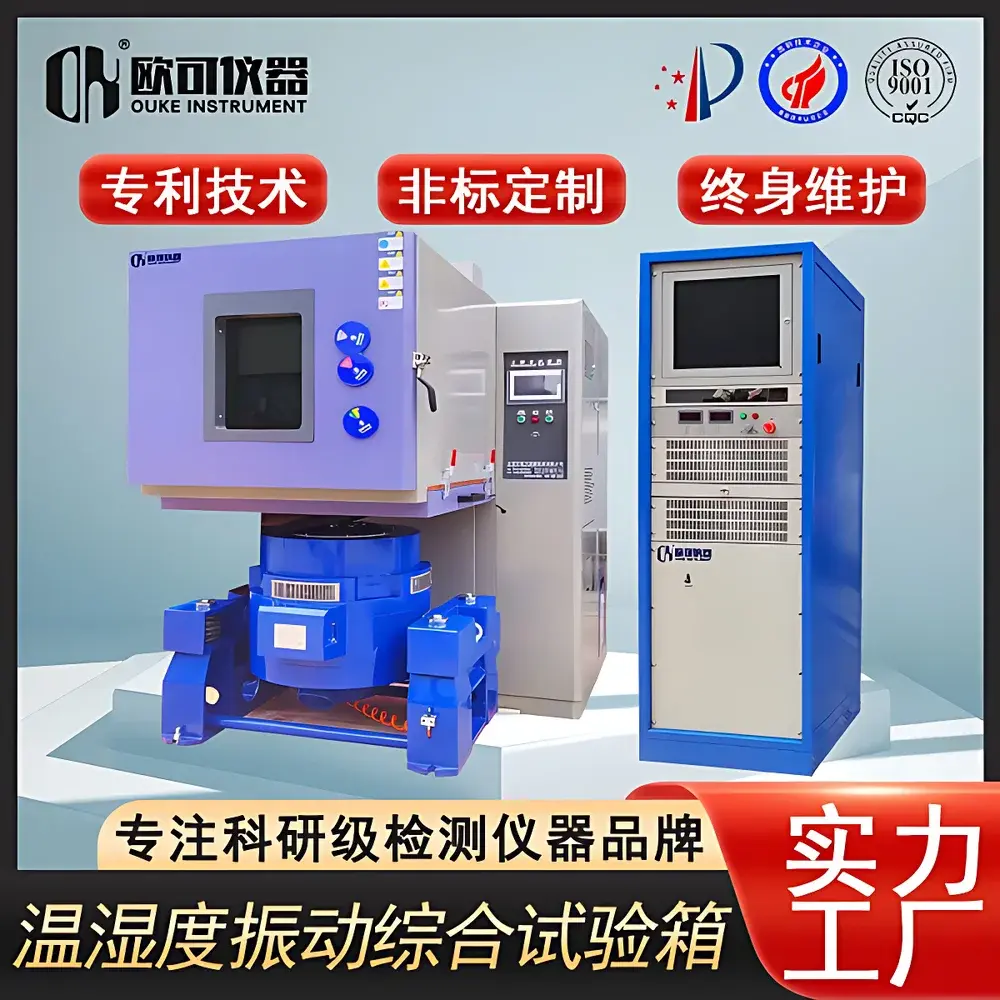
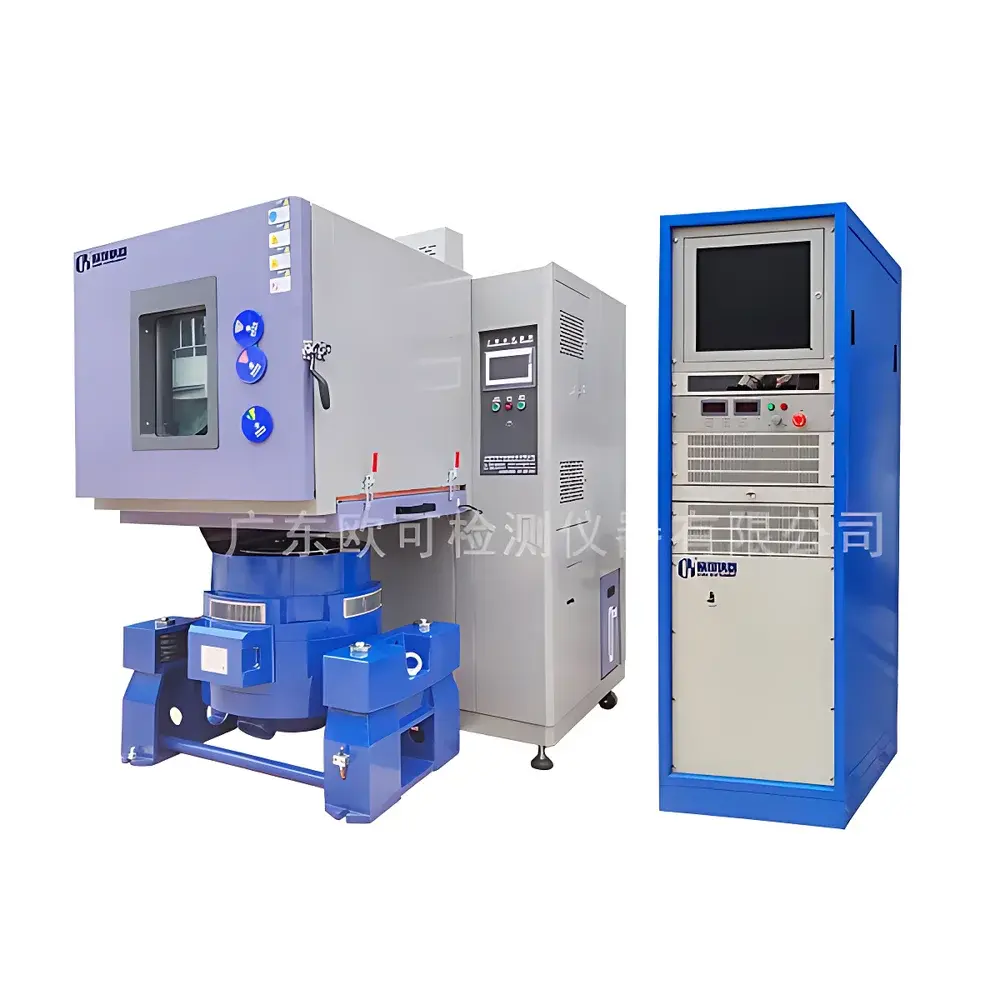
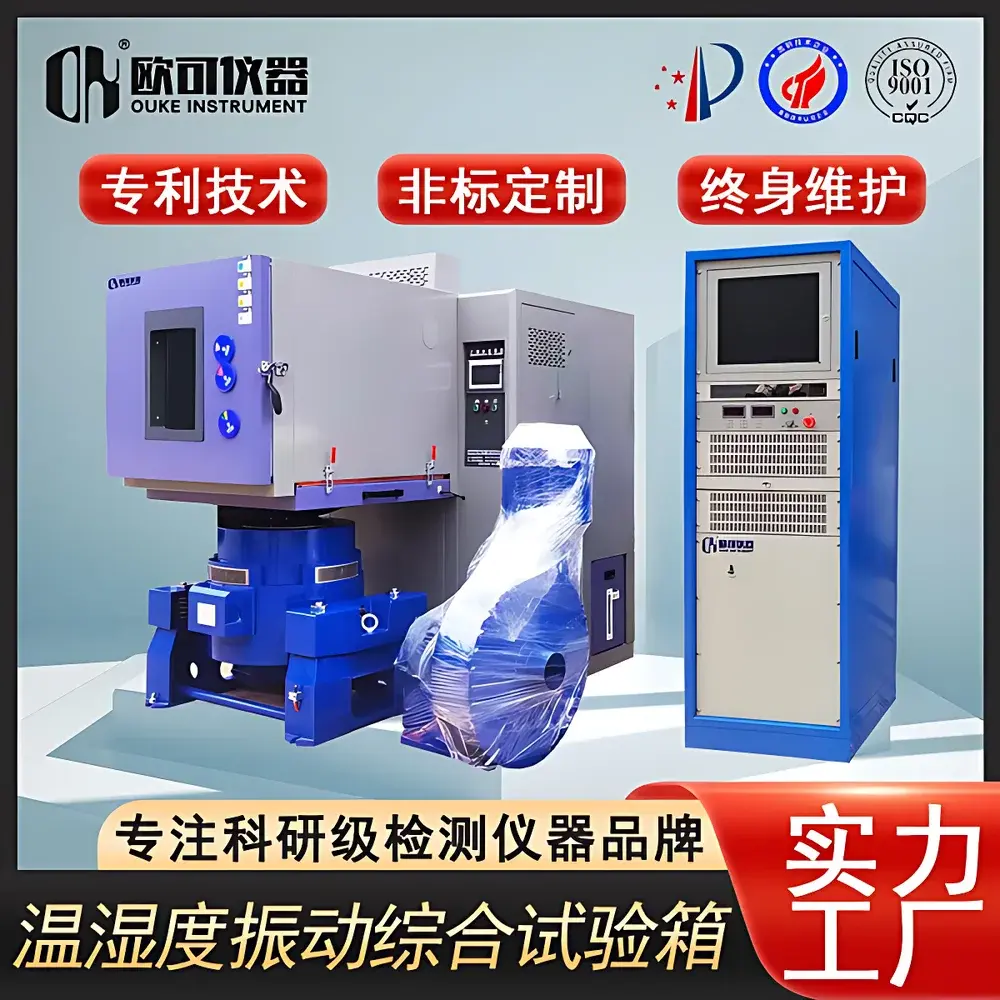
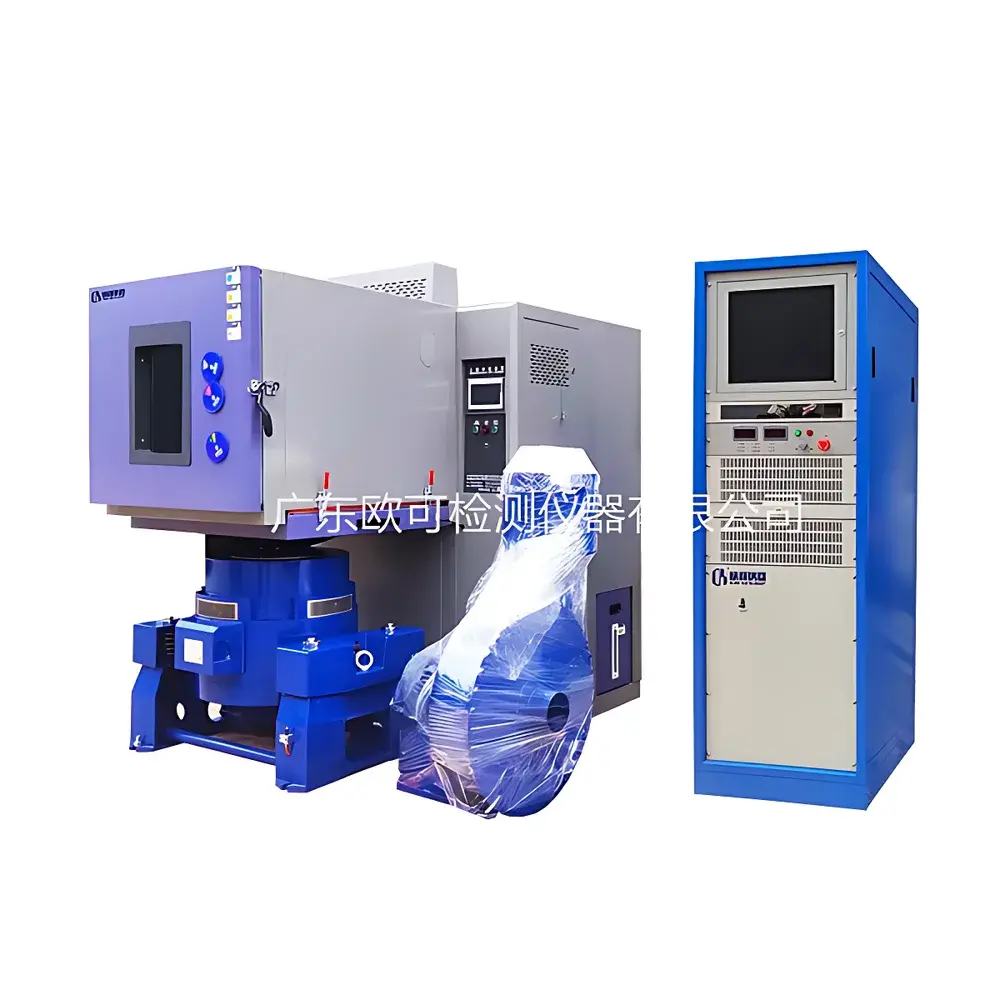
OK Instruments OK-ZTH-1440.369 Combined Temperature-Humidity-Vibration Environmental Test System
| Brand | OK Instruments |
|---|---|
| Origin | Guangdong, China |
| Manufacturer Type | Direct Manufacturer |
| Model | OK-ZTH-1440.369 |
| Temperature Range | −70 °C to +150 °C |
| Humidity Range | 20–98 %RH (at 20–85 °C) |
| Temperature Ramp Rate | 5 / 10 / 15 °C/min |
| Temperature Uniformity | ≤ ±0.5 °C |
| Standard Load Capacity | 15 kg aluminum mass (350 W thermal dissipation) |
Overview
The OK Instruments OK-ZTH-1440.369 is an integrated environmental test system engineered for simultaneous temperature, humidity, and mechanical vibration stress application—commonly referred to as a tri-combined (temperature-humidity-vibration) test chamber. It operates on the principle of synergistic stress exposure: thermal cycling induces material expansion/contraction, humidity drives hygroscopic swelling or corrosion mechanisms, and controlled electrodynamic vibration replicates transport, operational, or seismic mechanical loads. This multi-stress methodology enables accelerated reliability assessment per IEC 60068-2-64, MIL-STD-810H Method 520.3, and ISO 16750-4 for automotive electronics, aerospace avionics, medical device packaging, and high-reliability PCB assemblies. The system integrates a climatic chamber with a high-performance shaker table, mechanically decoupled yet synchronized via a unified control architecture to maintain phase coherence between thermal transients and vibration profiles.
Key Features
- Tri-combined capability: Concurrent operation of temperature (-70 °C to +150 °C), humidity (20–98 %RH within 20–85 °C operating band), and broadband electrodynamic vibration (5–2000 Hz, up to 100 gpk depending on payload).
- Modular cooling architecture: Dual-stage cascade refrigeration system optimized for sub-zero stability; air-cooled compressors with pressure monitoring and automatic fault lockout.
- Vibration actuator design: High-strength, frameless moving coil with air-spring suspension and precision bearing-guided gimbal mount; supports random, sine, shock, and fatigue testing per ISO 10816 and ASTM D4728.
- Thermal performance: Programmable ramp rates of 5/10/15 °C/min; temperature uniformity ≤ ±0.5 °C across 1440 L working volume; humidity resolution 0.1 %RH with distribution accuracy ±3.0 %RH.
- Structural integration: Stainless steel (SUS#304) chamber interior and exterior; high-density polyurethane foam insulation with low thermal conductivity (<0.022 W/m·K); reinforced base plate with M12 threaded mounting inserts for shaker interface.
- Safety compliance: Triple-layer protection including refrigerant high/low pressure cutoffs, over-temperature/over-humidity interlocks, dry-run detection for humidifier, emergency stop circuitry, and real-time fault logging with event timestamping.
Sample Compatibility & Compliance
The OK-ZTH-1440.369 accommodates samples up to 15 kg mounted on a standardized aluminum test plate (flatness tolerance ≤ 0.05 mm/m²). Its internal dimensions (W×D×H: 1000 × 1200 × 1200 mm) support full-size automotive ECUs, server rack modules, and industrial control enclosures. All control firmware and data acquisition comply with GLP/GMP traceability requirements: audit trails, user access levels (admin/operator), electronic signatures, and 21 CFR Part 11–compatible data archiving are supported via optional software licensing. The system meets CE marking requirements under Directive 2014/30/EU (EMC) and 2014/68/EU (PED), and conforms to ISO/IEC 17025 calibration traceability standards when paired with accredited external verification.
Software & Data Management
Control is executed via OK Instruments’ proprietary TriSync™ platform—a Windows-based application supporting real-time synchronization of thermal setpoints, humidity profiles, and vibration spectra (sine sweep, random PSD, transient shock). Data logging records all analog inputs (chamber sensors, accelerometer feedback, thermocouple arrays) at configurable intervals (10 ms to 10 s), with raw binary export in IEEE 754-compliant .tdms format. The software includes built-in compliance reporting templates aligned with ISTA 3A, JEDEC JESD22-A108, and IPC-9701. Optional network connectivity enables remote monitoring through HTTPS-secured web interface, SNMP trap generation, and OPC UA server integration for MES/SCADA systems.
Applications
- Accelerated life testing of consumer electronics subjected to shipping vibration + desert/humid climate exposure.
- Qualification of battery management systems (BMS) under combined thermal runaway initiation and mechanical shock.
- Validation of hermetic seal integrity in MEMS sensors using humidity soak followed by resonant frequency shift analysis.
- Testing of military-grade connectors per MIL-DTL-38999 under temperature cycling while vibrated at 20 gpk at 500 Hz.
- Reliability screening of LED lighting drivers exposed to condensation cycles and broadband vibration to assess solder joint fatigue.
FAQ
What is the maximum allowable payload for vibration testing inside the chamber?
The standard configuration supports 15 kg on the aluminum test plate. Payload capacity is load-path dependent—higher masses require static load verification and may reduce maximum acceleration output.
Can the system perform humidity-only tests without temperature or vibration stress?
Yes. All three stress domains operate independently or in any two-domain combination (e.g., temp+humidity, temp+vibration) via software-selectable test modes.
Is the vibration table compatible with third-party slip tables or horizontal shakers?
The OK-ZTH-1440.369 offers optional bolt-on interfaces for 600 mm × 600 mm horizontal slip tables per ISO 10816-3, with pre-aligned mounting holes and dynamic balancing certification.
How is calibration maintained across combined stress conditions?
Chamber sensors are calibrated annually per ISO/IEC 17025-accredited procedures; shaker force and displacement transducers include NIST-traceable certificates. OK Instruments provides on-site recalibration services with documented uncertainty budgets.
Does the system meet FDA requirements for medical device validation?
When configured with 21 CFR Part 11 software modules (electronic signature, audit trail, role-based access), it satisfies FDA guidance for Design Verification and Process Validation per ISO 13485:2016 Annex C.



