
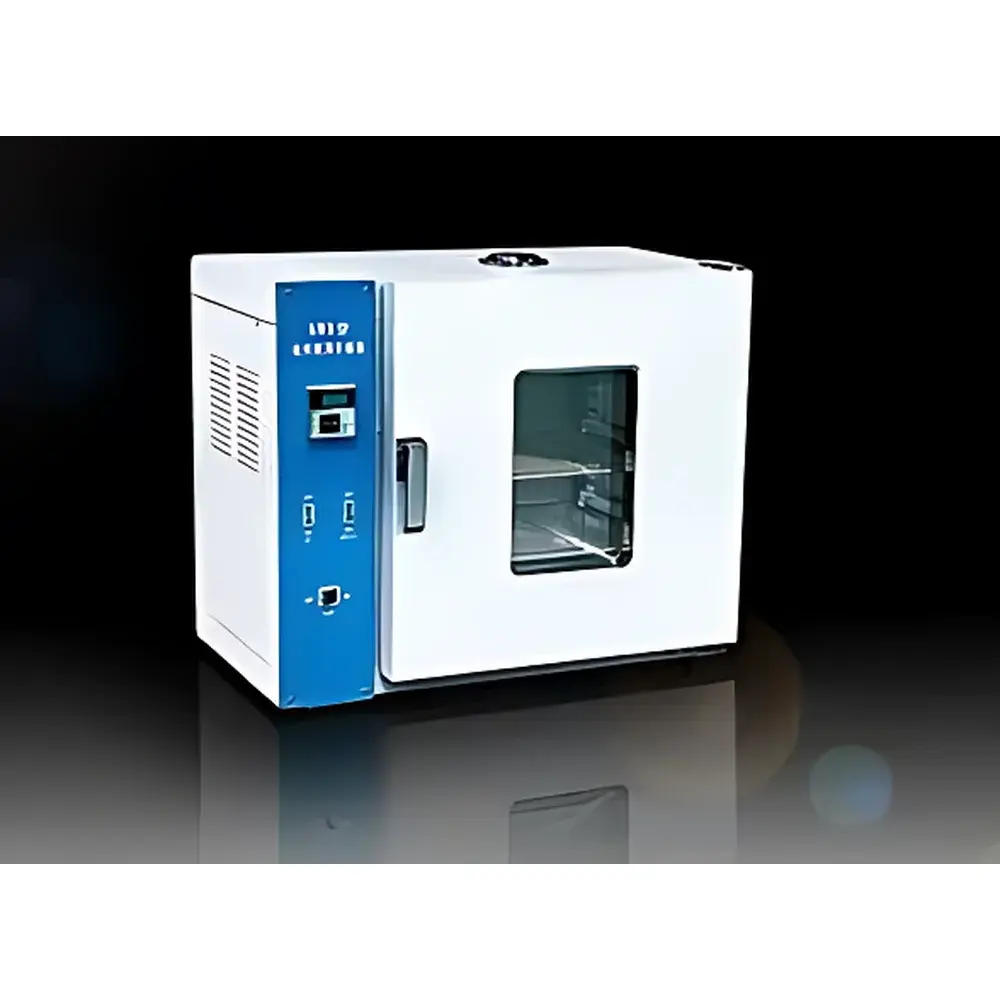
Hanuo 202-2ES Digital Display Constant-Temperature Drying Oven
| Brand | Hanuo |
|---|---|
| Model | 202-2ES |
| Type | General-Purpose Forced-Air Drying Oven |
| Temperature Range | 50–250 °C |
| Temperature Uniformity | ±2 °C |
| Interior Dimensions (W×D×H) | 550×550×450 mm |
| Exterior Dimensions (W×D×H) | 840×620×760 mm |
| Net Weight | 92 kg |
| Power Supply | 220 V, 50 Hz |
| Heating Power | 2.5 kW |
| Heating Method | Forced Convection (Hot Air Circulation) |
| Interior Material | Galvanized Steel (Standard) |
| Control System | Digital PID Temperature Controller with Setpoint & Real-Time Display |
Overview
The Hanuo 202-2ES is a general-purpose forced-air drying oven engineered for precise thermal processing in laboratory, pharmaceutical, and industrial quality control environments. It operates on the principle of convective heat transfer via a horizontally mounted axial fan and heating elements positioned at the rear wall, ensuring uniform air circulation across the working chamber. Designed to meet routine requirements for drying, baking, sterilization, wax melting, and polymer curing, the unit complies with fundamental thermal stability and safety expectations outlined in ISO 17025-accredited laboratories. Its temperature range of 50–250 °C supports applications from low-temperature moisture removal to high-temperature material conditioning, while its ±2 °C temperature fluctuation specification reflects consistent thermal performance under steady-state operation.
Key Features
- Forced-air convection system with rear-mounted blower ensures homogeneous temperature distribution throughout the chamber—critical for reproducible drying kinetics and sample integrity.
- Digital PID temperature controller with real-time display and setpoint adjustment enables stable thermal regulation without manual intervention; optional time-based program control available upon request.
- Robust exterior housing finished with electrostatic powder coating provides corrosion resistance and mechanical durability in shared lab environments.
- Double-layer tempered glass observation window integrated into the front door allows continuous visual monitoring of samples without compromising chamber integrity or thermal stability.
- Standard interior chamber constructed from galvanized steel; stainless steel lining (designated by suffix “B” in model variants) is available for enhanced chemical resistance and ease of cleaning in regulated settings.
- Over-temperature protection circuit automatically cuts power if internal sensor detects deviation beyond safe operational limits—meeting basic IEC 61000-6-2 EMC and IEC 61010-1 safety compliance benchmarks.
Sample Compatibility & Compliance
The 202-2ES accommodates standard laboratory glassware (e.g., Petri dishes, weighing boats, crucibles), metal trays, and polymer substrates up to 550 mm wide. Its chamber volume (~136 L) supports batch processing of multiple samples simultaneously while maintaining thermal consistency per ASTM E145-22 “Standard Specification for Gravity-Convection and Forced-Ventilation Ovens.” Though not certified for Class II biological safety or explosion-proof use, the oven is routinely deployed in GLP-compliant QC labs for residual solvent evaporation (per USP ), loss-on-drying assays (USP ), and pre-weighing sample conditioning prior to elemental analysis. Documentation packages—including factory calibration certificates traceable to NIM (China National Institute of Metrology)—can be provided upon order for audit readiness.
Software & Data Management
This analog-digital hybrid oven does not include embedded data logging or network connectivity as standard. However, the digital controller outputs a 0–10 V analog signal corresponding to chamber temperature, enabling integration with external data acquisition systems (e.g., LabVIEW, Delta Tau PMAC) for continuous monitoring and CSV export. For GMP-regulated environments requiring electronic records, third-party USB/RS485 data loggers compliant with FDA 21 CFR Part 11 (with user authentication, audit trail, and electronic signature support) may be interfaced via the controller’s auxiliary port. Calibration verification intervals are recommended every 6 months or per internal SOPs, using NIST-traceable reference thermometers.
Applications
- Moisture content determination in raw materials (pharmaceutical excipients, food powders, ceramics).
- Pre-drying of filters and membranes prior to gravimetric particulate analysis (EPA Method 160.1).
- Curing of epoxy-coated substrates and adhesive bonds in materials R&D.
- Sterilization of non-critical glassware and stainless-steel tools where steam autoclaving is impractical.
- Accelerated aging studies under controlled thermal stress (ASTM D5870).
- Pre-heating of samples before FTIR, XRD, or TGA analysis to eliminate ambient humidity interference.
FAQ
What is the difference between the “202” and “202-S” or “202-B” model designations?
The base “202” series denotes constant-temperature ovens; “S” indicates digital display control (as in the 202-2ES), while “B” specifies stainless steel interior construction. Models combining both features are designated “202-ESB”.
Does this oven support programmable ramp-hold temperature profiles?
No—the 202-2ES uses a single-setpoint PID controller. Multi-step programming requires upgrading to the 202-C series with intelligent microprocessor-based controllers.
Is the temperature sensor calibrated at the factory, and can it be recalibrated onsite?
Yes—a certificate of conformity with initial calibration at 100 °C and 200 °C is included. Field recalibration is possible using a calibrated reference thermometer and the controller’s offset adjustment function.
Can the oven be used for sterilization of surgical instruments?
It is not validated for medical device sterilization per ISO 17665. It may be used for depyrogenation of glassware at ≥250 °C for ≥30 minutes, but validation must be performed per internal protocols.
What maintenance is required to ensure long-term accuracy?
Monthly inspection of door gasket integrity, quarterly cleaning of air intake grilles and fan blades, and biannual verification of thermal uniformity using a 9-point mapping procedure per ASTM E2203.



