
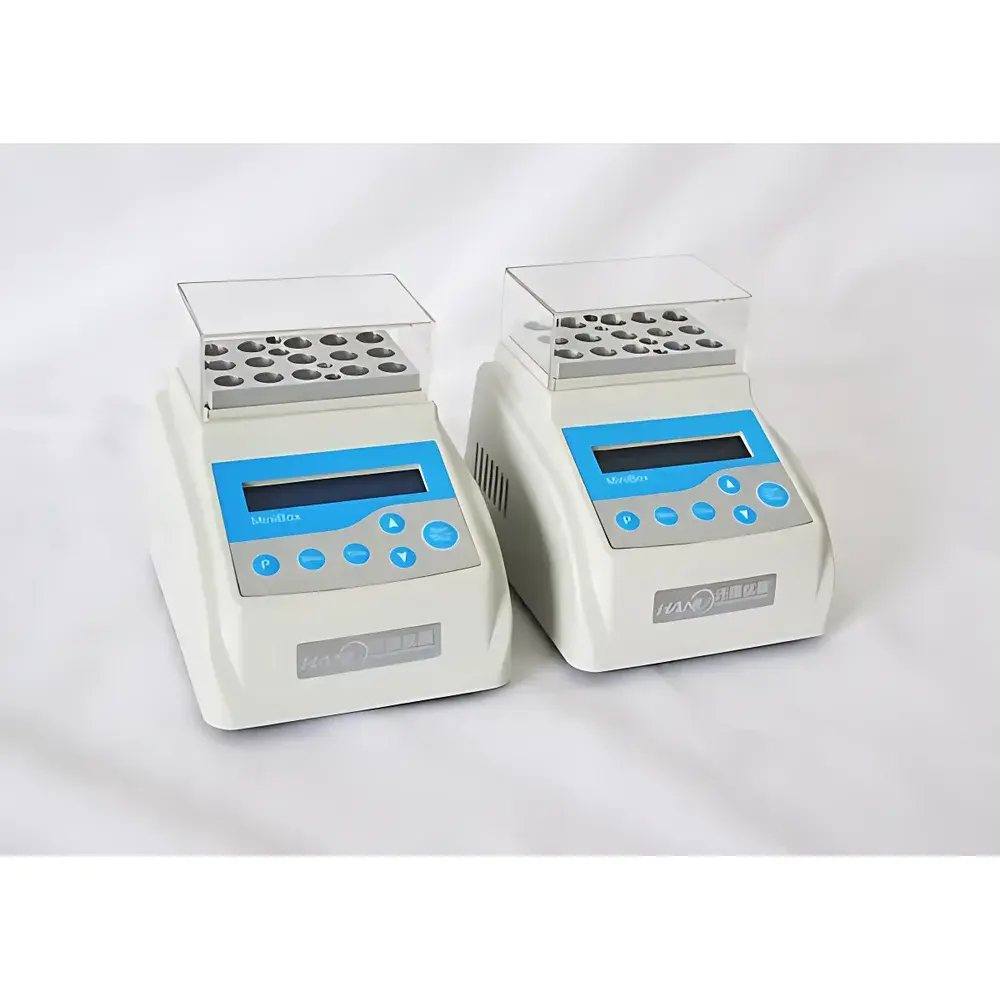
Hanuo MINIC-100 Refrigerated Compact Metal Block Heater
| Brand | Hanuo |
|---|---|
| Model | MINIC-100 |
| Temperature Range | 0–100 °C |
| Temperature Accuracy | ±0.3 °C |
| Heating Time (25 °C → 100 °C) | ≤20 min |
| Cooling Time (100 °C → 25 °C) | ≤20 min |
| Cooling Time (RT → RT−15 °C) | ≤25 min |
| Block Uniformity | ±0.3 °C |
| Display Resolution | 0.1 °C |
| Timer Range | 1 s–99 min 59 s or ∞ / 1 min–99 h 59 min or ∞ |
| Power Supply | AC 100–240 V, 50–60 Hz |
| Dimensions | 145 × 113 × 140 mm |
| Net Weight | 1.8 kg |
| Safety Certification | CE-compliant |
| Module Options | Mini-A (15 × 2.0 mL), Mini-B (15 × 1.5 mL), Mini-C (24 × 0.5 mL), Mini-D (32 × 0.2 mL) |
Overview
The Hanuo MINIC-100 is a compact, refrigerated metal block heater engineered for precise thermal control in space-constrained and mobile laboratory environments. Unlike traditional water baths or larger dry-block systems, the MINIC-100 integrates Peltier-based active cooling with PID-controlled resistive heating within a single aluminum alloy heating block—enabling bidirectional temperature regulation from 0 °C to 100 °C, including sub-ambient operation down to 15 °C below ambient. Its thermally optimized block architecture ensures rapid thermal response and minimal spatial gradient across the sample zone. Designed for applications requiring strict thermal reproducibility—such as enzyme inactivation, serum coagulation, DNA denaturation prior to PCR, and pre-electrophoresis sample conditioning—the MINIC-100 delivers consistent thermal profiles without fluid media, eliminating contamination risks and evaporation artifacts associated with water baths.
Key Features
- Compact footprint (145 × 113 × 140 mm) and lightweight design (1.8 kg) for benchtop, field, or vehicle-mounted deployment.
- PID-fuzzy logic control algorithm ensuring ±0.3 °C temperature accuracy and ≤±0.3 °C block uniformity across all operating points.
- Integrated thermoelectric (Peltier) cooling module enabling sub-ambient operation—critical for heat-sensitive sample stabilization and cold-start protocols.
- Five programmable temperature/time setpoints with up to 99-cycle repeat functionality for multi-step thermal protocols (e.g., hot-start PCR prep, sequential incubation-cooling).
- Dual timer modes: high-resolution (1-second increments) for short-duration reactions and extended-hour mode (up to 99 h 59 min) for overnight assays.
- Intelligent power management with auto-restart after power interruption and configurable “power-on auto-run” mode for unattended operation.
- Transparent polycarbonate insulation cover allows real-time visual monitoring without compromising thermal integrity or safety.
- Ergonomic, heat-resistant module handle enables safe, tool-free block exchange—even at elevated temperatures—minimizing workflow disruption.
- Comprehensive safety architecture: over-temperature cutoff, short-circuit protection, ground-fault detection, and thermal fuse redundancy—all compliant with CE marking requirements per EN 61010-1:2010.
Sample Compatibility & Compliance
The MINIC-100 supports standardized microcentrifuge tube formats via interchangeable aluminum blocks: Mini-A (15 × 2.0 mL), Mini-B (15 × 1.5 mL), Mini-C (24 × 0.5 mL), and Mini-D (32 × 0.2 mL). All blocks are CNC-machined for dimensional repeatability and optimal thermal coupling. The system meets IEC/EN 61010-1 safety standards for laboratory electrical equipment and conforms to electromagnetic compatibility (EMC) directives (EN 61326-1). While not inherently 21 CFR Part 11–compliant, its audit-ready operational logs (when used with optional RS232/USB data export) support GLP/GMP-aligned documentation practices. It is routinely deployed in QC labs performing ASTM D5296 (polymer molecular weight analysis), USP sterility test incubation prep, and ISO 15197 blood glucose assay calibration workflows requiring defined thermal preconditioning.
Software & Data Management
The MINIC-100 operates via an intuitive front-panel interface with dual-line LCD display (0.1 °C resolution) and tactile membrane keys. Optional PC connectivity via RS232 or USB enables remote parameter configuration, real-time temperature logging, and protocol archiving using Hanuo’s validated LabControl Suite v3.2. Exported CSV files include timestamped block temperature, setpoint, elapsed time, and alarm status—facilitating traceability in regulated environments. Audit trail features record user-initiated changes (e.g., setpoint modification, timer reset), supporting compliance with ALCOA+ data integrity principles. Firmware updates are performed offline via USB stick, preserving instrument uptime during validation maintenance cycles.
Applications
- Pre-PCR thermal denaturation of DNA templates (95 °C for 5 min) and hot-start enzyme activation.
- Serum clotting assays (37 °C incubation followed by 4 °C hold) in clinical chemistry labs.
- Enzyme kinetic studies requiring precise thermal ramping between reaction steps.
- Sample equilibration prior to HPLC injection or mass spectrometry analysis.
- Field-deployable nucleic acid extraction workflows aboard research vessels or mobile diagnostic units.
- Quality control testing of temperature-sensitive reagents (e.g., restriction enzymes, ligases) under ISO/IEC 17025-accredited conditions.
FAQ
Does the MINIC-100 support continuous operation at 4 °C?
Yes—the refrigeration system maintains stable 4 °C storage indefinitely, with automatic compensation for ambient fluctuations up to 35 °C.
Can multiple temperature ramps be programmed sequentially?
Yes—up to five discrete setpoints can be chained with independent dwell times; cycling up to 99 times is supported.
Is the unit suitable for use in a biosafety cabinet?
Yes—its low electromagnetic emissions, absence of moving parts, and compact form factor allow safe integration into Class II A2 cabinets.
What is the expected service life of the Peltier module?
Rated for ≥50,000 hours of cumulative operation under standard lab conditions (25 °C ambient, 50% duty cycle).
Are calibration certificates available?
NIST-traceable factory calibration reports (including block uniformity mapping at 4 °C, 37 °C, and 95 °C) are provided with each unit; on-site verification services are available upon request.



