
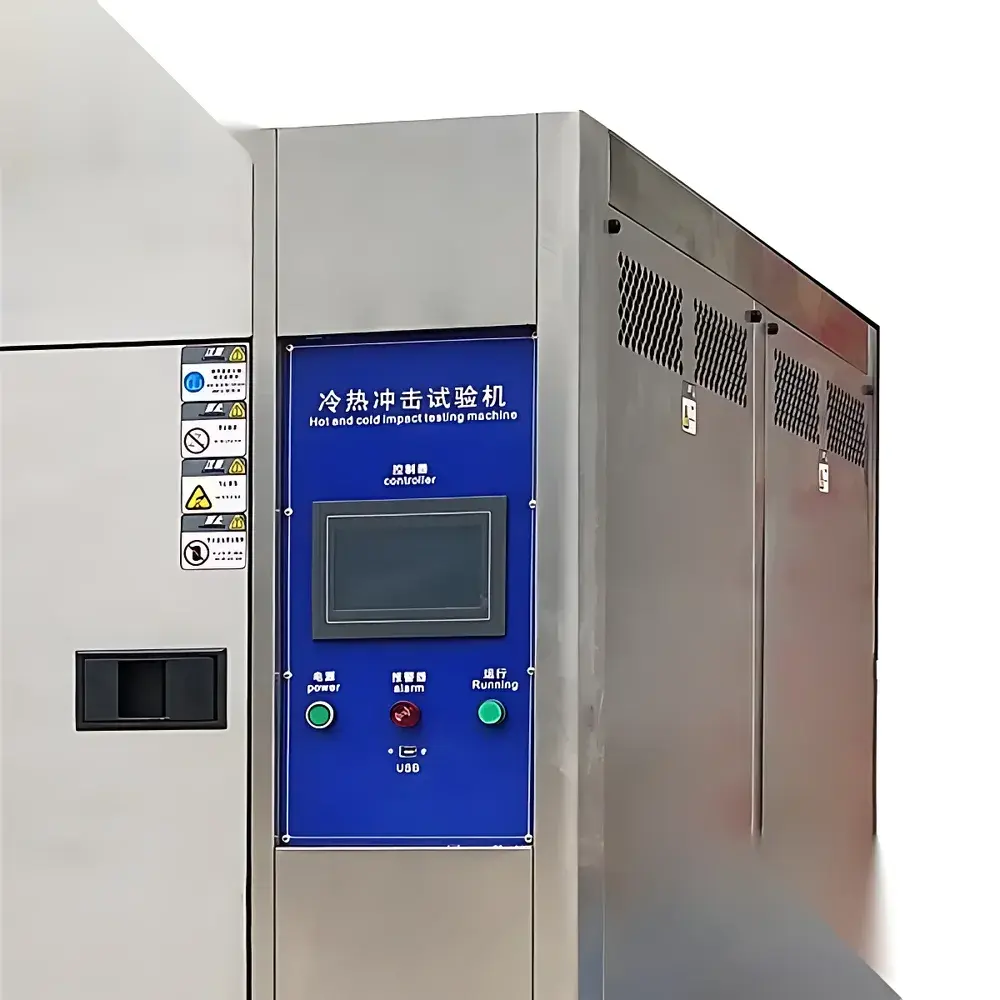
English Product Name
| Brand | OEM / Private Label |
|---|---|
| Origin | Imported |
| Manufacturer Type | Authorized Distributor |
| Power Supply | AC220V±10% 50Hz / AC380V±10% 50Hz |
| Operating Ambient Temperature | +5°C to +35°C |
| Temperature Range (A/B/C) | −20°C to +100°C / −40°C to +100°C / −60°C to +100°C |
| Temperature Uniformity | ≤ ±2.0°C |
| Temperature Stability | ≤ ±0.5°C |
| Temperature Deviation | ≤ ±2.0°C |
| Heating Rate | ≥3°C/min |
| Cooling Rate | 0.7–1.0°C/min |
| Refrigeration System | Air-Cooled Single-Stage Mechanical Compression |
| Compressor | Hermetic Industrial Scroll Compressor |
| Controller | Intelligent PID-Based Digital Temperature Controller |
| Internal Chamber Material | SUS304 Stainless Steel |
| Compliance | GB10589, GB11158, GB10586, IEC 60068-3-5, GB/T 2423-1/2/3/4 |
Overview
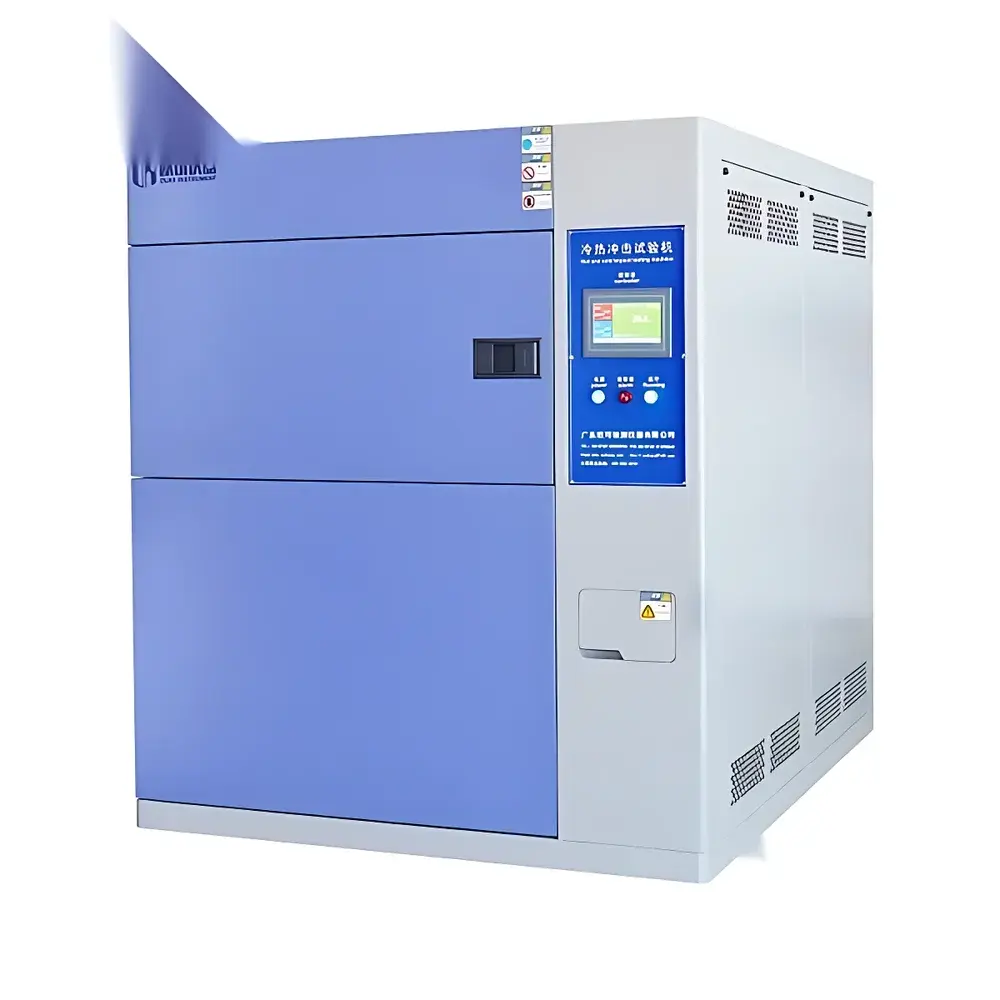
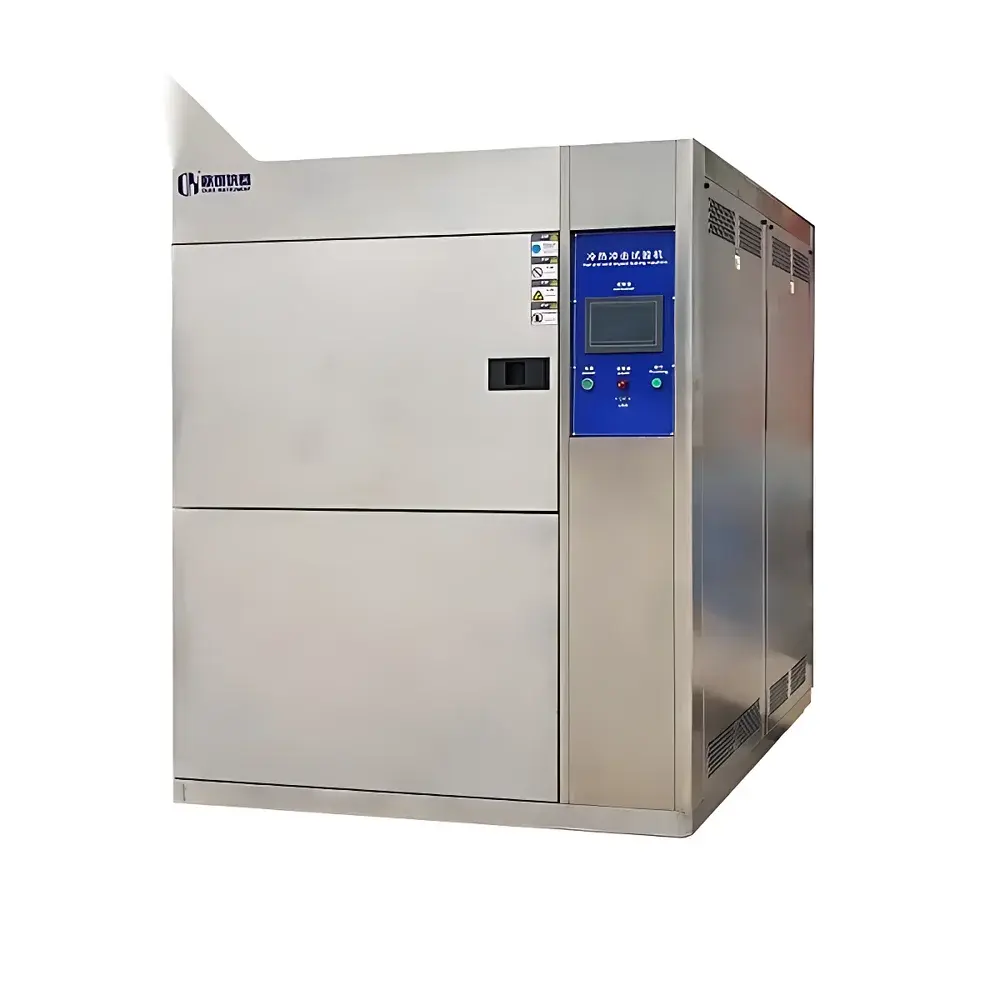
The OK-TS Series Pneumatic Thermal Shock Test Chamber is an engineered environmental simulation system designed for rapid, repeatable thermal cycling between extreme low and high temperature zones. Unlike liquid-based or mechanical transfer systems, this chamber employs a pneumatically actuated dual-chamber architecture—featuring separate hot and cold zones with high-speed air transfer valves—to achieve precise, contamination-free thermal shock exposure. It operates on the principle of accelerated thermal stress induction, enabling evaluation of material integrity, solder joint reliability, coating adhesion, and electronic component failure mechanisms under abrupt temperature transitions. The system conforms to internationally recognized test standards including IEC 60068-2-14 (Test N: Change of Temperature), GB/T 2423.22 (Environmental Testing – Part 2: Tests – Test N: Change of Temperature), and supports qualification testing per MIL-STD-810H Method 503.5. Its robust construction and calibrated thermal performance make it suitable for R&D labs, quality assurance departments, and third-party certification facilities requiring traceable, GLP-aligned environmental validation.
Key Features
- High-speed pneumatic transfer mechanism ensures rapid specimen transition (< 10 s) between independently controlled hot and cold chambers, minimizing dwell time and maximizing thermal gradient fidelity.
- Optimized airflow distribution via multi-directional vane-assisted wind tunnels achieves uniform temperature distribution (≤ ±2.0°C) across the entire working volume, validated per IEC 60068-3-5.
- Hermetically sealed industrial scroll compressors—sourced from European OEM suppliers—deliver stable refrigeration output with low acoustic emission (< 65 dB(A)) and extended service life under continuous duty cycles.
- SUS304 stainless steel interior chamber and insulated double-wall construction prevent condensation buildup, corrosion, and thermal bridging—critical for long-term repeatability in humidity-capable configurations.
- Dual-stage safety architecture includes independent overtemperature cutoff (mechanical backup), compressor thermal overload protection, fan motor overheat monitoring, and real-time refrigerant pressure surveillance.
- Intelligent digital controller with 0.1°C resolution, auto-tuning PID algorithms, and programmable ramp-soak profiles supports up to 99 cycles with timestamped event logging.
Sample Compatibility & Compliance
The OK-TS series accommodates a broad range of sample geometries—from PCB assemblies and automotive sensors to polymer housings and aerospace fasteners—within internal volumes spanning 49 L to 900 L. All models are certified to meet national and international environmental test standard requirements: GB10589 (Low-Temperature Test Chambers), GB11158 (High-Temperature Test Chambers), GB10586 (Damp Heat Test Chambers), and IEC 60068-3-5 (Methods for Determining the Performance of Environmental Test Chambers). For regulated industries, the system supports audit-ready documentation packages aligned with ISO/IEC 17025, and optional validation protocols (IQ/OQ/PQ) can be executed per GMP Annex 15 and FDA 21 CFR Part 11-compliant data integrity frameworks.
Software & Data Management
Equipped with a Windows-compatible communication interface (RS485/Modbus RTU or optional Ethernet TCP/IP), the chamber integrates seamlessly into centralized laboratory information management systems (LIMS) and MES platforms. The embedded controller logs all critical parameters—including chamber setpoints, actual temperatures, valve actuation timestamps, and alarm events—with automatic CSV export capability. Optional PC-based software provides graphical cycle visualization, statistical process control (SPC) charting, deviation alerts, and electronic signature support for 21 CFR Part 11 compliance. Audit trails retain immutable records of user actions, parameter changes, and calibration history for regulatory review.
Applications
This thermal shock chamber is routinely deployed in electronics reliability engineering for JEDEC JESD22-A104 qualification of integrated circuits; in automotive Tier-1 supplier labs for ISO 16750-4 environmental stress screening; in medical device manufacturing for ISO 14971 risk analysis of sterilization-resistant components; and in academic materials science research for investigating phase transition kinetics in shape-memory alloys and thermoplastic composites. Its consistent thermal response and documented uncertainty budgets support comparative studies across laboratories participating in inter-laboratory proficiency testing schemes.
FAQ
What is the difference between pneumatic thermal shock and mechanical lift-type shock chambers?
Pneumatic systems use compressed air to rapidly open/close isolation valves between hot and cold zones, eliminating moving parts that contact samples—reducing mechanical wear, vibration coupling, and cross-contamination risks.
Can this chamber perform humidity-controlled thermal shock tests?
Yes—models configured with humidification modules comply with GB10586 and IEC 60068-2-30 (Damp Heat, Cycle), enabling combined temperature-humidity shock protocols.
Is calibration traceability available for this system?
Standard configuration includes factory calibration with NIST-traceable reference sensors; on-site calibration services and uncertainty budgets are available upon request.
What maintenance intervals are recommended for the refrigeration system?
Compressor oil and filter replacement every 12 months; annual verification of refrigerant charge, insulation integrity, and valve actuation timing is advised for ISO/IEC 17025 compliance.
Does the controller support remote monitoring and alarm notification?
Yes—via optional Ethernet module with SMTP email/SMS alerting, Modbus TCP integration, and web-based dashboard access using standard HTTP authentication.



