
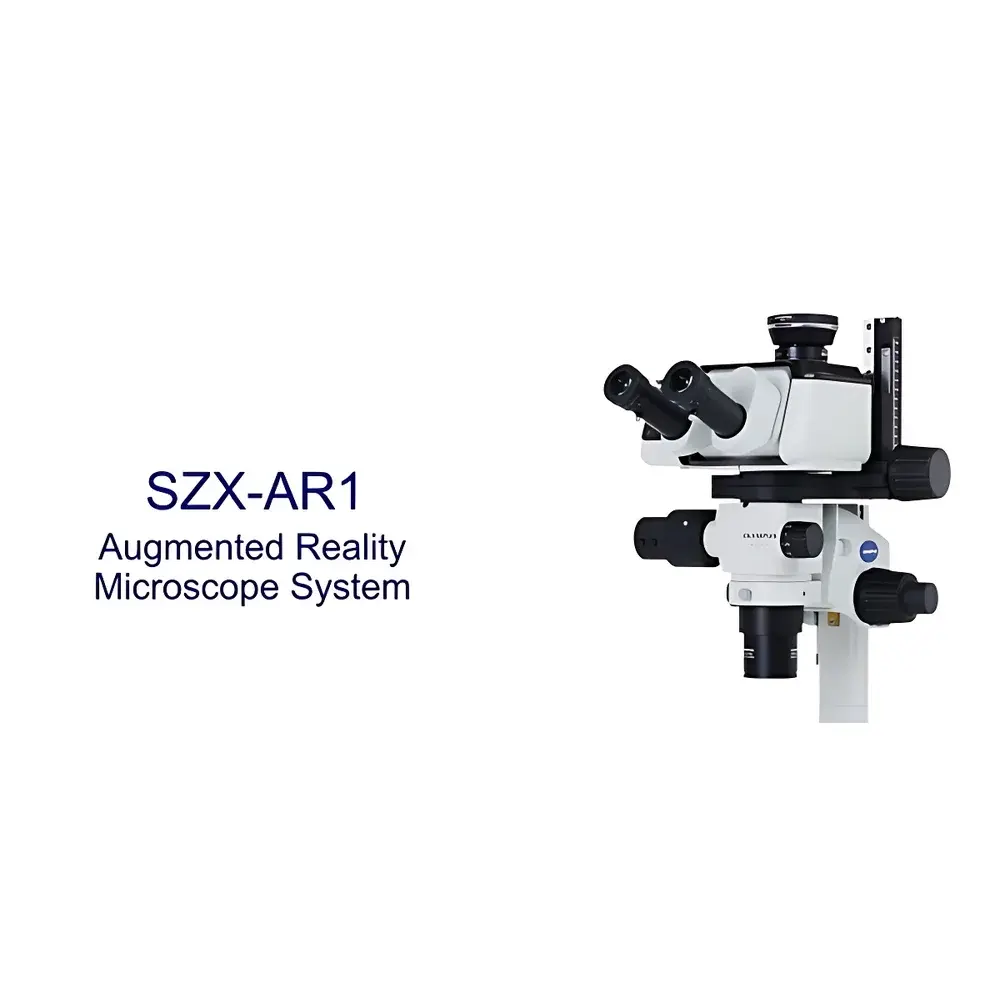
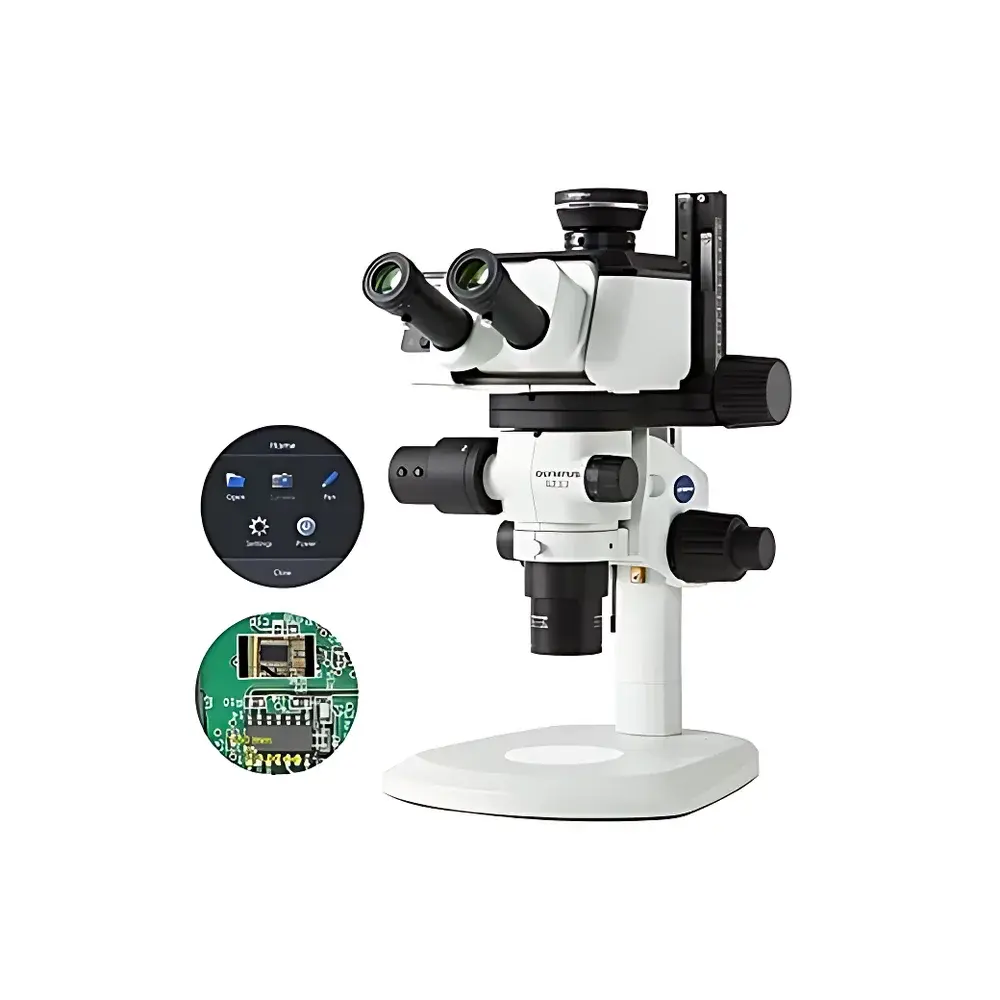
Olympus SZX-AR1 Augmented Reality Stereo Microscope System
| Brand | Olympus |
|---|---|
| Origin | Japan |
| Manufacturer | Olympus Corporation |
| Product Category | Imported Instrument |
| Model | SZX-AR1 |
| Total Magnification | Contact for specification |
| Zoom Ratio | Contact for specification |
| Field Diameter | Contact for specification |
| Working Distance | Contact for specification |
| Objective Type | Modular stereo objective system (compatible with SZX series) |
| Illumination Type | Integrated LED illumination (dual-arm or ring-light options available) |
| Depth of Field | Optimized for extended DOF at low-to-mid magnifications |
| Numerical Aperture | Configurable per objective (typical range: 0.05–0.15) |
Overview
The Olympus SZX-AR1 Augmented Reality Stereo Microscope System is an engineered integration module designed to transform existing Olympus SZX-series stereo microscopes into intelligent, context-aware visualization platforms. Unlike conventional optical augmentation solutions, the SZX-AR1 operates on a precision-aligned optical overlay architecture—projecting digital annotations, procedural overlays, and real-time collaborative feeds directly into the user’s binocular field of view without compromising native optical resolution, parallax fidelity, or ergonomic posture. Built upon the mechanical and optical integrity of the SZX platform—including its Greenough optical path, modular zoom body, and interchangeable objectives—the AR1 module introduces a calibrated, non-invasive beam-combining interface that maintains full compatibility with all standard SZX accessories, including transmitted light bases, polarizers, and fluorescence modules. Its primary operational domain spans high-mix, low-volume manufacturing environments where manual microscopic assembly, inspection, and verification remain indispensable—particularly in medical device assembly, microelectronics packaging, precision optics alignment, and regulated R&D prototyping.
Key Features
- Optically registered AR overlay: Pixel-accurate projection aligned to the microscope’s optical axis with sub-arcminute angular stability across zoom and focus adjustments.
- Zero-occlusion dual-path viewing: Simultaneous presentation of native stereoscopic image and semitransparent digital layer; no loss of depth perception or contrast.
- Real-time collaboration interface: Native support for Microsoft Teams, Zoom, and WebRTC-based streaming—enabling remote expert guidance with synchronized viewport annotation.
- Procedure-driven workflow engine: Import and execute step-by-step SOPs (Standard Operating Procedures) as layered instructions—text, vector graphics, measurement crosshairs, scale bars, and time-stamped video clips—all anchored to specimen coordinates.
- Modular hardware integration: Installs without modification to the host SZX microscope; retains full functionality of trinocular port, camera output, and illumination controls.
- Ergonomic continuity: Fully compatible with Olympus’ ergonomic accessories—including tilting trinocular tubes, eye-point adjusters, and height-adjustable stands—ensuring sustained operator comfort during extended tasks.
Sample Compatibility & Compliance
The SZX-AR1 supports all sample types routinely examined under SZX-series stereo microscopes: opaque, translucent, and reflective specimens up to 150 mm in height (subject to working distance constraints of installed objective). It complies with ISO 10934-1 (stereomicroscope performance standards), IEC 61000-6-3 (EMC emissions), and IEC 62366-1 (usability engineering for medical devices). When deployed in FDA-regulated environments (e.g., Class II/III device manufacturing), the system supports audit-ready documentation through optional integration with validated electronic logbook software compliant with 21 CFR Part 11 requirements—including electronic signatures, change tracking, and secure data export. All firmware updates undergo version-controlled release validation per ISO 13485:2016 Annex A guidelines.
Software & Data Management
The SZX-AR1 operates with Olympus’ proprietary AR Studio software suite—a Windows-based application supporting offline SOP authoring, calibration validation reports, and encrypted session logging. AR Studio generates tamper-evident .arlog files containing timestamped metadata (user ID, microscope configuration, zoom/focus positions, annotation timestamps, and stream hash values). Export formats include PDF (for training records), CSV (for process metric analysis), and MP4 (for reviewable procedure playback). Optional API access enables integration with MES (Manufacturing Execution Systems) and LIMS platforms via RESTful endpoints, allowing automated trigger-based instruction loading based on part number or batch ID.
Applications
- Medical device assembly: Real-time overlay of torque specifications, solder joint acceptance criteria (per IPC-A-610), and component orientation markers during catheter hub bonding or PCB flex connector placement.
- Microelectronics rework: Guided wire-bonding sequences with dynamic crosshair alignment, thermal drift compensation, and pass/fail visual cues tied to AOI (Automated Optical Inspection) reference images.
- Regulatory training: GLP-compliant onboarding workflows with embedded knowledge checks, competency scoring, and automatic certificate generation upon SOP completion.
- Failure analysis labs: Remote expert-led root-cause investigation using live viewport sharing, synchronized annotation, and side-by-side comparison against reference defect libraries.
- Academic microscopy education: Interactive curriculum delivery with instructor-controlled annotation layers, student response capture, and anonymized performance analytics.
FAQ
Is the SZX-AR1 compatible with all generations of the SZX stereo microscope series?
Yes—the AR1 module interfaces mechanically and optically with SZX7, SZX10, SZX12, SZX16, and SZX-ILLB base configurations. Adapter kits are provided for legacy trinocular ports manufactured prior to 2015.
Does the AR overlay affect optical resolution or color fidelity?
No. The beam-combiner design preserves the full MTF (Modulation Transfer Function) of the native optical path. Chromatic aberration and luminance uniformity remain within OEM specifications per ISO 9335.
Can AR content be authored offline and deployed without network connectivity?
Yes. AR Studio supports fully offline authoring, local deployment via USB drive, and execution in air-gapped environments. No cloud dependency is required for core functionality.
How is calibration maintained over time and after maintenance?
Each unit ships with a NIST-traceable calibration certificate. Recalibration is performed using the built-in auto-alignment routine and verified via the included test target set (ISO 19906-compliant). Calibration logs are stored internally and exportable.
What cybersecurity measures are implemented in the AR Studio software?
AR Studio employs TLS 1.3 encryption for all external communications, AES-256 encryption for local session logs, and role-based access control (RBAC) with AD/LDAP integration support. All binaries are digitally signed and verified at runtime.






