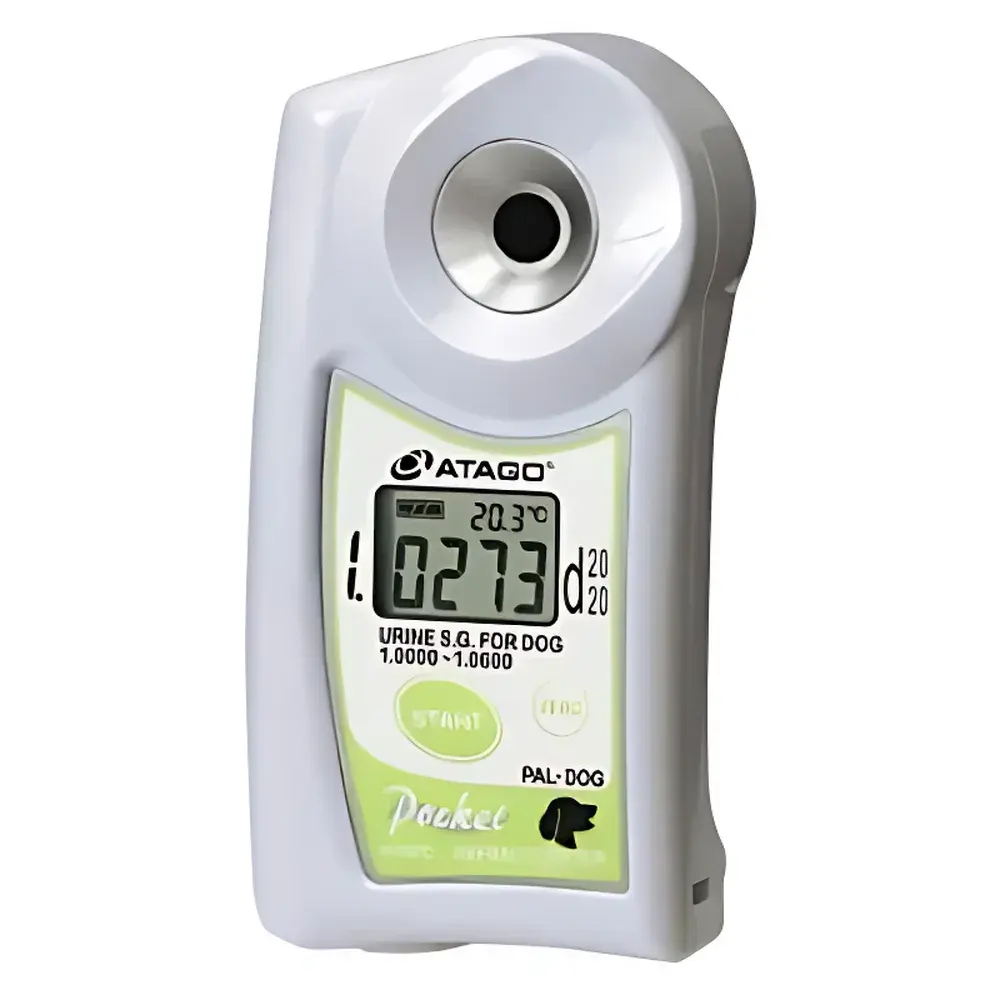
ATAGO PAL-DOG Canine Urine Specific Gravity Refractometer
| Brand | ATAGO |
|---|---|
| Origin | Japan |
| Model | PAL-DOG |
| Measurement Range | 1.0000–1.0600 SG |
| Resolution | 0.0001 |
| Accuracy | ±0.0010 |
| Temperature Compensation | Automatic, 10–35°C |
| Sample Volume | 0.3 mL |
| Measurement Time | 3 seconds |
| Power Supply | 2 × AAA batteries |
| Ingress Protection Rating | IP65 |
| Dimensions | 55(W) × 31(D) × 109(H) mm |
| Weight | 100 g (without accessories) |
Overview
The ATAGO PAL-DOG Canine Urine Specific Gravity Refractometer is a handheld, optical precision instrument engineered exclusively for veterinary clinical assessment of urine specific gravity (USG) in dogs. It operates on the principle of critical-angle refractometry: light passing through a urine sample undergoes refraction proportional to solute concentration, enabling direct quantification of USG without chemical reagents or calibration curves. Designed for point-of-care use in veterinary clinics, emergency hospitals, and mobile practice settings, the PAL-DOG delivers rapid, repeatable measurements within a clinically relevant range (1.0000–1.0600), optimized to detect subtle shifts in renal concentrating ability—critical for evaluating dehydration status, chronic kidney disease progression, diabetes insipidus, and post-therapeutic monitoring. Its compact form factor, battery-powered operation, and robust IP65-rated enclosure ensure reliable performance under demanding clinical conditions while maintaining full compliance with ISO 15197:2013 general requirements for in vitro diagnostic medical devices used in animal health.
Key Features
- Canine-specific optical calibration: Factory-calibrated using canine urine matrix standards to minimize matrix effect bias common in generic refractometers.
- High-resolution digital display: 0.0001 resolution enables detection of minute USG variations—essential for serial monitoring of glomerular filtration rate (GFR) proxies and tubular function.
- Automatic temperature compensation (ATC): Integrated thermistor corrects readings across 10–35°C ambient and sample temperatures, eliminating manual correction tables and reducing inter-operator variability.
- Minimal sample requirement: Only 0.3 mL of uncentrifuged, fresh urine required—compatible with cystocentesis, free-catch, or catheterized samples.
- Rapid acquisition: Stable reading achieved in ≤3 seconds after sample application, supporting high-throughput triage workflows.
- Dust- and water-resistant housing (IP65): Withstands routine disinfection protocols, accidental splashes, and transport in field kits without degradation of optical path integrity.
- Low-power design: Operates continuously for >10,000 measurements on two standard AAA alkaline batteries; no charging infrastructure required.
Sample Compatibility & Compliance
The PAL-DOG is validated for use with native canine urine specimens—including those containing moderate levels of protein (up to 300 mg/dL), glucose (≤2,000 mg/dL), and bilirubin—without significant interference. Hematuria or pyuria at clinically typical concentrations does not affect refractive index-based USG determination. The device meets essential requirements of Regulation (EU) 2017/746 (IVDR) for Class A in vitro diagnostic medical devices intended for veterinary use. Its measurement traceability aligns with NIST-traceable reference solutions, and documentation supports GLP-compliant recordkeeping when integrated into laboratory quality management systems per ISO/IEC 17025:2017 Annex A.3.
Software & Data Management
As a standalone analog-digital hybrid instrument, the PAL-DOG does not incorporate onboard data logging or wireless connectivity. However, its consistent output format (four-decimal SG value) enables seamless manual transcription into electronic health records (EHR), practice management software (e.g., IDEXX Cornerstone, Covetrus Pulse), or spreadsheet-based longitudinal tracking templates. For facilities requiring audit-ready documentation, optional third-party barcode scanners or dedicated veterinary data capture tablets may be deployed alongside the PAL-DOG to timestamp and geotag each measurement—supporting FDA 21 CFR Part 11–aligned electronic record integrity where applicable.
Applications
- Early-stage renal dysfunction screening during wellness exams in geriatric and at-risk breeds (e.g., Cocker Spaniels, Bull Terriers).
- Dynamic assessment of hydration status pre- and post-anesthesia or fluid therapy.
- Monitoring response to diuretic administration in congestive heart failure or protein-losing nephropathy.
- Differentiating prerenal azotemia from intrinsic renal disease via serial USG trends paired with serum creatinine.
- Supporting differential diagnosis of polyuria-polydipsia (PU/PD) syndromes including hyperadrenocorticism and central diabetes insipidus.
- Quality control verification of automated urinalysis platforms when discordant dipstick SG results occur.
FAQ
Is the PAL-DOG suitable for feline or equine urine analysis?
No. The optical calibration curve is derived exclusively from canine urine osmolality correlations; use in other species introduces systematic bias beyond ±0.0020 SG.
Does hemoglobinuria or myoglobinuria interfere with measurement?
Neither pigment significantly alters refractive index at concentrations observed in clinical canine cases; however, grossly turbid samples should be centrifuged prior to analysis.
How often does the instrument require recalibration?
ATAGO recommends annual verification against certified reference standards (e.g., ATAGO SR-1.020); field recalibration is not user-serviceable due to sealed prism assembly.
Can the PAL-DOG be sterilized using autoclave or ethylene oxide?
No. Autoclaving exceeds thermal limits; EO sterilization is incompatible with internal electronics. Wipe disinfection with 70% isopropyl alcohol is approved.
What is the shelf life of the instrument under storage conditions?
When stored at 5–30°C and 30–80% RH with batteries removed, functional longevity exceeds 10 years per ATAGO’s accelerated aging validation protocol.