
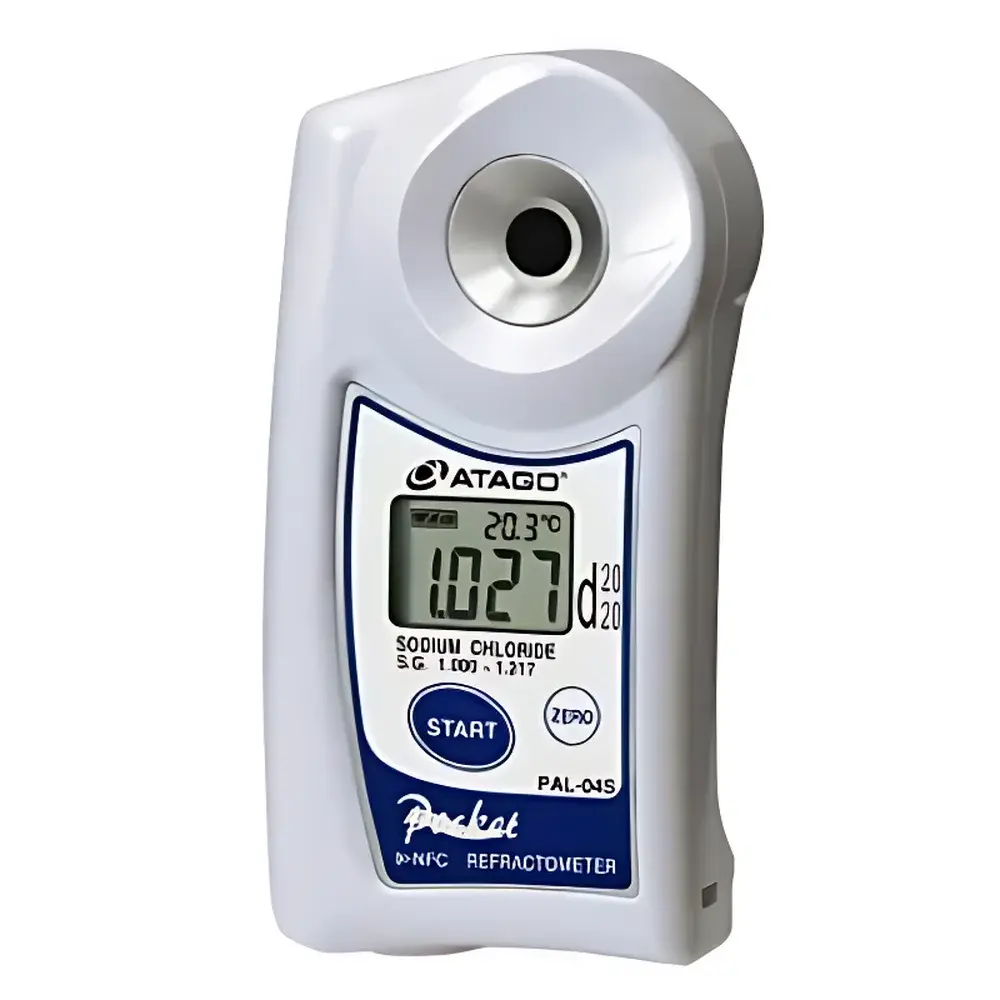
ATAGO PAL-04S Portable Sodium Chloride Refractometer
| Brand | ATAGO |
|---|---|
| Origin | Japan |
| Model | PAL-04S |
| Measuring Principle | Abbe Refraction |
| NaCl Range | 1.000–1.217 (specific gravity, 20 °C reference) |
| Accuracy | ±0.001–±0.002 SG |
| Automatic Temperature Compensation (ATC) | 10–40 °C |
| Response Time | ≤3 s |
| Display | Digital LCD |
| Application Scope | Aqueous NaCl solutions including seawater, brine, de-icing agents, and pickling liquors |
Overview
The ATAGO PAL-04S Portable Sodium Chloride Refractometer is a precision optical instrument engineered for rapid, field-deployable quantification of sodium chloride concentration in aqueous solutions via the principle of critical-angle refractometry. Based on the Abbe refractometer design, it measures the specific gravity (SG) of NaCl solutions—directly correlated to mass fraction under standardized conditions—by analyzing the angular deviation of monochromatic light as it transitions from prism to sample medium. Calibrated against NIST-traceable NaCl standards at 20 °C, the PAL-04S delivers traceable, repeatable readings without requiring reagent addition, solvent evaporation, or electrical conductivity assumptions. Its compact, handheld architecture integrates a temperature-compensated sapphire prism and high-stability LED light source, enabling reliable operation across variable ambient conditions typical of marine, industrial, and municipal environments.
Key Features
- Optical measurement principle ensures immunity to ionic interference—unaffected by presence of K⁺, Ca²⁺, Mg²⁺, or other non-NaCl solutes commonly found in natural brines or process streams
- Integrated Automatic Temperature Compensation (ATC) spanning 10–40 °C eliminates manual correction and maintains calibration integrity across seasonal or operational thermal gradients
- Digital LCD display with backlight provides unambiguous, high-contrast readout of specific gravity (1.000–1.217 SG) in ≤3 seconds after sample application
- Robust anodized aluminum housing rated IP65 for dust and water resistance—suitable for outdoor deployment, shipboard use, and wet-process environments
- No battery replacement required during standard operation; powered by energy-efficient LED illumination with >10,000-hour service life
- Prism surface fabricated from synthetic sapphire (Mohs hardness 9) for scratch resistance and long-term optical fidelity
Sample Compatibility & Compliance
The PAL-04S is validated for homogeneous, non-turbid aqueous NaCl solutions—including seawater (typical SG ≈ 1.025), saturated brine (up to ~26 wt% NaCl, SG ≈ 1.200), road de-icing solutions, food-grade pickling brines, and electrolyte recovery streams. It is not suitable for emulsions, suspensions, viscous glycol mixtures, or solutions containing volatile organics that may evaporate during measurement. While not certified to ISO/IEC 17025 for accredited testing, the instrument conforms to JIS Z 8014 (Japanese Industrial Standard for refractometers) and supports GLP-compliant documentation when paired with ATAGO’s optional data logging accessories. Its measurement traceability aligns with ASTM D1193 Type IV water purity specifications for reference solution preparation.
Software & Data Management
The PAL-04S operates as a standalone optical sensor with no embedded firmware or connectivity interfaces. For audit-ready recordkeeping, users may pair it with ATAGO’s PAL-Print portable thermal printer (sold separately) to generate timestamped, hard-copy reports compliant with internal quality control protocols. When integrated into laboratory workflows, manual entry of SG values into LIMS or Excel-based tracking systems satisfies FDA 21 CFR Part 11 requirements for electronic records—provided institutional SOPs define validation procedures for transcription accuracy and reviewer sign-off. No proprietary software installation or cloud synchronization is involved, minimizing cybersecurity exposure and IT infrastructure dependencies.
Applications
- Marine operations: Real-time verification of ballast water salinity prior to discharge per IMO Ballast Water Management Convention guidelines
- Food processing: Monitoring brine concentration during vegetable fermentation, meat curing, and dairy whey desalination
- Winter maintenance: Quantitative assessment of NaCl-based de-icer concentration in storage tanks and spray systems to ensure efficacy below eutectic temperature (−21 °C)
- Chemical manufacturing: In-process control of NaCl crystallization endpoints in chlor-alkali or salt purification units
- Aquaculture: Routine checks of hatchery seawater dilution ratios and recirculating system salinity stability
- Academic teaching labs: Demonstrating colligative properties, refractive index–concentration relationships, and calibration methodology per undergraduate physical chemistry curricula
FAQ
What does the specific gravity range 1.000–1.217 correspond to in wt% NaCl?
At 20 °C, this SG range corresponds approximately to 0–26.4 wt% NaCl, based on IAPWS-formulated density tables for aqueous NaCl solutions.
Can the PAL-04S measure other salts such as CaCl₂ or KCl?
No—it is factory-calibrated exclusively for NaCl/water systems. Using it for other solutes introduces systematic bias due to differing partial molar volumes and refractive increments.
Is periodic recalibration required?
Yes—ATAGO recommends daily verification with distilled water (SG = 1.000) and a secondary standard (e.g., 10 wt% NaCl reference solution) before critical measurements, per ISO 8655-6 guidance for volumetric calibration traceability.
How should the prism be cleaned between samples?
Rinse thoroughly with distilled water, then gently wipe with lens tissue—never use acetone, ethanol, or abrasive cloths, which may degrade the anti-reflective coating or scratch sapphire.
Does ATC compensate for sample temperature or ambient temperature?
The ATC sensor measures the actual temperature of the prism-sample interface, providing real-time compensation based on the physical dispersion curve of NaCl solutions—not ambient air temperature.




