
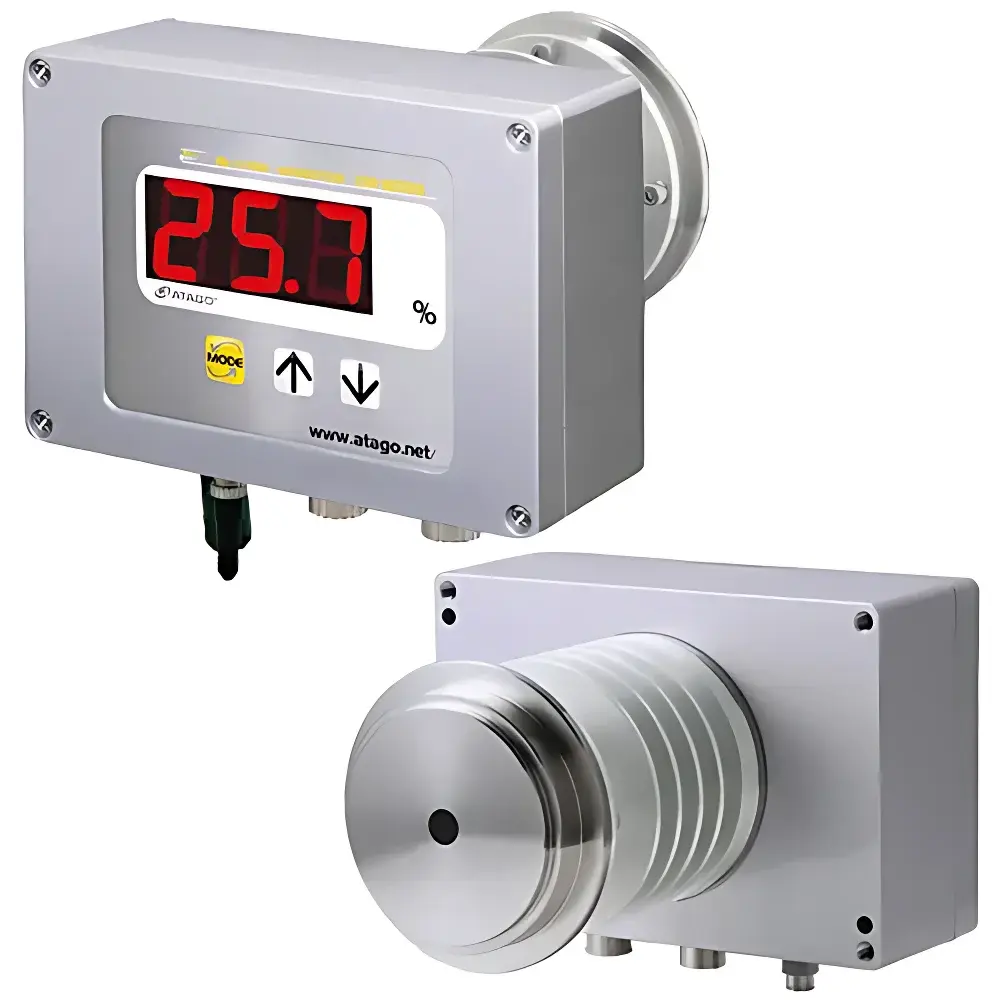
ATAGO CM-800α-NaOH Online Refractometer for Sodium Hydroxide Concentration Monitoring
| Brand | ATAGO |
|---|---|
| Origin | Japan |
| Model | CM-800α-NaOH |
| Product Type | In-line Refractometer |
| Temperature Control | Yes |
| Digital Display | Yes |
| Measurement Range | 0.0–38.0% (w/w NaOH) |
| Accuracy | ±0.2% (w/w) |
| Temperature Range | −15 to 160°C |
| Temperature Compensation | Automatic (10–35°C) |
| Output | 4–20 mA & RS-232C |
| IP Rating | IP67 |
| Prism Material | Synthetic Sapphire |
| Housing Material | SUS316L |
| Dimensions | 160 × 167 × 110 mm |
| Weight | 2.4 kg |
| Power Supply | DC 24 V (AC 100 V optional with AD-32 adapter) |
Overview
The ATAGO CM-800α-NaOH is a high-stability, in-line process refractometer engineered for continuous, real-time measurement of sodium hydroxide (NaOH) concentration in industrial liquid streams. It operates on the principle of critical-angle refractometry—measuring the refractive index (RI) of the solution at near-sodium-D-line wavelength (~589 nm) using an LED light source—and converts RI to NaOH mass fraction (w/w %) via a factory-calibrated, chemically specific algorithm. Designed for direct integration into production pipelines—including L-type and straight-tube configurations—the instrument delivers rapid, non-invasive concentration monitoring without sample extraction or reagent consumption. Its robust optical architecture ensures long-term stability under thermal cycling and mechanical vibration typical in chemical, pulp & paper, textile, and water treatment environments. The built-in automatic temperature compensation (ATC) function corrects for thermal drift across the 10–35°C process temperature range, maintaining metrological integrity even during transient operating conditions.
Key Features
- Chemically optimized calibration for NaOH solutions: Validated across 0.0–38.0% w/w, with guaranteed accuracy of ±0.2% w/w within the 0.0–20% range at 10–30°C ambient
- High-reliability optical path: Synthetic sapphire prism (Mohs hardness 9) bonded to SUS316L wetted housing for corrosion resistance against concentrated alkaline media
- True in-line operation: No flow cell, no bypass loop—installed directly in pipe with standard flange or sanitary clamp mounting options
- Dual-output interface: Simultaneous analog (4–20 mA, HART-compatible) and digital (RS-232C) outputs; RS-232 supports configurable data format (refractive index, % w/w, or temperature)
- Programmable measurement interval: Default 1-second cycle, adjustable to five user-defined intervals (1 s to 60 s) to align with process dynamics
- IP67-rated enclosure: Sealed against dust ingress and temporary immersion, suitable for washdown and humid industrial zones
- Low-maintenance design: No consumables, no moving parts, no optical alignment required over service life
Sample Compatibility & Compliance
The CM-800α-NaOH is validated for homogeneous aqueous NaOH solutions containing no suspended solids, emulsions, or opaque particulates that would scatter incident light. It is not intended for slurries, viscous gels, or multi-phase systems. Applications include caustic cleaning solutions, kraft pulping liquors, mercerization baths, petroleum refining caustic wash streams, and ion exchange regeneration brines. From a regulatory standpoint, the instrument supports compliance with Good Manufacturing Practice (GMP) and GLP frameworks by enabling traceable, time-stamped concentration records. While the device itself does not carry FDA 21 CFR Part 11 certification, its analog and serial outputs integrate seamlessly with validated SCADA/DCS systems that implement electronic signature, audit trail, and data integrity controls per ISO/IEC 17025 and ASTM D1193 (reagent water specifications).
Software & Data Management
Data acquisition is handled externally via the 4–20 mA signal (compatible with PLCs, DCS, or PID controllers) or through RS-232C serial communication using ASCII protocol. ATAGO provides PC-based configuration software (RefractoLink™) for initial setup, calibration verification, and output mapping—though routine operation requires no host computer. All measurements are timestamped internally and retain full resolution (0.1% w/w, 1°C). For enterprise-level integration, users commonly route the 4–20 mA output to historians such as OSIsoft PI or AspenTech IP.21, where concentration trends, deviation alerts, and statistical process control (SPC) charts are generated. The absence of internal storage eliminates concerns about data retention policies or firmware-level security vulnerabilities.
Applications
- Pulp & Paper: Real-time monitoring of white liquor (NaOH + Na₂S) strength in kraft recovery cycles to optimize delignification efficiency and reduce chemical overfeed
- Textile Processing: Control of NaOH concentration in cotton mercerization baths to ensure consistent fiber swelling, luster development, and dye uptake uniformity
- Chemical Cleaning: Closed-loop dosing control of caustic cleaning-in-place (CIP) solutions for food, pharma, and biotech equipment, ensuring validated removal of organic residues
- Water & Wastewater: Precise feed-forward control of NaOH addition for pH adjustment and heavy metal precipitation in tertiary treatment stages
- Petroleum Refining: Verification of caustic wash concentration used to remove acidic contaminants (e.g., H₂S, mercaptans) from hydrocarbon streams
- Food & Beverage: Monitoring of NaOH concentration during equipment sanitation cycles and starch processing, aligned with GB 2920-1996 and Codex Alimentarius guidelines
FAQ
Does the CM-800α-NaOH require periodic recalibration?
No—factory calibration is stable over time. However, users should perform annual verification using certified NaOH reference standards traceable to NIST or JCSS.
Can it measure other alkaline solutions, such as KOH or Na₂CO₃?
No. The algorithm and calibration curve are exclusively optimized for NaOH/water systems. Using it for other solutes introduces unquantified systematic error.
Is the sensor compatible with high-pressure pipelines?
Yes—when installed with appropriate pressure-rated flanges, it withstands static line pressures up to 1.0 MPa (145 psi) at 20°C, per ASME B16.5 Class 150 rating.
How is temperature measured, and where is the sensor located?
A Pt100 RTD is embedded in the prism mount, measuring bulk fluid temperature at the optical interface—not ambient air—to ensure accurate ATC.
What maintenance is required during normal operation?
Only periodic visual inspection of the sapphire window for fouling; cleaning with deionized water and lint-free cloth if deposits occur. No optical recalibration or alignment is needed.




