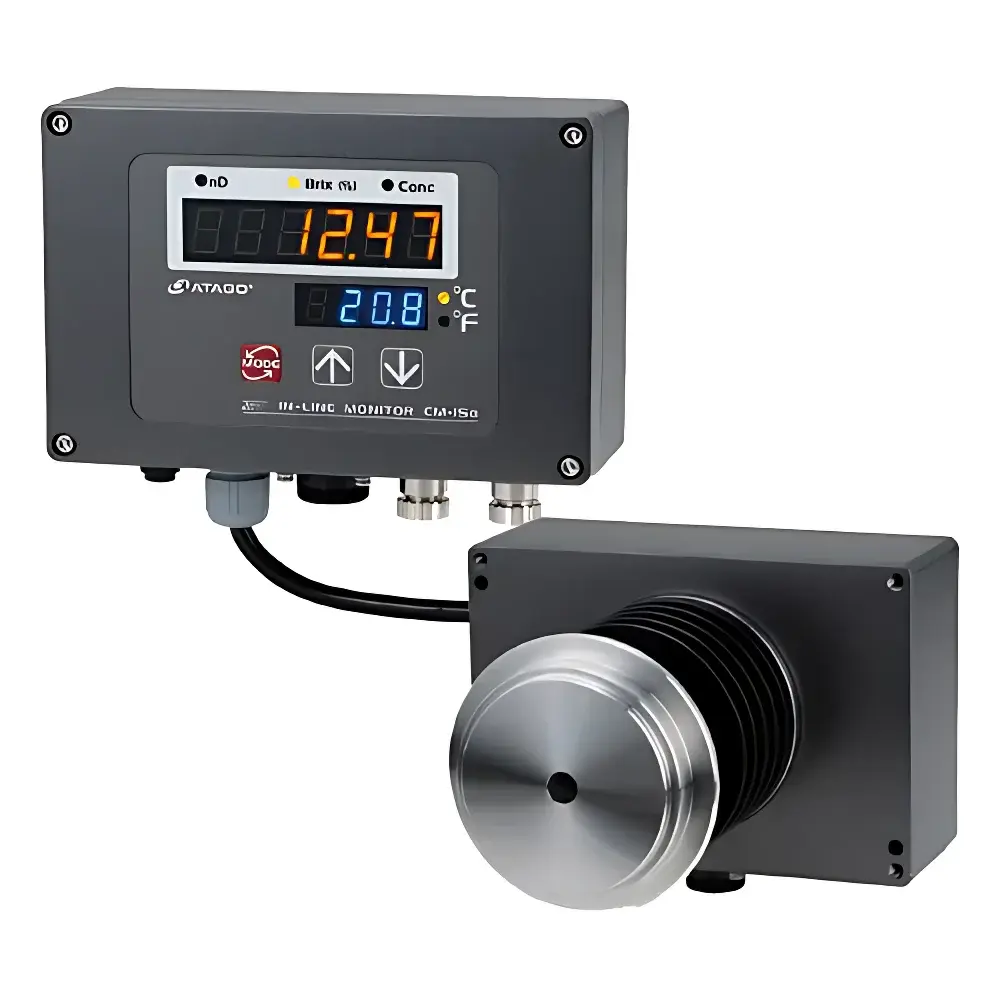

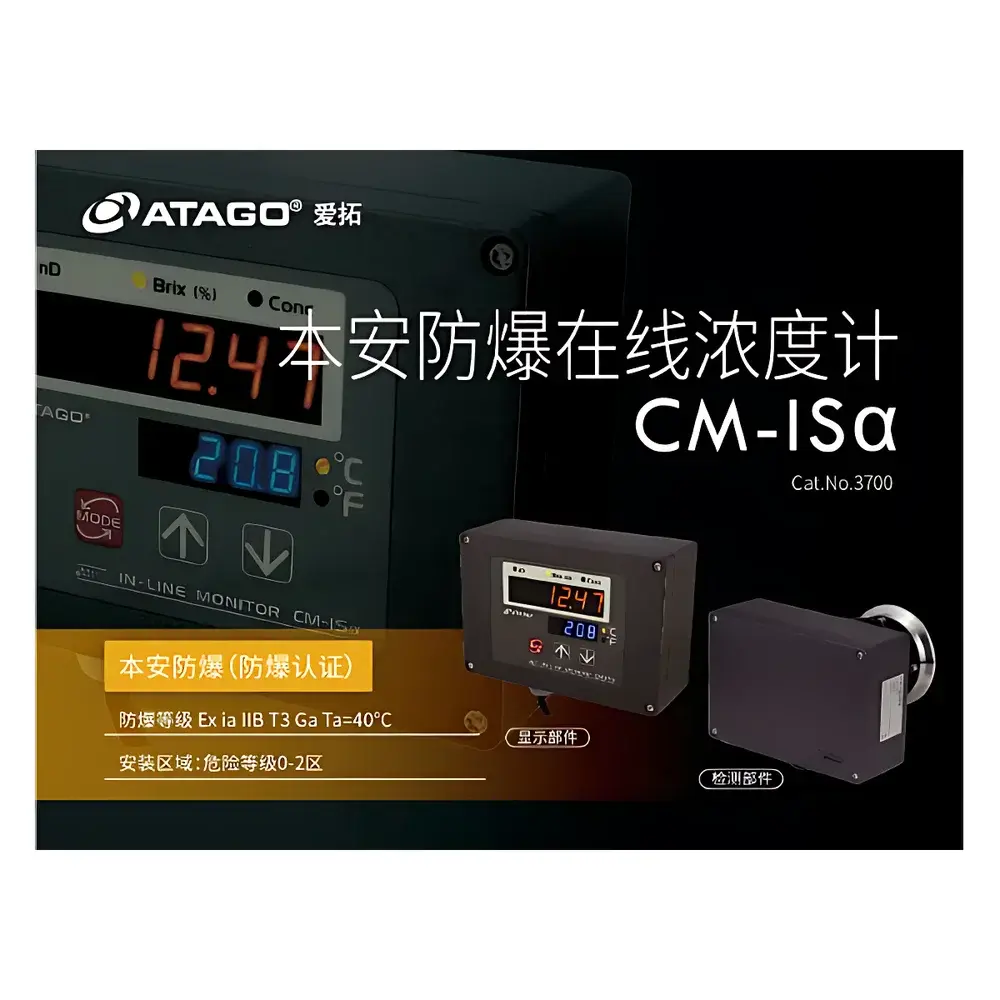
ATAGO CM-ISα Intrinsically Safe Ethanol Online Refractometer
| Brand | ATAGO |
|---|---|
| Origin | Japan |
| Model | CM-ISα |
| Measurement Range | Brix 0.0–80.0%, Refractive Index (nD) 1.32000–1.49100 |
| Resolution | Brix 0.01% or 0.1%, Refractive Index 0.00001 or 0.0001 |
| Accuracy | Brix ±0.1%, Refractive Index ±0.0002 |
| Temperature Control Range | 5–100°C |
| Intrinsic Safety Rating | Ex ia IIB T3 Ga TA |
| Output | DC 4–20 mA or RS-232C |
| Power Supply | DC 24 V |
| Temperature Compensation Range | 5–100°C |
Overview
The ATAGO CM-ISα Intrinsically Safe Ethanol Online Refractometer is an industrial-grade, real-time process analyzer engineered for continuous, non-invasive concentration monitoring in hazardous environments where flammable vapors—particularly ethanol—are present. It operates on the principle of critical-angle refractometry: a collimated light beam passes through the process liquid in direct contact with a sapphire prism; the angle at which total internal reflection occurs is precisely measured and converted into refractive index (nD), from which Brix (% soluble solids), ethanol concentration (wt% or vol%), and temperature-corrected process values are derived. Unlike optical absorption or conductivity methods, refractometry is inherently insensitive to sample color, turbidity, suspended solids, or minor particulate load—making it uniquely suited for fermentation broths, crude distillates, solvent blends, and aggressive chemical streams. The CM-ISα is certified to Ex ia IIB T3 Ga TA, indicating intrinsic safety for Zone 0/1 gas group IIB (including ethanol, acetone, and IPA) with a maximum surface temperature of ≤75°C under fault conditions—ensuring operational integrity without explosion risk.
Key Features
- Intrinsically safe design compliant with IEC 60079-0, IEC 60079-11, and ATEX/IECEx directives for Zone 0 installation.
- High-precision sapphire measuring prism with chemical resistance to strong acids, alkalis, alcohols, and organic solvents—including 95% ethanol, DMF, DMSO, NMP, and H2O2.
- Real-time dual-output capability: analog 4–20 mA (HART optional) for PLC/DCS integration and digital RS-232C for local diagnostics, calibration logging, and firmware updates.
- Integrated Peltier-based temperature control (5–100°C) with ±0.1°C stability, enabling precise automatic temperature compensation (ATC) per ISO 21748 and ASTM D1218 standards.
- Configurable resolution modes: 0.00001 nD / 0.01% Brix for R&D-grade accuracy or 0.0001 nD / 0.1% Brix for high-speed industrial control loops.
- Robust stainless steel (SS316L) wetted parts and IP67-rated electronics housing rated for washdown and corrosive ambient conditions.
Sample Compatibility & Compliance
The CM-ISα maintains measurement fidelity across diverse process media including aqueous ethanol solutions (0–100% v/v), fermentation liquors, pharmaceutical solvent mixtures, semiconductor cleaning baths, and wastewater effluents. Its optical method eliminates interference from dye additives, yeast biomass, colloidal haze, or emulsified oils—common challenges in bioethanol production and biopharmaceutical downstream processing. Regulatory alignment includes support for 21 CFR Part 11-compliant data audit trails when integrated with ATAGO’s optional PC-based configuration software; calibration records, timestamped measurements, and operator ID logging meet GLP/GMP documentation requirements. The device conforms to EN 14113 for alcohol concentration determination in fuel-grade ethanol and supports validation protocols aligned with USP , EP 2.2.37, and ISO 21527-1 for microbial process monitoring.
Software & Data Management
Configuration, calibration, and diagnostics are managed via ATAGO’s Windows-compatible CM-Series Setup Utility, which provides password-protected access levels (operator, engineer, administrator). All measurement parameters—including nD, Brix, concentration curves (user-defined or preloaded for ethanol/water, NaOH, HCl, etc.), and ATC coefficients—are stored in non-volatile memory with write-cycle protection. The system logs up to 10,000 timestamped readings with millisecond resolution and supports CSV export for LIMS or MES integration. Optional Modbus RTU/TCP gateway modules enable seamless communication with Rockwell, Siemens, and Yokogawa DCS platforms. Calibration verification routines include built-in reference checks using NIST-traceable sucrose or ethanol standard solutions, with deviation alerts triggered if drift exceeds ±0.0001 nD over 24 h.
Applications
- Biofuel Production: Continuous monitoring of ethanol concentration in beer column sidestreams, rectifier overheads, and hydrous/anhydrous product lines—enabling dynamic reflux ratio control and energy optimization.
- Pharmaceutical Manufacturing: In-line verification of ethanol/water ratios in extraction solvents, tablet coating suspensions, and sterilant formulations per pharmacopeial monographs.
- Semiconductor Wet Processing: Real-time tracking of H2O2/H2SO4 (Piranha), NH4OH/H2O2/H2O (SC-1), and HF-based etchants to maintain bath consistency and prevent wafer defects.
- Chemical Synthesis: Closed-loop control of alcoholysis reactions, esterification endpoints, and solvent recovery columns involving IPA, methanol, or butanol.
- Food & Beverage: Verification of alcohol content in spirits, wine must, and flavored alcoholic beverages during blending and dilution—supporting label compliance and batch release.
FAQ
What does “Ex ia IIB T3 Ga TA” certification mean for installation?
It certifies that the CM-ISα is intrinsically safe for use in Zone 0 (continuous hazard) and Zone 1 (likely hazard) areas with Group IIB gases (e.g., ethylene, acetone, ethanol), with a maximum surface temperature of 75°C (T3) and suitability for ambient temperatures down to –20°C (TA designation).
Can the CM-ISα measure pure ethanol or only aqueous solutions?
Yes—it is calibrated and validated for the full ethanol/water binary system (0–100% v/v) and supports user-defined concentration curves for non-aqueous solvents such as ethanol/IPA or ethanol/ethyl acetate mixtures.
Is temperature control mandatory for accurate readings?
While automatic temperature compensation (ATC) is active across 5–100°C, active Peltier-based thermal stabilization is recommended for processes with rapid ambient fluctuations (>±2°C/min) or where ±0.05% Brix repeatability is required.
How often does the instrument require recalibration?
Under stable process conditions, annual verification against traceable standards suffices; however, daily zero-checks with deionized water and weekly span checks with certified ethanol standards are recommended for GMP-regulated operations.
Does the CM-ISα support custom concentration units beyond Brix and nD?
Yes—up to five user-defined concentration equations (polynomial or linear) can be programmed, enabling direct output in wt%, vol%, mol/L, or specific gravity for proprietary formulations.