
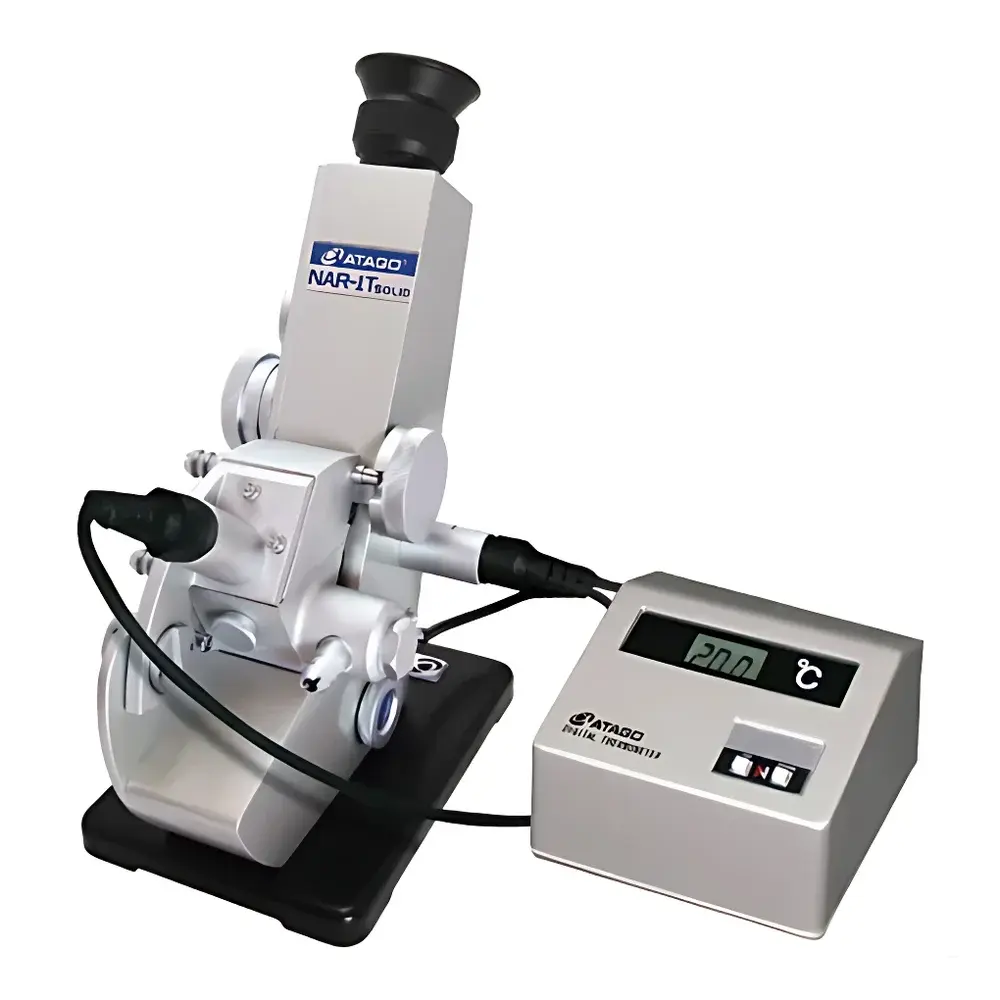
ATAGO NAR-1T-LO Low-Index Abbe Refractometer
| Brand | ATAGO |
|---|---|
| Origin | Japan |
| Model | NAR-1T-LO (Low Refractive Index) |
| Type | Benchtop Abbe Refractometer |
| Measurement Range | 1.1500–1.4800 nD |
| Accuracy | ±0.0002 nD |
| Resolution | 0.001 nD |
| Light Source | LED (D-line equivalent, ~589.3 nm) |
| Temperature Range | 5–50 °C |
| Power Supply | AC 100–240 V, 50/60 Hz |
| Power Consumption | 5 VA |
| Dimensions (Main Unit) | 13 × 18 × 23 cm |
| Weight (Main Unit) | 1.8 kg |
| Dimensions (Optional Temperature Display Unit) | 10 × 11 × 7 cm |
| Weight (Temperature Display Unit) | 0.5 kg |
Overview
The ATAGO NAR-1T-LO Low-Index Abbe Refractometer is a precision optical instrument engineered for the accurate determination of refractive index (nD) across an extended low-to-mid range—specifically 1.1500 to 1.4800—using the classical Abbe principle. Based on critical-angle measurement at the sample-prism interface under monochromatic illumination (LED source spectrally centered near the sodium D-line at 589.3 nm), this benchtop refractometer delivers high reproducibility and long-term stability without reliance on electronic digital readout or active temperature control. Its mechanical-optical architecture ensures minimal drift and insensitivity to ambient electromagnetic interference—critical for laboratories operating under GLP-compliant workflows or conducting method validation per ISO 17025 requirements. Designed for routine characterization of optically transparent and semi-transparent media, the NAR-1T-LO supports fundamental optical metrology in R&D, quality assurance, and teaching environments where traceable, operator-independent measurements are essential.
Key Features
- Extended low-index measurement capability (1.1500–1.4800 nD), optimized for fluids and solids with sub-1.30 refractive indices—such as liquid CO2 (nD ≈ 1.2000), liquid nitrogen (nD ≈ 1.2053), and MgF2-based thin films (nD ≈ 1.378–1.390)
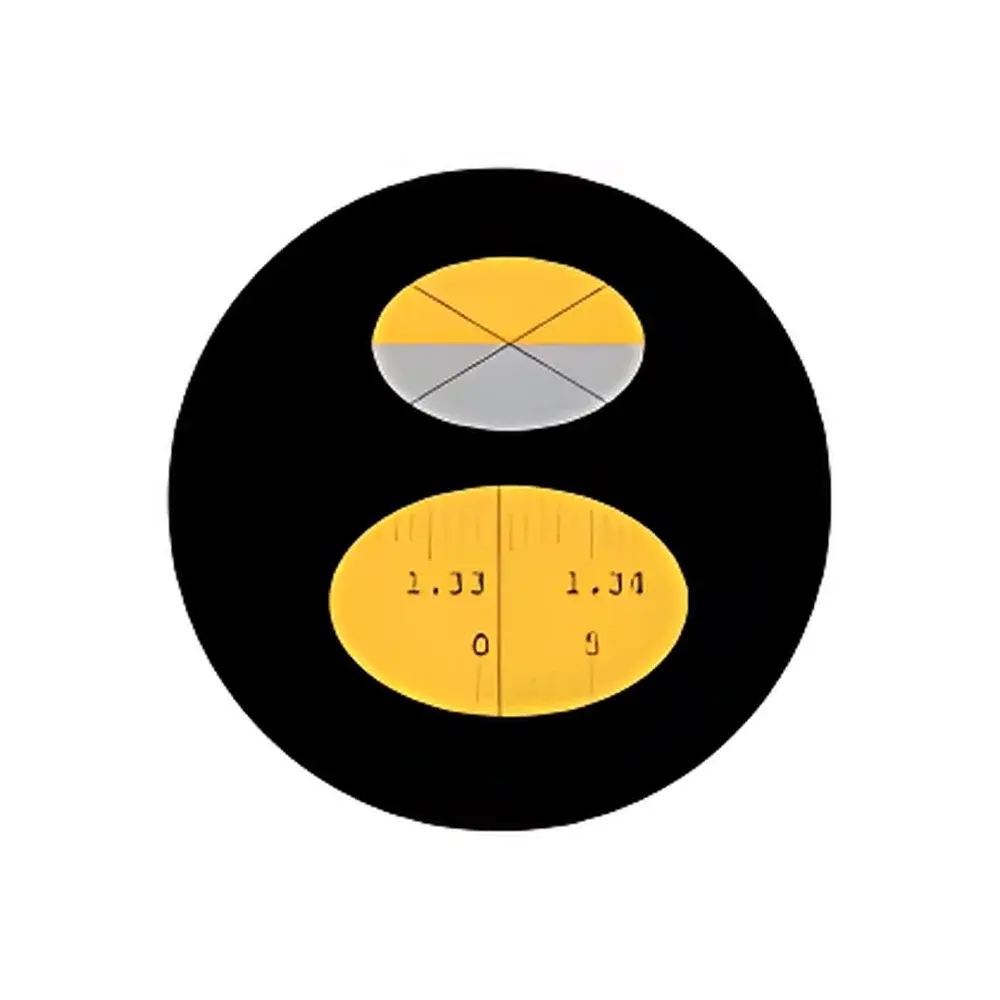
- Mechanical analog scale with vernier eyepiece for direct visual reading; resolution of 0.001 nD and certified accuracy of ±0.0002 nD against NIST-traceable standards
- High-stability glass prism assembly with anti-reflective coating and precisely controlled thermal mass to minimize short-term thermal hysteresis
- Integrated LED light source providing stable, D-line–equivalent illumination without warm-up delay or spectral drift over time
- Benchtop form factor (13 × 18 × 23 cm, 1.8 kg) with optional external temperature display unit (10 × 11 × 7 cm, 0.5 kg) for manual correlation of sample temperature during non-controlled measurements
- No internal electronics in the optical path—ensuring immunity to EMI, zero firmware dependency, and compliance with legacy instrumentation audit trails required in regulated pharmaceutical and academic settings
Sample Compatibility & Compliance
The NAR-1T-LO accommodates both liquid and solid samples—including low-viscosity solvents, cryogenic liquids (when handled within its 5–50 °C operational envelope), optical coatings, polymer films, and rigid transparent materials such as fused silica, acrylic, and polycarbonate substrates. Its wide aperture and adjustable sample stage facilitate uniform contact with irregular or thin-film specimens. While not equipped with Peltier-based thermostatic control, the instrument’s thermal design enables stable readings over periods up to 15 minutes under ambient laboratory conditions (±1 °C). It conforms to ASTM D1218 and ISO 1042 standards for refractive index measurement methodology, and its mechanical calibration protocol aligns with ISO/IEC 17025 clause 6.5.2 for reference standard traceability. For applications requiring regulatory documentation, the absence of software-based data handling simplifies 21 CFR Part 11 compliance when paired with manual logbook recording.
Software & Data Management
The NAR-1T-LO operates entirely without embedded firmware or proprietary software. All measurements are recorded manually via the calibrated scale and verified using the built-in vernier. This analog-first architecture eliminates cybersecurity risks, software obsolescence, and validation overhead associated with digital instruments. Users may integrate readings into LIMS or ELN systems through standardized manual entry protocols. Optional third-party temperature monitoring devices (e.g., calibrated Pt100 probes) can be used alongside the external temperature display unit to document thermal context per USP guidelines for optical property verification. No drivers, SDKs, or cloud connectivity are provided or required.
Applications
- Characterization of low-nD immersion media for high-NA microscopy and adaptive optics
- Quality control of fluorinated solvents and specialty gases in liquefied phase for semiconductor cleaning processes
- Verification of anti-reflective coating thickness and composition on photovoltaic glass and display substrates
- Teaching fundamental optical physics concepts—including dispersion analysis, Snell’s law validation, and critical angle derivation—in university physics and materials science laboratories
- Batch consistency testing of polymer resins and encapsulants used in LED packaging and fiber optic coupling
- Supporting ASTM D4052 density-to-refractive-index correlation studies in petrochemical QA workflows
FAQ
Does the NAR-1T-LO support automatic temperature compensation (ATC)?
No. The instrument does not incorporate ATC; users must record sample temperature separately and apply empirical correction factors if required by application-specific standards.
Can it measure opaque or highly scattering samples?
No. The Abbe principle requires optical transparency at the prism-sample interface; turbid, milky, or strongly absorbing samples will yield indeterminate or erroneous readings.
Is calibration traceable to national standards?
Yes. ATAGO provides factory calibration certificates referencing NIST-traceable reference liquids (e.g., bromonaphthalene, distilled water) with documented uncertainty budgets per ISO/IEC 17025.
What maintenance is required?
Routine cleaning of the prism surface with lens-grade tissue and reagent-grade ethanol; annual verification against certified reference standards is recommended for ISO 17025-accredited labs.
Is the LED light source replaceable by the user?
Yes. The LED module is field-replaceable using standard M3 screws and requires no recalibration upon replacement.




