
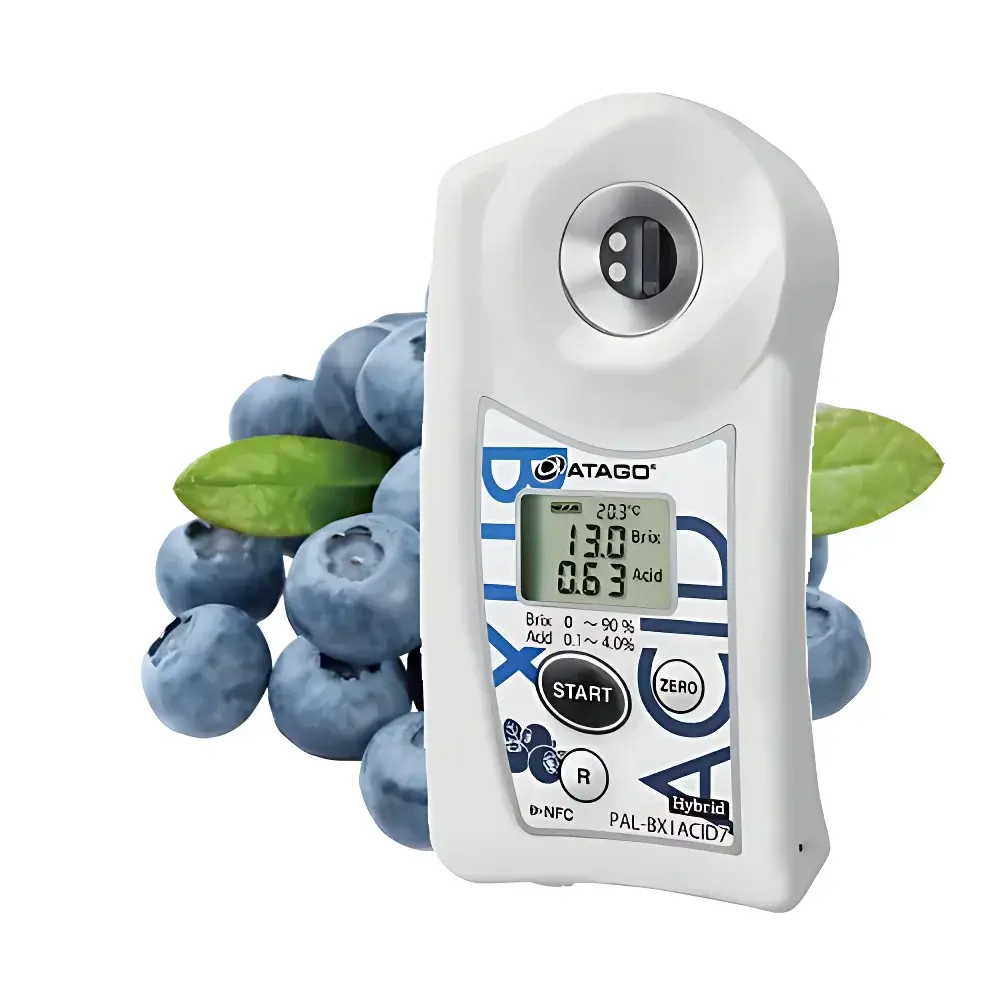
ATAGO PAL-BX/ACID 7 Blueberry Brix & Acidity Meter
| Brand | ATAGO |
|---|---|
| Origin | Japan |
| Model | PAL-BX/ACID 7 |
| Instrument Type | Portable |
| Measurement Parameters | Dual (Brix and Total Acidity as Citric Acid) |
| Brix Range | 0.0–90.0% |
| Acidity Range | 0.10–4.00% (as citric acid) |
| Brix Resolution | 0.1% |
| Acidity Resolution | 0.01% |
| Brix Accuracy | ±0.2% |
| Acidity Accuracy | ±0.10% (0.10–1.00%), ±10% relative (1.01–4.00%) |
| Temperature Compensation | 10–40°C |
| IP Rating | IP65 |
| Dimensions | 5.5 × 3.1 × 10.9 cm |
| Weight | 100 g (host only) |
| Power | 2 × AAA alkaline batteries |
Overview
The ATAGO PAL-BX/ACID 7 Blueberry Brix & Acidity Meter is a handheld, dual-parameter refractometric analyzer engineered for rapid, on-site quantification of soluble solids content (Brix) and total titratable acidity (expressed as citric acid equivalent) in fresh blueberries and processed blueberry products. Unlike conventional benchtop titration systems requiring reagents, glassware, and trained personnel, the PAL-BX/ACID 7 integrates Abbe-type optical refractometry with proprietary temperature-compensated algorithms to deliver simultaneous Brix and acidity measurements from a single, minimally prepared sample. Its core measurement principle relies on the correlation between refractive index and sugar concentration, combined with a validated empirical calibration curve linking refractive index shift under dilution to citric acid concentration—enabling direct acid estimation without chemical titration. This approach satisfies routine quality control needs across harvest assessment, post-harvest sorting, processing validation, and sensory correlation studies where real-time sugar-acid balance evaluation is critical.
Key Features
- Integrated dual-parameter measurement: Simultaneous Brix (0.0–90.0%) and total acidity (0.10–4.00% as citric acid) in one instrument cycle
- One-touch sugar-acid ratio calculation: Pressing the “R” key automatically computes and displays the dimensionless sugar-acid ratio (Brix ÷ % acidity), a key indicator of flavor balance and physiological maturity
- Offset curve correction function: Enables alignment of instrument readings with reference methods (e.g., AOAC 973.18 titration) or alternate reporting units via user-defined calibration offsets—essential for method equivalence validation in GLP environments
- Rugged, field-deployable design: IP65-rated enclosure ensures resistance to dust ingress and low-pressure water jets; compact form factor (5.5 × 3.1 × 10.9 cm) and lightweight construction (100 g) support extended use in orchards, packing houses, and cold storage facilities
- Automatic temperature compensation (ATC): Built-in thermistor corrects for sample temperature variations across 10–40°C, minimizing operator-induced error and ensuring repeatability without external thermostatic control
- Low-sample preparation protocol: Brix requires direct juice expression; acidity determination uses standardized 1:50 (w/v) dilution with distilled water—eliminating organic solvents, hazardous reagents, and multi-step extraction procedures
Sample Compatibility & Compliance
The PAL-BX/ACID 7 is optimized for intact or homogenized blueberry fruit tissue, clarified blueberry juice, purees, and concentrate intermediates. It is not intended for highly viscous, particulate-laden, or non-aqueous matrices without prior filtration or centrifugation. The instrument’s acidity calibration is traceably referenced to citric acid standards per ISO 750:2016 (fruit and vegetable products — determination of titratable acidity) and aligns with common industry practices for berry crops specified in USDA AMS Blueberry Grade Standards. While not a primary compliance device for regulatory submission, its measurements are suitable for internal process control, lot release decisions, and pre-screening prior to confirmatory AOAC-validated titration. Data generated meet foundational requirements for audit readiness under GMP-aligned quality systems when paired with documented calibration logs and offset verification records.
Software & Data Management
The PAL-BX/ACID 7 operates as a standalone, embedded-system meter with no onboard data logging or PC connectivity. All measurements are displayed in real time on a high-contrast LCD screen with unit-specific resolution (0.1% for Brix; 0.01% for acidity in the 0.00–9.99% range). For traceability, users must manually record results alongside batch identifiers, sampling location, date/time, and environmental conditions. To support structured data capture, ATAGO recommends integration with laboratory notebooks compliant with 21 CFR Part 11 Annex 11 principles—specifically, handwritten entries co-signed by analyst and reviewer, or entry into validated LIMS platforms using standardized templates. The instrument’s offset function allows periodic recalibration against reference materials, with change history maintained in instrument maintenance logs per ISO/IEC 17025 clause 6.4.10.
Applications
- Harvest timing optimization: Monitoring dynamic shifts in sugar-acid ratio during ripening to identify optimal picking windows for fresh market vs. processing grades
- Post-harvest sorting and grading: Objective classification of blueberries into commercial tiers (e.g., U.S. No. 1, Fancy) based on minimum Brix and target sugar-acid thresholds
- Processing line control: Rapid verification of incoming raw material consistency and intermediate product specifications (e.g., juice blends, frozen puree batches)
- Varietal screening and breeding programs: High-throughput phenotyping of sugar accumulation and acid retention traits across germplasm collections
- Sensory correlation modeling: Generating empirical datasets linking instrumental sugar-acid ratios to hedonic panel scores for sweetness, tartness, and overall flavor acceptability
- Educational and extension use: Demonstrating fundamental principles of fruit physiology and quality metrics in horticultural science curricula
FAQ
How is acidity measured without titration?
The PAL-BX/ACID 7 estimates total acidity indirectly via refractive index changes induced by controlled 1:50 dilution with distilled water. This empirically calibrated relationship correlates dilution-induced optical shift to citric acid concentration, eliminating need for titrant, indicators, or burettes.
Can this meter be used for other berries?
While calibrated specifically for blueberry matrix effects—including anthocyanin interference and endogenous acid profile—the instrument may yield acceptable results for closely related Vaccinium species (e.g., bilberry, huckleberry) after local validation against reference titration. Cross-species use for strawberry or raspberry requires full revalidation.
What does the OFFSET function correct for?
The OFFSET feature applies a linear additive or multiplicative correction to reported acidity values, enabling alignment with lab-based titration results or harmonization across multiple instruments—critical for multi-site consistency in large-scale quality assurance programs.
Is battery life sufficient for full-day field use?
With two AAA alkaline cells, typical continuous operation exceeds 10,000 measurements per set under ambient conditions (25°C); auto-power-off after 3 minutes of inactivity further extends service intervals.
Does the IP65 rating permit washdown in packinghouse environments?
IP65 certifies protection against dust and low-pressure water jets from any direction, making it suitable for surface cleaning with damp cloths or targeted rinse-down—but not submersion or high-pressure spray cleaning.






