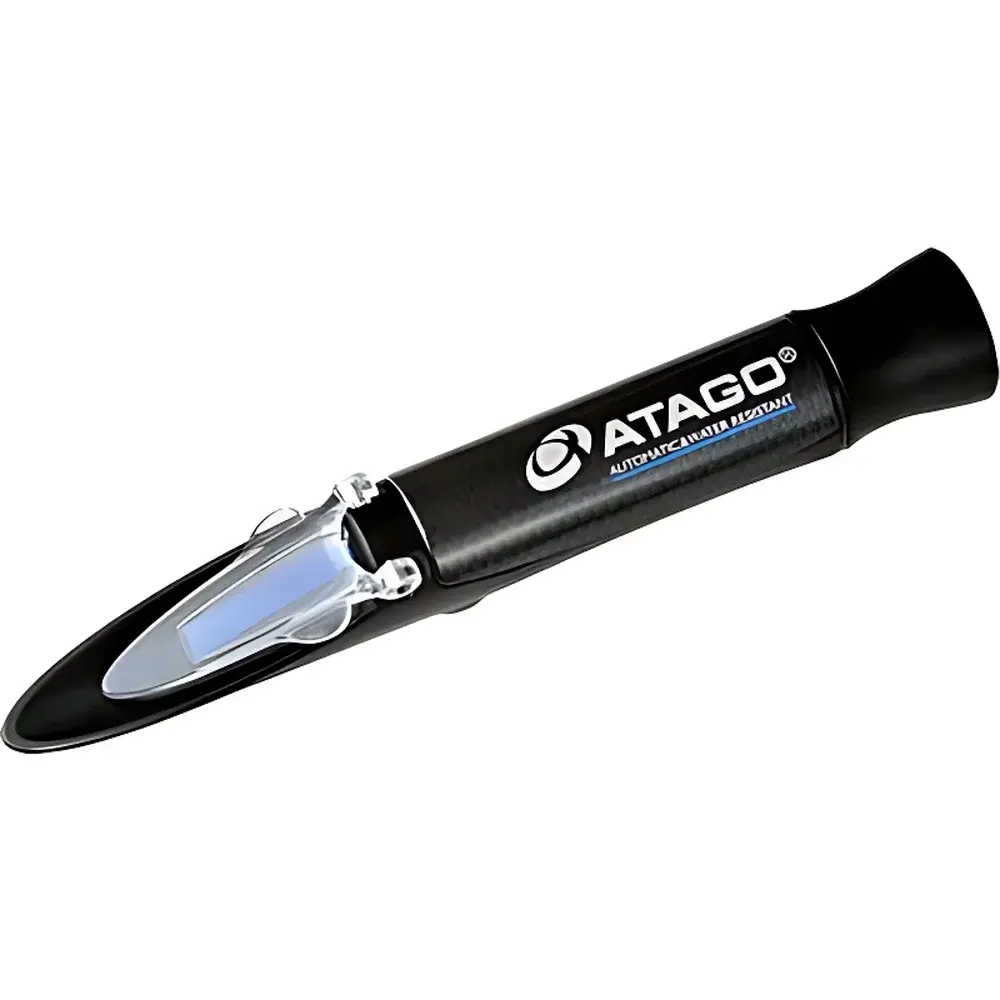
ATAGO MASTER-SUR/NM Clinical Refractometer
| Brand | ATAGO |
|---|---|
| Origin | Japan |
| Model | MASTER-SUR/NM |
| Measurement Scales | Urine Specific Gravity (1.000–1.060), Serum Protein (0.0–12.0 g/100 mL), Refractive Index (nD 1.3330–1.3660) |
| Resolution | Urine SG: 0.001 |
| Serum Protein | 0.2 g/100 mL |
| Refractive Index | 0.0005 nD |
| Temperature Compensation | Manual only (no ATC) |
| IP Rating | Not rated for water resistance |
| Part Number | 2773 |
Overview
The ATAGO MASTER-SUR/NM Clinical Refractometer is a precision optical instrument engineered for rapid, on-site quantification of three clinically relevant parameters—urine specific gravity (USG), serum protein concentration, and refractive index (nD)—using a single drop of sample. Based on the fundamental principle of critical angle refractometry, it measures the degree to which light bends as it passes from a prism (sapphire or high-grade optical glass) into the sample medium; this angular deviation correlates directly with solute concentration and density. Unlike automated digital units, the MASTER-SUR/NM employs a robust analog Abbe-type optical system with triple-scale reticle viewing, enabling simultaneous visual readout without electronic components or battery dependency. Designed specifically for point-of-care diagnostics, emergency triage, and clinical laboratory support workflows, it delivers consistent results under ambient lighting conditions and requires no external power source. Its mechanical construction prioritizes durability in mobile or resource-constrained settings, though it lacks automatic temperature compensation (ATC) and ingress protection—users must perform manual calibration at reference temperature (typically 20 °C) using distilled water or standard reference solutions.
Key Features
- Triple-scale optical eyepiece with engraved, parallax-free graduation lines for urine specific gravity (1.000–1.060), serum protein (0.0–12.0 g/100 mL), and refractive index (nD 1.3330–1.3660)
- High-precision sapphire prism surface offering long-term optical stability and resistance to chemical abrasion from biological fluids
- Manual zero adjustment via calibrated screw mechanism—enabling periodic verification against traceable standards (e.g., ISO 17025-accredited calibration fluids)
- Compact, ergonomic handheld form factor (180 mm × 40 mm × 35 mm) with non-slip rubberized grip for one-handed operation in clinical environments
- No electronic components, batteries, or firmware—ensuring operational continuity during power outages or electromagnetic interference scenarios
- Compliance with ISO 10937:2021 (Refractometers — Calibration and verification procedures) for manual optical instruments used in medical testing
Sample Compatibility & Compliance
The MASTER-SUR/NM accepts aqueous biological specimens including whole urine, centrifuged urine supernatant, diluted serum, and cerebrospinal fluid (CSF). Sample volume requirement is ≤0.05 mL per measurement. It is not intended for viscous, turbid, or highly pigmented samples without prior clarification (e.g., filtration or centrifugation), as particulate matter may distort the critical angle interface. While not certified under IVD Directive (EU 98/79/EC) or FDA 510(k), its measurement methodology aligns with CLSI EP15-A3 guidelines for precision evaluation of clinical refractometers. Results are traceable to NIST SRM 1921b (refractive index standards) when calibrated per ATAGO’s documented procedure (Ref. Manual Rev. 4.2). The device meets general laboratory safety requirements per ISO 15195:2018 for reference measurement systems.
Software & Data Management
As a purely optical analog instrument, the MASTER-SUR/NM does not incorporate embedded software, data logging, or connectivity interfaces. All measurements are recorded manually by the operator into paper-based logbooks or LIMS-compatible spreadsheets. For audit readiness in GLP- or CAP-accredited laboratories, users are advised to maintain calibration logs documenting date, operator ID, reference standard lot number, and observed offset values. ATAGO provides optional traceable calibration kits (Cat. No. 2773-KIT) containing certified reference fluids with uncertainty budgets compliant with ISO/IEC 17025. No software validation (e.g., FDA 21 CFR Part 11) applies, eliminating associated qualification overhead.
Applications
- Rapid assessment of renal concentrating ability via urine specific gravity in acute care and veterinary clinics
- Screening for hypoalbuminemia or paraproteinemia through serum total protein estimation in field-deployed diagnostic units
- Quality control of dialysate and irrigation solutions in nephrology and urology departments
- Verification of reagent concentrations (e.g., saline, dextrose) prior to IV preparation in pharmacy satellite units
- Supporting ISO 15189-compliant internal quality control programs where orthogonal methods (e.g., automated analyzers) require secondary verification
- Teaching tool in medical technology and biomedical engineering curricula for demonstrating optical principles in clinical metrology
FAQ
Does the MASTER-SUR/NM comply with CLIA or CAP requirements for waived testing?
No—this instrument is classified as a general-purpose refractometer and does not carry CLIA-waived status. Its use in regulated clinical testing must be validated per laboratory-developed test (LDT) protocols.
Can it measure undiluted whole blood?
No. Whole blood is optically opaque and incompatible with critical-angle refractometry. Only clarified serum or plasma derivatives are suitable.
What is the recommended recalibration frequency?
Daily before first use and after any significant ambient temperature shift (>3 °C); additionally, after cleaning with ethanol or isopropanol.
Is there a certified calibration service available outside Japan?
Yes—ATAGO-authorized service centers in Germany (Darmstadt), USA (Chicago), and Singapore offer NIST-traceable calibration with ISO 17025 test reports.
How does resolution translate to clinical decision-making?
A 0.001 USG resolution supports detection of subtle hydration shifts (e.g., 1.015 vs. 1.016), while 0.2 g/100 mL serum protein resolution aligns with WHO-recommended thresholds for malnutrition screening (e.g., <3.5 g/dL).