
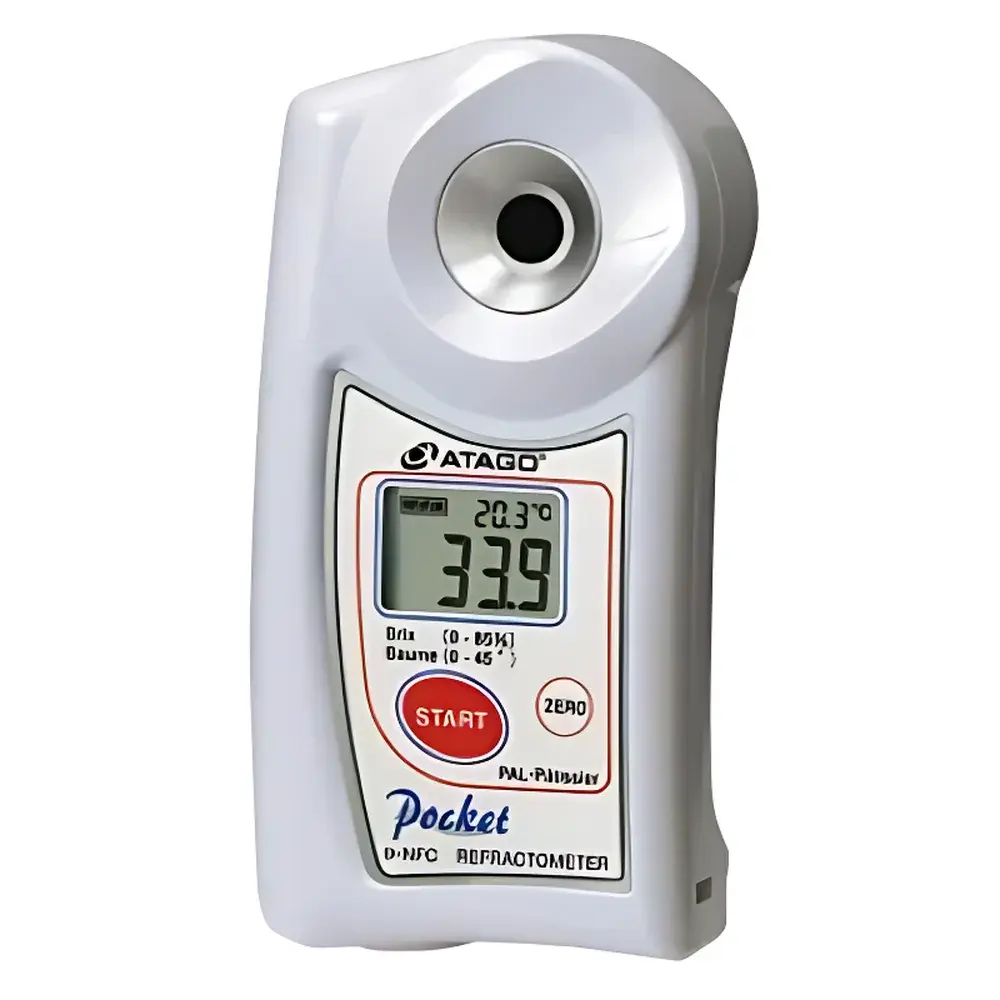
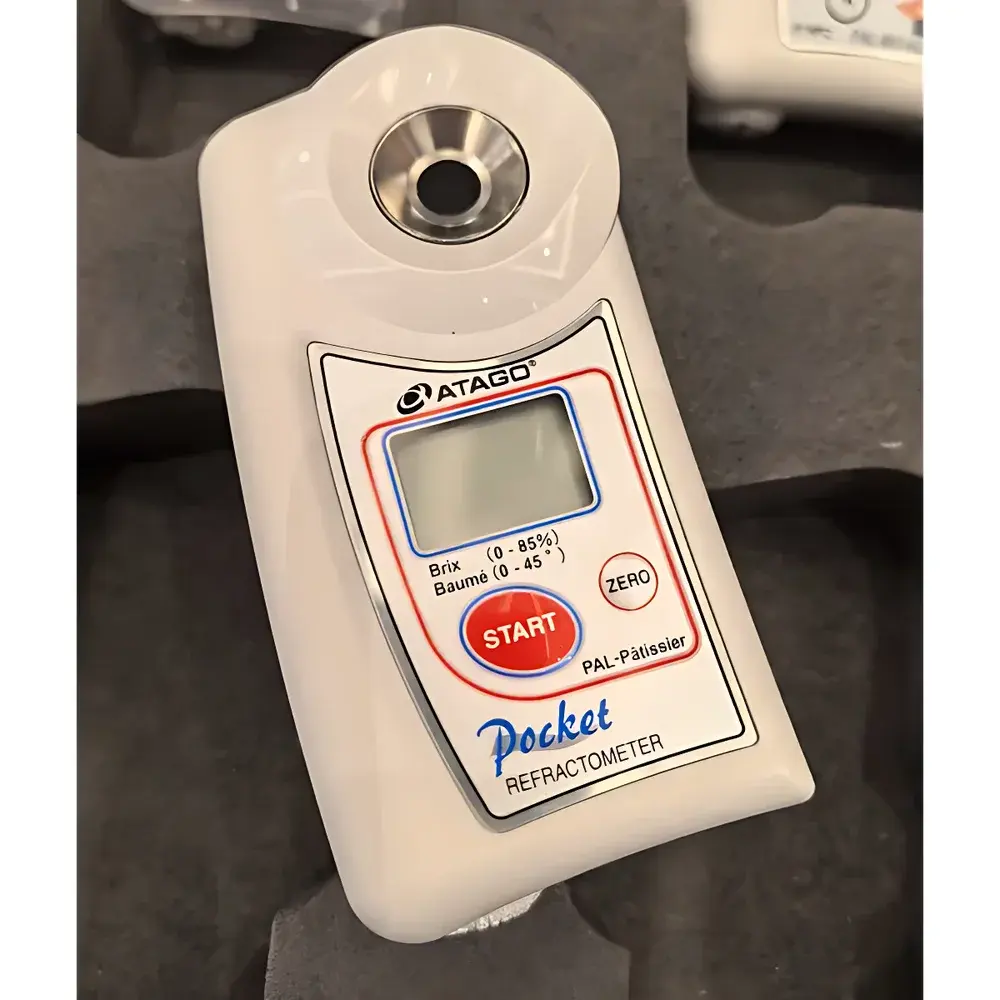
ATAGO PAL-Patissier Dual-Scale Brix & Baumé Handheld Refractometer
| Brand | ATAGO |
|---|---|
| Origin | Japan |
| Model | PAL-Patissier |
| Product Type | Handheld Refractometer |
| Temperature Compensation | Automatic (ATC, 10–100°C) |
| Display | Digital LCD |
| Measurement Range | Brix 0.0–85.0%, Baumé 0–45° |
| Accuracy | ±0.2% Brix, ±1° Baumé |
| Resolution | 0.1% Brix, 1° Baumé |
| Power | 2×AAA batteries |
| IP Rating | IP65 |
| Dimensions | 5.5×3.1×10.9 cm |
| Weight | 100 g (instrument only) |
Overview
The ATAGO PAL-Patissier is a precision-engineered handheld refractometer designed specifically for confectionery and pastry production environments where rapid, repeatable, and temperature-compensated measurement of sugar concentration is critical. It operates on the principle of total internal reflection: light passing through a sample undergoes refraction at the prism-sample interface, with the critical angle directly correlated to the solution’s refractive index—and thus its soluble solids content. This optical method enables non-destructive, single-drop analysis without reagents or calibration fluids. Unlike generic refractometers, the PAL-Patissier integrates dual-scale readout—simultaneous Brix (% w/w sucrose equivalent) and Baumé (°Bé)—a historically established scale in syrup and caramel preparation, particularly across European and Japanese patisserie standards. Its built-in Automatic Temperature Compensation (ATC) ensures metrological consistency across operational temperatures from 10°C to 100°C, eliminating manual correction and supporting real-time monitoring during hot-stage processes such as jam boiling, sugar syrup cooking, or fruit compote reduction.
Key Features
- Dual-scale digital display showing Brix (0.0–85.0%) and Baumé (0–45°) concurrently—optimized for confectionery formulation and process control.
- Robust ATC system compliant with ISO 21745:2020 guidelines for temperature-dependent refractive index correction, validated across the full 10–100°C measurement range.
- IP65-rated enclosure—dust-tight and protected against low-pressure water jets—suitable for humid, high-sugar-residue environments typical of commercial kitchens and pilot-scale food labs.
- High-contrast LCD with 0.1% Brix resolution and 1° Baumé resolution, enabling detection of subtle concentration shifts during critical thermal transitions (e.g., soft-ball vs. hard-crack stages).
- Compact ergonomic form factor (5.5 × 3.1 × 10.9 cm, 100 g) with balanced weight distribution for one-handed operation during extended use.
- No external power supply required—operates on two standard AAA batteries with >10,000 measurements per set under typical usage conditions.
Sample Compatibility & Compliance
The PAL-Patissier is validated for aqueous sugar solutions including sucrose, glucose, fructose, and invert syrups—common in jam, marmalade, caramel, fondant, and fruit purée applications. It is not intended for highly viscous, opaque, or particulate-laden samples (e.g., whole-fruit pulps or nut pastes), nor for non-aqueous solvents or acidic media below pH 3.5. While not certified for regulated pharmaceutical or clinical use, its performance aligns with ASTM D1078–21 (Standard Test Method for Distillation Range of Volatile Organic Liquids) and USP general guidance on optical clarity assessment for liquid dosage forms. For GLP/GMP-aligned facilities, users may document instrument verification using NIST-traceable sucrose reference standards (e.g., 10%, 40%, and 65% w/w) at defined ambient and elevated temperatures.
Software & Data Management
The PAL-Patissier is a standalone field instrument with no Bluetooth, USB, or software integration capability. All measurements are displayed in real time on the integrated LCD; no data logging, export, or audit trail functionality is provided. This design prioritizes operational simplicity, hygiene (no touchscreens or ports), and compliance with environments where electronic data capture is either unnecessary or restricted (e.g., Class A kitchen zones). Users requiring traceable records must manually transcribe readings into lab notebooks or LIMS-compatible spreadsheets. For facilities subject to FDA 21 CFR Part 11, supplementary procedural controls—including operator ID annotation, timestamped entries, and second-operator verification—are recommended for critical process checkpoints.
Applications
- Real-time monitoring of sugar syrup concentration during caramelization, achieving precise thermal endpoints (e.g., 32–35°Bé for Italian meringue; 40–42°Bé for hard crack stage).
- Quality control of fruit-based preserves: verifying minimum soluble solids (≥65% Brix) to meet EU Directive 2001/113/EC requirements for jam classification.
- Batch-to-batch consistency verification in chocolate ganache, praline, and coulis preparation where sugar saturation affects texture and shelf stability.
- In-process validation of sugar inversion during acid-catalyzed syrup preparation (e.g., glucose-fructose equilibrium in golden syrup).
- Educational use in culinary science programs for teaching colligative property relationships between concentration, boiling point elevation, and refractive index.
FAQ
Does the PAL-Patissier require calibration before each use?
No—factory calibration is stable under normal handling. ATAGO recommends verification with distilled water (0% Brix / 0°Bé) prior to first use and after prolonged storage. Routine recalibration is not necessary unless physical shock or thermal abuse is suspected.
Can it measure honey or maple syrup accurately?
Yes, for filtered, clarified honey and Grade A maple syrup—but accuracy degrades above 80% Brix due to non-sucrose solute interference. Use only with homogeneous, bubble-free samples applied to the prism surface.
Is the ATC function compatible with steam-jacketed kettles?
Yes—the ATC mechanism responds to prism temperature, not ambient air. When placed directly against a hot kettle wall or immersed in a steam-heated sample bath (≤100°C), it maintains valid compensation within specification limits.
What maintenance is required for long-term reliability?
Wipe the sapphire prism with lens tissue and distilled water after each use. Avoid alcohol or abrasive cleaners. Store in the supplied protective case with desiccant to prevent humidity-induced fogging.
Is this instrument suitable for ISO/IEC 17025-accredited testing laboratories?
It may be used for in-house process control, but its lack of data output, audit trail, or formal uncertainty budget precludes direct use as a primary measuring instrument in accredited conformity assessment. External verification per ISO/IEC 17025 Clause 6.4.10 is required for such applications.




