
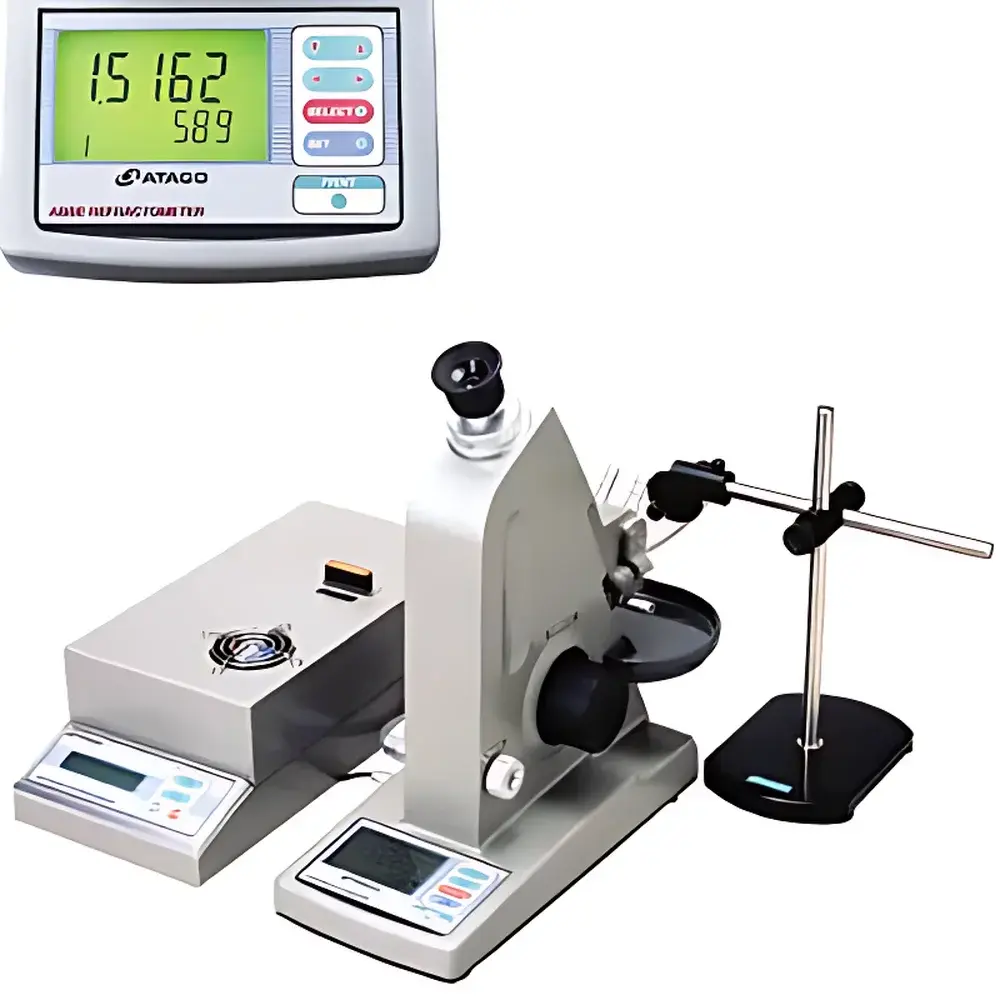
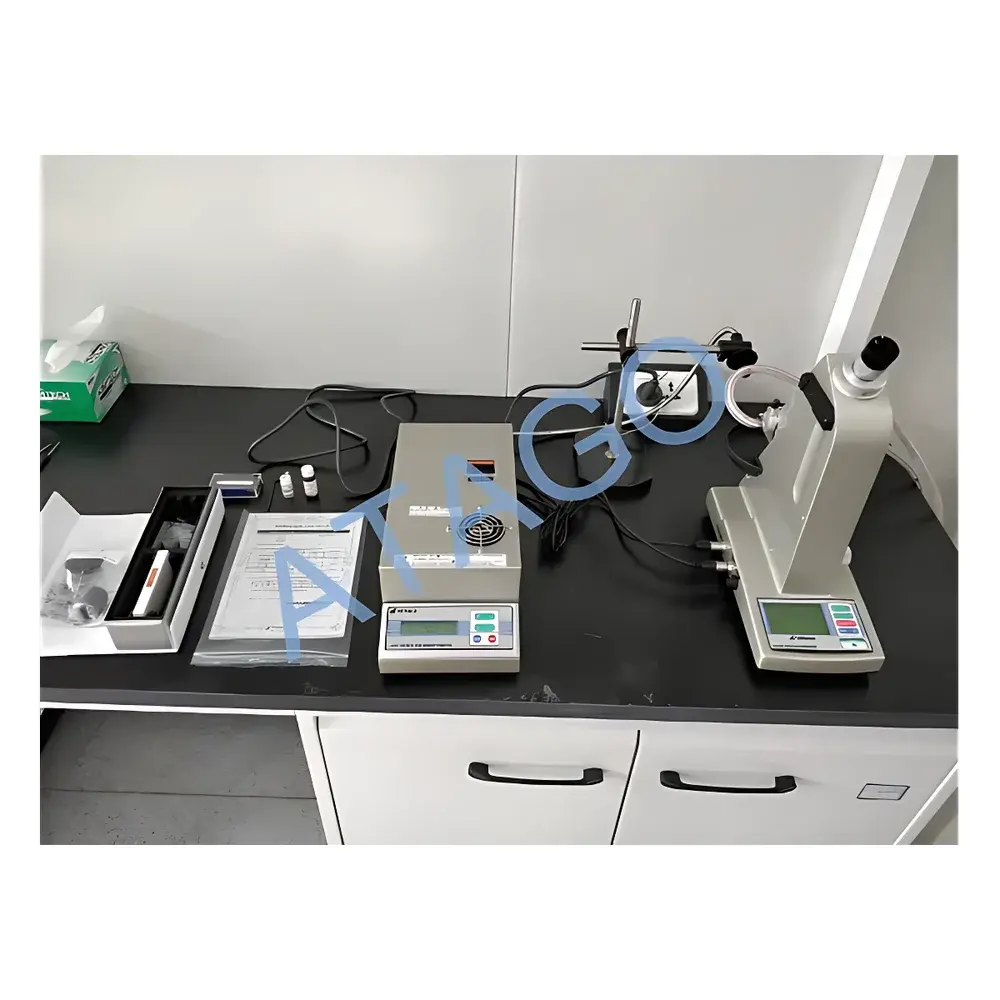
ATAGO DR-M2 Multi-Wavelength Abbe Refractometer (1100 nm)
| Brand | ATAGO |
|---|---|
| Origin | Japan |
| Model | DR-M2 (1100 nm) |
| Product Type | Benchtop Refractometer |
| Temperature Control | Yes |
| Digital Display | Yes |
| Measurement Range | 1.3278–1.7379 (at 450 nm) |
| Measurement Accuracy | ±0.0002 for refractive index (nD) using test plates calibrated between 500–650 nm |
| Wavelength Range | 450–1100 nm (with interference filters) |
| Resolution | 0.0001 (nD), 0.1 (Abbe number νd/νe) |
| Operating Temperature | 5–50 °C |
| Light Source | Halogen lamp |
| Power Supply | AC 100–240 V, 50/60 Hz |
| Dimensions (main unit) | 13 × 29 × 31 cm |
| Weight (main unit) | 6.0 kg |
| Optional Accessories | Circulating water bath 60-C5 (P/N 1923), Digital Printer DP-AD(B) (P/N 3145) |
Overview
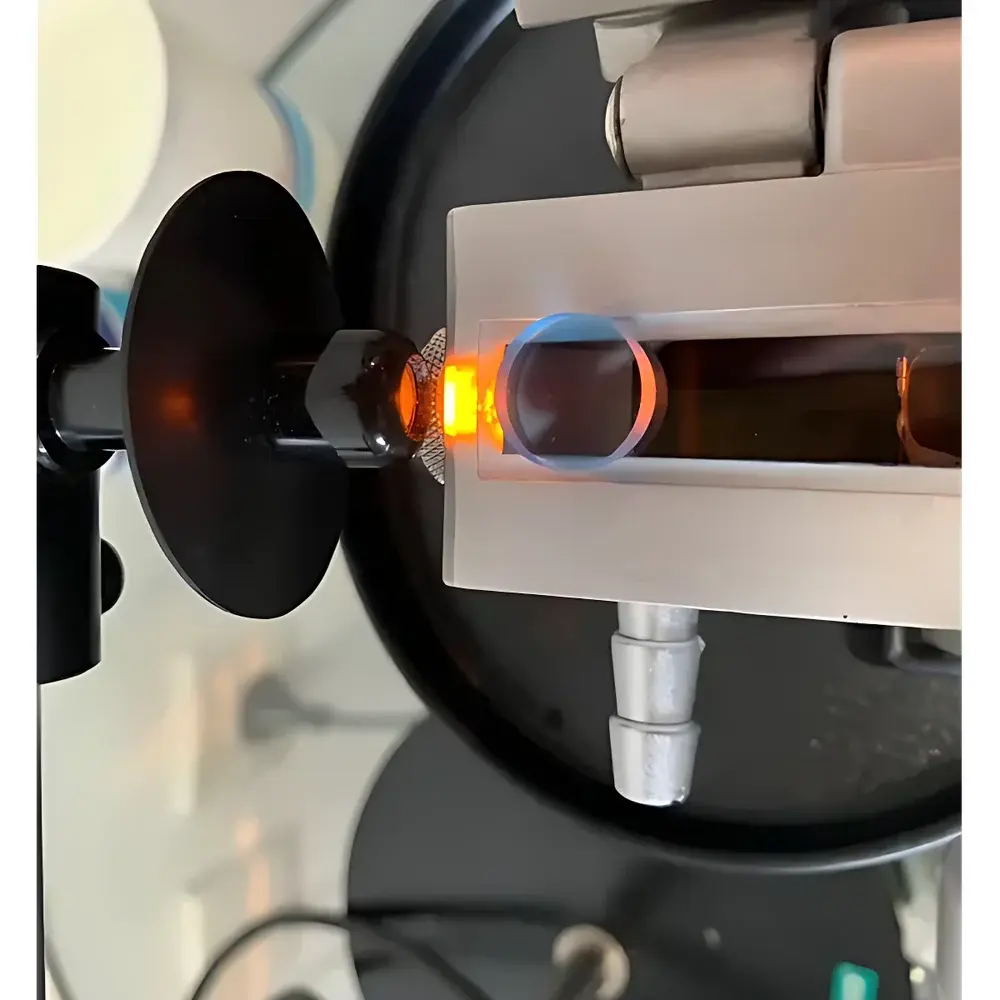
The ATAGO DR-M2 Multi-Wavelength Abbe Refractometer (1100 nm) is a precision benchtop optical instrument engineered for high-accuracy measurement of refractive index (nD) and Abbe number (νd/νe) across a broad spectral range—from 450 nm in the visible to 1100 nm in the near-infrared (NIR). Based on the classical Abbe principle—utilizing critical angle determination at the prism-sample interface—the DR-M2 employs interchangeable interference filters to select discrete wavelengths, enabling wavelength-dependent dispersion characterization essential for optical material qualification. Unlike single-wavelength refractometers, this system supports rigorous chromatic dispersion analysis required for advanced lens design, polymer film development, and liquid crystal formulation. Its halogen light source ensures stable spectral output, while the integrated temperature-controlled sample stage (5–50 °C) minimizes thermal drift and enhances measurement reproducibility. The instrument conforms to fundamental optical metrology standards underpinning ISO 10110-2 (optical materials), ASTM D1218 (refractive index of hydrocarbons), and JIS K 0061 (general refractometry methods).
Key Features
- Multi-wavelength capability: Precise nD and Abbe number determination at user-selectable wavelengths from 450 nm to 1100 nm using certified interference filters
- High-resolution digital readout: 0.0001 resolution for refractive index; 0.1 for Abbe number; LCD display with crosshair-aligned boundary detection for visual verification
- Thermostatically regulated measurement stage: Integrated temperature control ensures compliance with ISO 21748 and ASTM E2251 requirements for temperature-stabilized optical measurements
- Robust Abbe optical architecture: Precision-ground glass prisms and collimated illumination deliver consistent critical-angle detection across diverse sample types—including curved lenses, thin films, and viscous gels
- Benchtop ergonomics: Compact footprint (13 × 29 × 31 cm), 6.0 kg main unit weight, and modular power supply (3.2 kg, 15 × 33 × 11 cm) facilitate integration into QC labs and R&D cleanrooms
- Expandable configuration: Compatible with optional circulating water bath (60-C5) for ±0.1 °C temperature stability and digital printer (DP-AD(B)) for GLP-compliant hardcopy output
Sample Compatibility & Compliance
The DR-M2 accommodates solid, semi-solid, and liquid samples relevant to ophthalmic optics, photonic polymers, and specialty coatings—including spectacle lenses (CR-39, polycarbonate, high-index plastics), PET and PMMA films, UV-curable resins, and nematic liquid crystal mixtures. Sample volume requirements are minimal (typically < 0.5 mL for liquids or a 10 mm diameter contact area for solids), and curvature compensation is achieved via adjustable prism pressure and standardized calibration protocols. All measurements adhere to traceable calibration practices aligned with ISO/IEC 17025:2017. The system supports audit-ready documentation when paired with the DP-AD(B) printer, satisfying FDA 21 CFR Part 11 requirements for electronic records in regulated environments (e.g., ISO 13485-certified medical device manufacturing).
Software & Data Management
While the DR-M2 operates as a standalone instrument with real-time digital display, its analog voltage output (0–5 V DC proportional to nD) enables connection to external data acquisition systems or LIMS platforms. No proprietary software is bundled; however, users may integrate readings into validated laboratory informatics systems using standard RS-232 or analog interfaces (adapter cables available upon request). Calibration certificates include NIST-traceable reference data for each filter wavelength. Internal memory retains no measurement history—ensuring data integrity and simplifying 21 CFR Part 11 validation by eliminating electronic record storage complexity.
Applications
- Optical lens manufacturers: Verification of nD and νd per ANSI Z80.1 for progressive and aspheric prescription lenses
- Polymer R&D labs: Quantification of dispersion behavior in acrylics, copolymers, and thermoplastic elastomers used in AR/HR coatings
- Display technology developers: Characterization of birefringence-sensitive liquid crystal formulations across visible–NIR bands
- Quality control in film production: Batch consistency checks for anti-reflective, conductive, or barrier films on flexible substrates
- Academic optics research: Empirical validation of Sellmeier coefficients and Cauchy equation parameters for novel transparent materials
FAQ
What wavelength options are supported without additional accessories?
The DR-M2 supports 450 nm, 589 nm (Na-D line), and 680 nm out-of-the-box using standard interference filters. Operation at 1100 nm requires the optional NIR viewing eyepiece (sold separately).
Can the DR-M2 measure curved or thick optical components directly?
Yes—its adjustable prism assembly accommodates plano-convex, biconvex, and cylindrical lenses up to 25 mm thickness, provided the measurement surface is optically polished and free of coatings that scatter incident light.
Is temperature calibration traceable to national standards?
The built-in Pt100 sensor is factory-calibrated against NIST-traceable references; users may perform periodic verification using certified thermostatic baths per ISO 17025 clause 6.5.
How is measurement uncertainty quantified for regulatory submissions?
Total expanded uncertainty (k = 2) for nD is ≤ ±0.0004 under controlled lab conditions (23 ± 0.5 °C, RH < 60 %), incorporating contributions from repeatability, temperature stability, filter bandwidth, and calibration standard uncertainty.
Does the instrument support Good Manufacturing Practice (GMP) workflows?
Yes—when used with the DP-AD(B) digital printer and documented calibration logs, the DR-M2 meets core GMP data integrity expectations per EU Annex 11 and PIC/S PI 041-2 for analytical instrumentation in pharmaceutical and medical optics manufacturing.




