
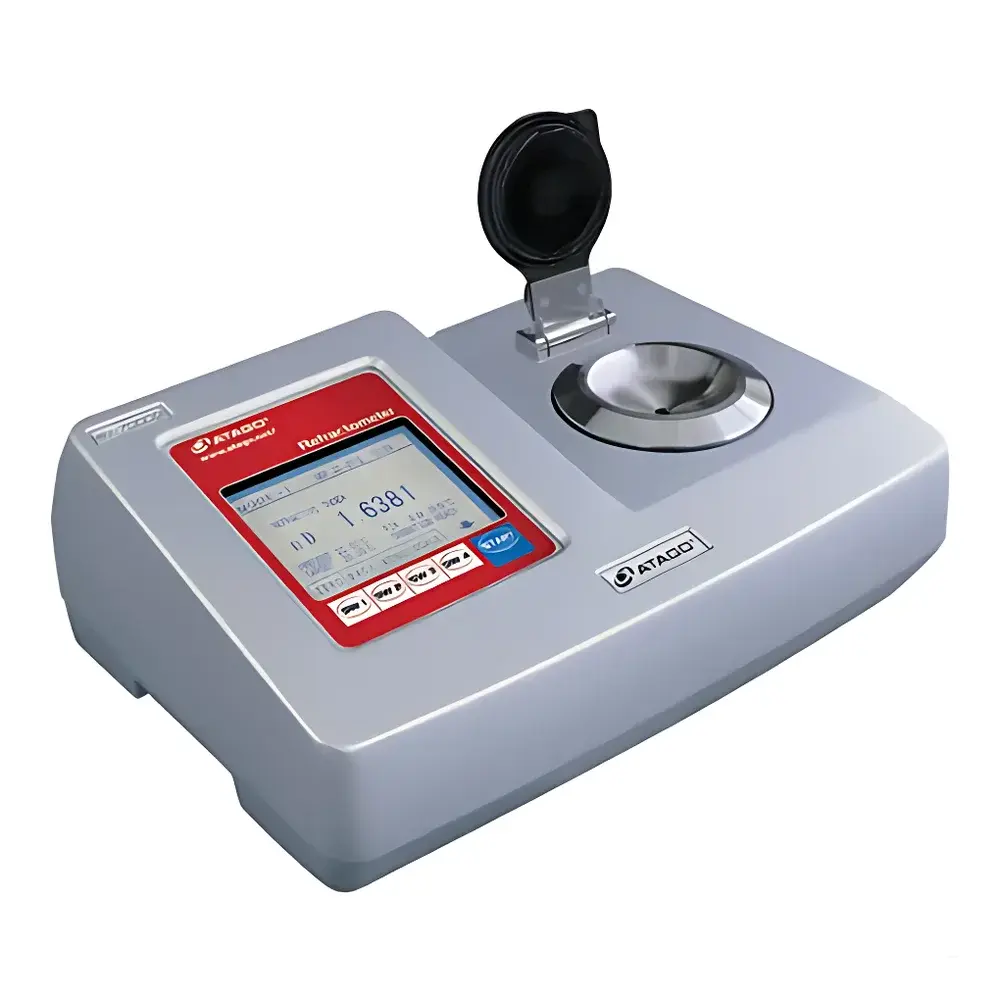
ATAGO RX-7000α Automatic Desktop Digital Refractometer
| Brand | ATAGO |
|---|---|
| Origin | Japan |
| Model | RX-7000α |
| Type | Benchtop Refractometer |
| Temperature Control | Peltier-based |
| Display | Digital LCD |
| Refractive Index Range | 1.29980–1.71500 |
| Brix Range | 0.00–100.00% |
| RI Accuracy | ±0.0001 |
| Brix Accuracy | ±0.1% |
| Temperature Accuracy | ±0.05°C |
| Temp. Control Range | 5.00–70.00°C (ambient lower limit: –10°C) |
| RI Resolution | 0.00001 |
| Brix Resolution | 0.01% (default) |
| Temp. Resolution | 0.01°C |
| Custom Scales | Up to 30 user-defined units |
Overview
The ATAGO RX-7000α Automatic Desktop Digital Refractometer is a high-precision, temperature-controlled optical instrument engineered for accurate and repeatable measurement of refractive index (RI) and related concentration units—including Brix, % w/w, % w/v, specific gravity, and custom-defined scales—across demanding industrial and research environments. Based on the fundamental principle of total internal reflection at the prism-sample interface, the RX-7000α employs a high-stability LED light source and a linear CCD array detector to determine the critical angle with sub-microradian resolution. Its upgraded optical architecture and enhanced thermal management system distinguish it from the prior RX-5000α generation, enabling reliable operation with high-boiling-point, thermally sensitive, or high-refractive-index samples such as essential oils, aromatic solvents, molten fats, polymer precursors, and specialty chemical intermediates.
Key Features
- Peltier-based thermostatic control (5.00–70.00°C) with ±0.05°C accuracy and 0.01°C resolution, ensuring strict adherence to standardized test temperatures per ASTM D1218, ISO 2872, and USP
- Extended refractive index range (1.29980–1.71500) optimized for both aqueous and non-aqueous systems—including organic solvents (e.g., chloroform, ethylene glycol), silicone oils, and resin formulations
- Dual-mode calibration: factory-traceable auto-calibration using certified reference standards, plus manual offset adjustment capability to align with legacy instruments or lab-specific reference values
- 30 programmable user-defined scale slots supporting industry-specific units (e.g., API gravity, nD20 correction, custom polynomial conversions) with full audit trail logging
- Robust stainless-steel sample stage, scratch-resistant sapphire prism (nD = 1.76), and integrated anti-drip design for safe handling of volatile or viscous liquids
- Compliance-ready firmware with timestamped measurement records, operator ID assignment, and password-protected configuration access
Sample Compatibility & Compliance
The RX-7000α accommodates liquid, semi-liquid, and low-viscosity paste samples (up to ~500 mPa·s) without dilution or filtration. Its wide RI range supports direct analysis of undiluted essential oils (e.g., eucalyptus oil, RI ≈ 1.460), anhydrous ethanol (RI ≈ 1.361), and high-boiling hydrocarbons (e.g., mineral oil, RI ≈ 1.475). The instrument meets mechanical and electromagnetic compatibility requirements per IEC 61326-1 and carries CE marking. Data integrity features—including electronic signature support, configurable data retention policies, and exportable CSV/Excel reports—facilitate alignment with GLP, GMP, and FDA 21 CFR Part 11 regulatory expectations in pharmaceutical, food safety, and contract testing laboratories.
Software & Data Management
The RX-7000α operates autonomously via its built-in 4.3-inch capacitive touchscreen interface, but also integrates seamlessly with ATAGO’s optional PC-based “ReflaX” software suite (v3.2+). ReflaX enables batch reporting, statistical process control (SPC) charting, method validation documentation (per ICH Q2(R2)), and automated synchronization with LIMS platforms via ODBC or RESTful API. All measurements are stored with embedded metadata: date/time stamp, operator ID, temperature setpoint, calibration status, and raw sensor output. Audit trails are immutable and exportable in PDF/A-1b format for internal QA review or external accreditation audits (e.g., ISO/IEC 17025).
Applications
- Quality control of edible oils and fats: monitoring iodine value proxies, oxidation stability indices, and adulteration detection via RI deviation analysis
- Pharmaceutical excipient verification: concentration profiling of propylene glycol, polyethylene glycols, and glycerin-based vehicles
- Flavor & fragrance R&D: real-time tracking of solvent evaporation kinetics and blend homogeneity during formulation development
- Chemical manufacturing: in-process verification of monomer purity (e.g., styrene, methyl methacrylate) and catalyst concentration in polymerization feeds
- Academic research: temperature-dependent RI studies for thermodynamic modeling of binary and ternary liquid mixtures
- Electrolyte formulation: correlation of RI with conductivity and density in lithium-ion battery electrolyte screening
FAQ
What temperature calibration standards are recommended for routine verification?
ATAGO recommends NIST-traceable liquid standards (e.g., bromonaphthalene, RI = 1.658 at 20°C; distilled water, RI = 1.3330 at 20°C) verified annually by an accredited metrology lab.
Can the RX-7000α measure opaque or turbid samples?
No—it requires optically clear or translucent samples; suspended solids or air bubbles will distort the critical angle detection and invalidate results.
Is automatic temperature compensation (ATC) applied across all user-defined scales?
Yes—ATC is embedded in all scale algorithms and dynamically adjusts based on real-time prism surface temperature, not ambient chamber reading.
How is data security maintained during network-connected operation?
ReflaX software enforces TLS 1.2+ encryption for remote transfers, and local device storage uses AES-256 encryption with role-based access controls.
Does the instrument support IQ/OQ/PQ documentation packages for regulated labs?
Yes—ATAGO provides validated installation qualification (IQ), operational qualification (OQ), and performance qualification (PQ) templates aligned with ASTM E2500 and EU Annex 15 guidelines.





