
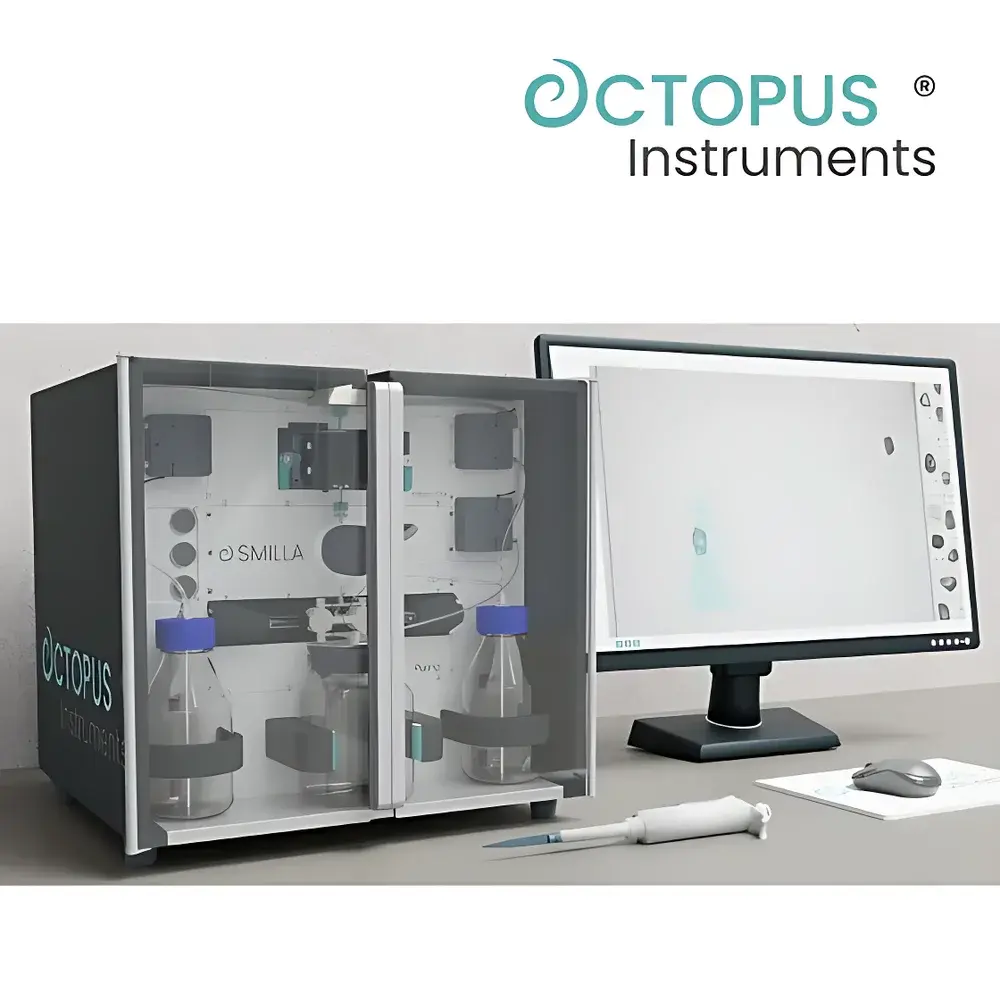
Octopus SAMILLA FIM LO Flow Imaging Microscopy System (Light Obscuration Hybrid)
| Brand | Octopus |
|---|---|
| Origin | Germany |
| Model | SAMILLA FIM LO |
| Application Field | Pharmaceutical |
| Instrument Type | Dynamic |
| Measurement Range | 200 nm – 2 mm |
| Camera Options | 12 MP monochrome or color camera |
| Sample Dispersion Method | Wet dispersion |
| Image Resolution | 12 MP |
| Measured Parameters | Full particle size and shape metrics (e.g., area, perimeter, circularity, aspect ratio, convexity, solidity, Feret diameters, intensity, texture) |
| Module Architecture | HiRes-FIM (High-Resolution Flow Imaging Microscopy), Light Obscuration (LO), Pump (MACRO/MICRO1/MICRO2/HYBRID), Auto-Clean |
Overview
The Octopus SAMILLA FIM LO is a modular, high-precision flow imaging microscopy (FIM) system engineered for regulatory-compliant subvisible and visible particle analysis in liquid pharmaceutical formulations. It integrates two orthogonal measurement principles—high-resolution image-based analysis (HiRes-FIM) and light obscuration (LO)—within a single platform, enabling concurrent, cross-validated particle characterization per sample injection. The HiRes-FIM module employs microfluidic laminar flow coupled with telecentric optical path design and ultra-short exposure imaging to capture diffraction-limited, motion-blur-free images of individual particles in suspension. This principle delivers true morphological fidelity—not inferred proxies—enabling quantification of both size (equivalent spherical diameter, Feret min/max, projected area) and shape descriptors (circularity, aspect ratio, convexity, solidity, texture heterogeneity). The LO module operates per ISO 21501-4 and USP , providing rapid, statistically robust particle counts and calibrated size distributions in the 1–120 µm range. Together, these technologies satisfy the dual analytical requirements defined in Ph. Eur. 2.9.19, USP , , and ICH Q5A(R2): quantitative enumeration *and* morphological classification of extrinsic, intrinsic, and intrinsic-like particles.
Key Features
- Modular architecture with automatic RFID-based module recognition: HiRes-FIM, LO, Pump (MACRO/MICRO1/MICRO2/HYBRID), and Auto-Clean modules integrate seamlessly without manual configuration.
- HiRes-FIM core: 12 MP monochrome or color CMOS sensor with real-time image acquisition at >30 fps; telecentric optics with interchangeable magnification modules (0.5×–4×) enabling sub-200 nm resolution under optimal conditions.
- Zero-motion-blur imaging: Exposure times <1 µs eliminate velocity-induced distortion across flow rates up to 100 µL/min, ensuring metrological traceability per ISO/IEC 17025.
- Auto-focus without calibration beads: Proprietary contrast-based autofocus algorithm maintains optical plane stability across thermal drift and viscosity shifts.
- Dual illumination modes: Transmitted brightfield for transparent/biological particles; optional reflected darkfield for optically dense or metallic contaminants.
- LO module with hydrodynamically optimized flow cell: Achieves >95% coincidence limit recovery at concentrations up to 10⁴ particles/mL, validated per ASTM F3256-20.
- Pump flexibility: MICRO1 for precise 10–500 µL injections; MICRO2 for uninterrupted 1–5 mL runs; HYBRID for multi-viscosity workflows (e.g., protein therapeutics + lipid nanoparticles).
Sample Compatibility & Compliance
The SAMILLA FIM LO supports aqueous and non-aqueous suspensions—including monoclonal antibodies, mRNA-LNPs, vaccines, small-molecule injectables, and ophthalmic solutions—with no requirement for staining or fixation. Wet dispersion is achieved via integrated sonication-assisted sample introduction and programmable dilution protocols. All modules comply with GMP-aligned design principles: stainless-steel fluidic paths, Class 100 cleanroom-compatible housing, and materials certified to USP Class VI and ISO 10993-5. Data integrity meets FDA 21 CFR Part 11 requirements through electronic signatures, audit trails (user action, parameter change, result export), and role-based access control. Software validation packages (IQ/OQ/PQ) are available for regulated environments. The system satisfies all reporting criteria in Ph. Eur. 2.9.19 Annex 1 and provides raw image archives compliant with ALCOA+ principles (Attributable, Legible, Contemporaneous, Original, Accurate, Complete, Consistent, Enduring, Available).
Software & Data Management
SMILLA View software serves as the unified control and analytics interface, supporting method development, real-time monitoring, and post-acquisition morphometric analysis. Each detected particle is assigned a unique ID linked to its full-resolution image, spatial coordinates, temporal stamp, and 40+ morphological parameters. Advanced filtering enables stratification by origin hypothesis (e.g., silicone oil droplets vs. protein aggregates vs. cellulose fibers) using machine learning–assisted clustering (k-means, PCA). QC workflows include automated pass/fail assessment against user-defined thresholds per USP limits. Reports are exportable in PDF, CSV, and XML formats, with native LIMS integration via ASTM E1384-compliant HL7 messaging. The Laboratory Analysis Data System (LADS) framework enables traceable data lineage from raw image → feature extraction → statistical summary → final report, fulfilling GLP audit requirements.
Applications
- Subvisible particle characterization in biologics: differentiation of proteinaceous aggregates, silicone oil droplets, and particulate leachables per ICH Q5C guidance.
- Process development support: monitoring filter integrity, filling line contamination, and formulation stability across accelerated and real-time studies.
- Root cause analysis of opalescence or haze: correlating morphology trends (e.g., increasing aspect ratio) with storage temperature or pH shifts.
- Comparability assessments: demonstrating equivalence between manufacturing sites or pre-/post-change batches using multivariate particle signature analysis.
- Raw material qualification: detection of undissolved excipients or crystalline impurities in active pharmaceutical ingredients (APIs).
- Cell and gene therapy product release: quantification of residual host cell debris, lipid vesicles, and nucleic acid complexes.
FAQ
Does SAMILLA FIM LO require calibration standards for routine operation?
Yes—NIST-traceable polystyrene microsphere suspensions (e.g., 2.0 µm, 10 µm, 25 µm) are used for optical magnification verification and LO voltage-to-size conversion. HiRes-FIM pixel calibration is performed during initial setup and re-verified quarterly.
Can the system analyze opaque or highly scattering samples?
Yes—the optional reflected darkfield illumination mode enables high-contrast imaging of metallic fragments, carbon black, or titanium dioxide without sample modification.
Is it possible to export raw image data for third-party AI model training?
Yes—SMILLA View exports uncompressed TIFF stacks with embedded metadata (exposure time, flow rate, gain, timestamp) in a structured directory hierarchy compatible with Python-based computer vision pipelines.
How does the Auto-Clean module prevent carryover between high-concentration samples?
It executes a three-stage protocol: (1) high-pressure reverse flush (200 psi) of the flow cell, (2) solvent exchange with ethanol/water gradient, and (3) nitrogen purge—validated to reduce residual particle carryover to <0.1% per USP Annex.
What level of technical support and service coverage is included?
Standard offering includes 24/7 remote diagnostics, annual preventive maintenance with optical alignment verification, and on-site application support for method transfer and regulatory submission preparation.



