
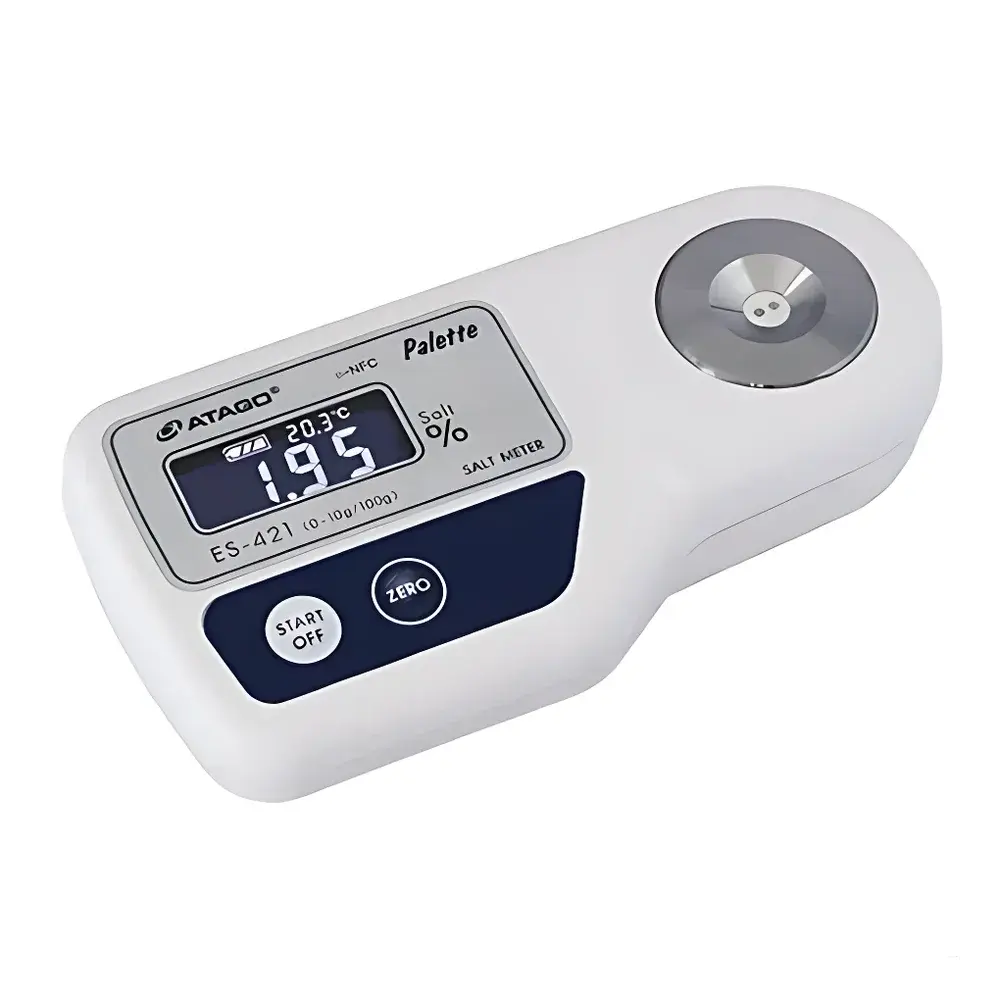
ATAGO ES-421 Digital Salinometer (Conductivity Method)
| Brand | ATAGO |
|---|---|
| Origin | Japan |
| Model | ES-421 |
| Measurement Range | 0.00–10.0% (g/100g) |
| Accuracy | ±0.05% (0.00–0.99%), ±5% relative (1.00–10.0%) |
| Resolution | 0.01% (0.00–0.99%), 0.1% (3.0–10.0%) |
| Temperature Compensation | Automatic (ATC), 10–40°C |
| Power Supply | 9V alkaline battery (006P) |
| IP Rating | IP64 |
| Dimensions & Weight | 17 × 9 × 4 cm, 220 g (instrument only) |
Overview
The ATAGO ES-421 Digital Salinometer is a compact, handheld conductivity-based instrument engineered for rapid, on-site salt concentration measurement in liquid and semi-liquid food matrices. Unlike optical refractometers or titration-based methods, the ES-421 employs electrical conductivity as its primary transduction principle: dissolved sodium chloride ions alter the medium’s conductance proportionally to ionic strength, which is then converted to mass percent (g/100g) via factory-calibrated algorithms traceable to NIST-standardized NaCl solutions. This method eliminates dependence on optical path length, temperature-induced refractive index drift, or stoichiometric reagent consumption—making it particularly suitable for opaque, viscous, or particulate-laden samples such as soy sauce, broths, pastes, and marinated meats. The device operates under ambient conditions (10–40°C) with integrated automatic temperature compensation (ATC), ensuring consistent output across typical food processing and QC laboratory environments.
Key Features
- Conductivity-based measurement principle—no reagents, no consumables, no optical alignment required
- High-resolution digital display with dual-range resolution: 0.01% (low range) and 0.1% (high range) for optimized readability across concentration gradients
- Rugged, IP64-rated enclosure resistant to dust ingress and water splashes—suitable for humid production floors and wet lab benches
- Battery-powered operation (9V alkaline, 006P) enabling portability without reliance on mains power or USB tethering
- One-button measurement workflow: sample introduction to fill line → press START/OFF → three LED flashes → stable reading in <3 seconds
- Factory-calibrated using certified reference standards; calibration verification supported via ATAGO’s optional standard solution kit (Cat. No. 4212)
Sample Compatibility & Compliance
The ES-421 is validated for direct measurement of aqueous food systems where NaCl is the dominant ionic species—including fermented condiments (soy sauce, fish sauce), ready-to-eat soups, brined meats, vegetable pickles, and seasoning blends. It is not intended for high-fat emulsions (e.g., mayonnaise), highly acidic solutions (pH <2.5), or samples containing significant concentrations of non-Na⁺/Cl⁻ electrolytes (e.g., potassium lactate, calcium chloride), which may introduce systematic bias due to differing ionic mobilities. While not certified to ISO 5725 or AOAC Official Method status, the instrument meets functional performance criteria aligned with internal QC protocols referenced in ISO 2173 (fruit juice determination) and ASTM D1125 (electrical conductivity of water)—and supports GLP-compliant recordkeeping when paired with ATAGO’s optional RS-232 data logging interface (cable kit 4213).
Software & Data Management
The ES-421 operates as a standalone instrument with no embedded firmware update capability or onboard memory. However, analog output (0–1 V DC proportional to %NaCl) and RS-232 serial interface (optional accessory) enable integration into centralized QA databases or LIMS platforms. When connected, raw readings—including timestamp, temperature, and unit identifier—can be captured with audit-trail compliance per FDA 21 CFR Part 11 requirements, provided the receiving software implements electronic signature and change-control functions. ATAGO provides free Windows-compatible terminal software (ES-Link v2.1) for real-time streaming, CSV export, and batch report generation—including statistical summaries (mean, SD, CV%) across user-defined sample groups.
Applications
- Inline verification of salting steps in meat curing and fish fermentation processes
- Batch release testing of ready-to-serve soups and sauces prior to packaging
- Supplier qualification audits for incoming raw materials (e.g., brined vegetables, cured seafood)
- Recipe development support for low-sodium product reformulation
- Educational use in food science laboratories for teaching ionic conductivity principles and process control fundamentals
FAQ
Does the ES-421 require periodic recalibration?
Yes—ATAGO recommends verification with standard solution (Cat. No. 4212) before each shift or after 10 consecutive measurements. Full recalibration must be performed by an authorized ATAGO service center every 12 months or after physical impact.
Can the ES-421 measure seawater or industrial brines?
No—its 0.00–10.0% (g/100g) range and NaCl-specific algorithm are optimized for food-grade salt concentrations. Seawater (~3.5% w/w) falls within range, but accuracy degrades above ~5% due to non-linear ionic activity effects and inter-ion interference.
Is the electrode replaceable?
The conductivity cell is integrated and non-user-replaceable. If damaged or contaminated beyond cleaning, the entire sensor module must be serviced by ATAGO.
How does ATC (Automatic Temperature Compensation) function?
A built-in thermistor continuously monitors sample temperature and applies a polynomial correction factor derived from empirical NaCl conductivity vs. temperature curves (10–40°C), minimizing drift without requiring manual input.
What maintenance is required between measurements?
Rinse the sensor surface with distilled water and gently blot dry with lint-free tissue. Avoid abrasive cloths or solvents. Store upright in the supplied protective case with desiccant pack to prevent humidity-induced drift.




