
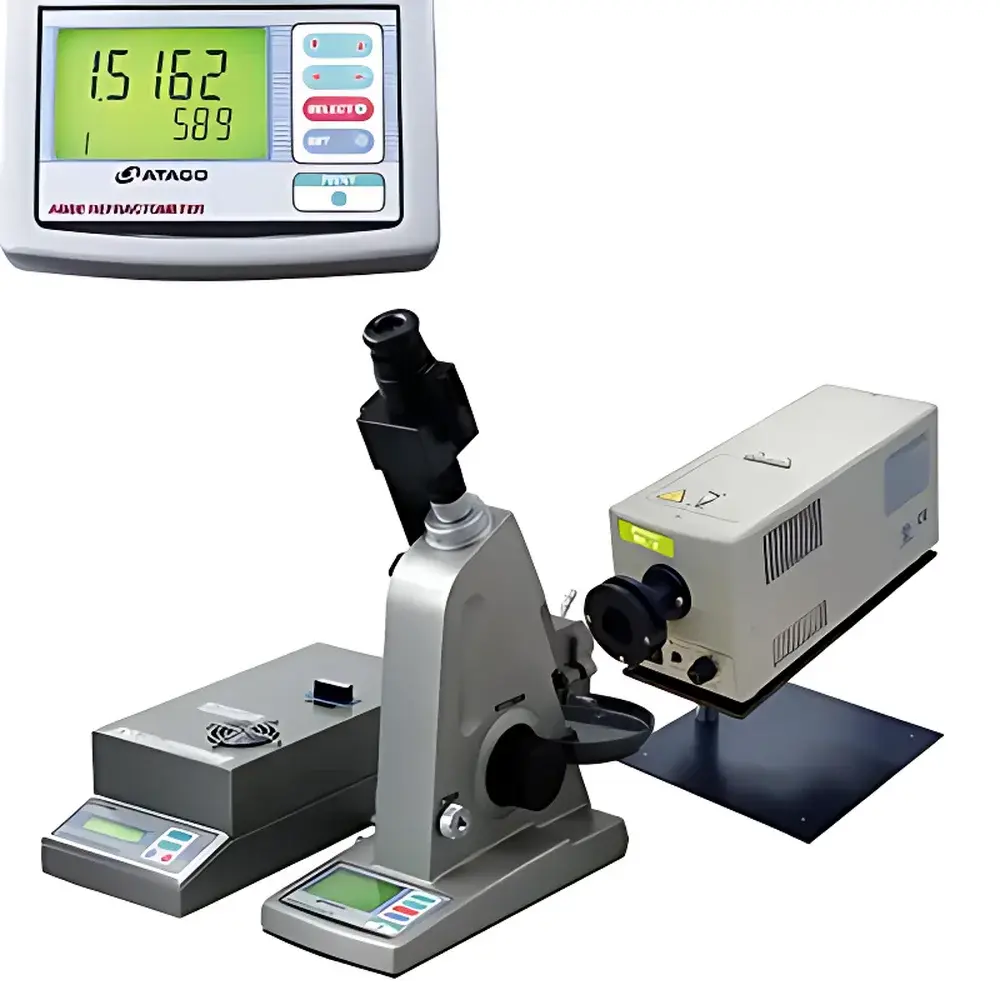
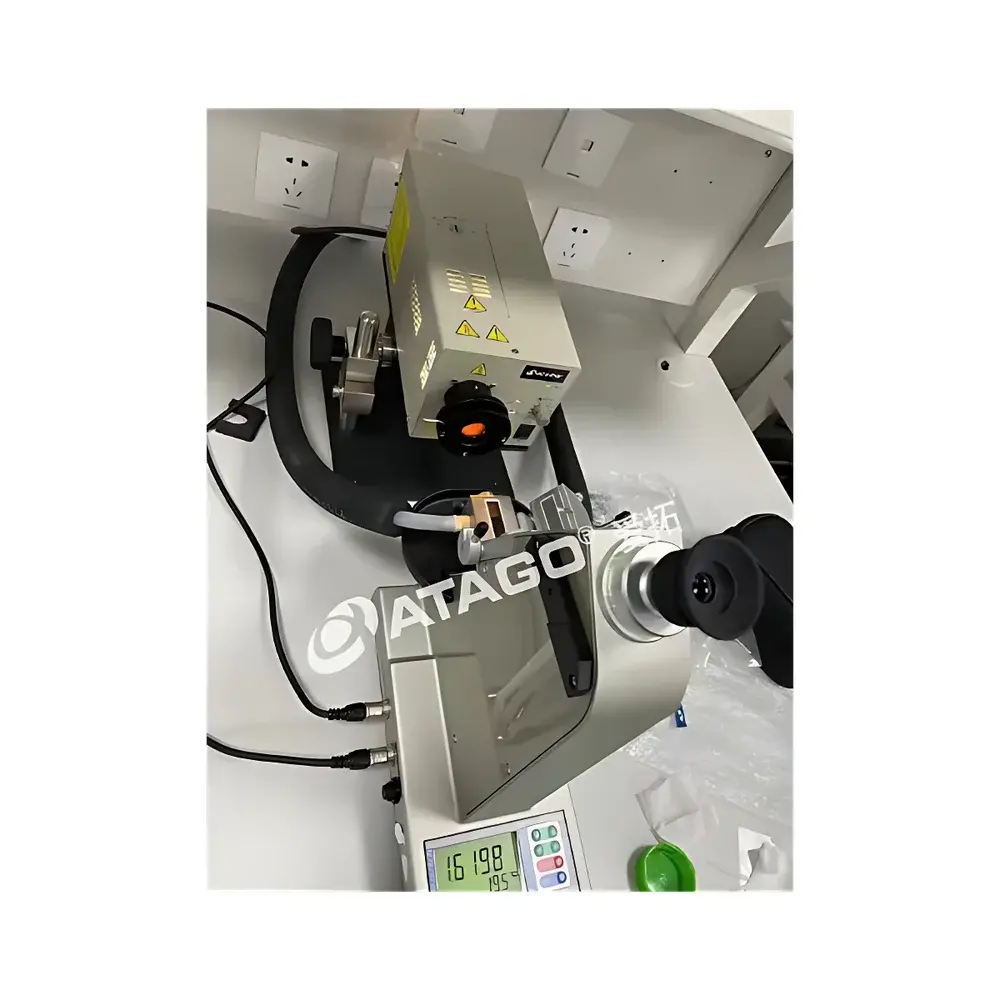
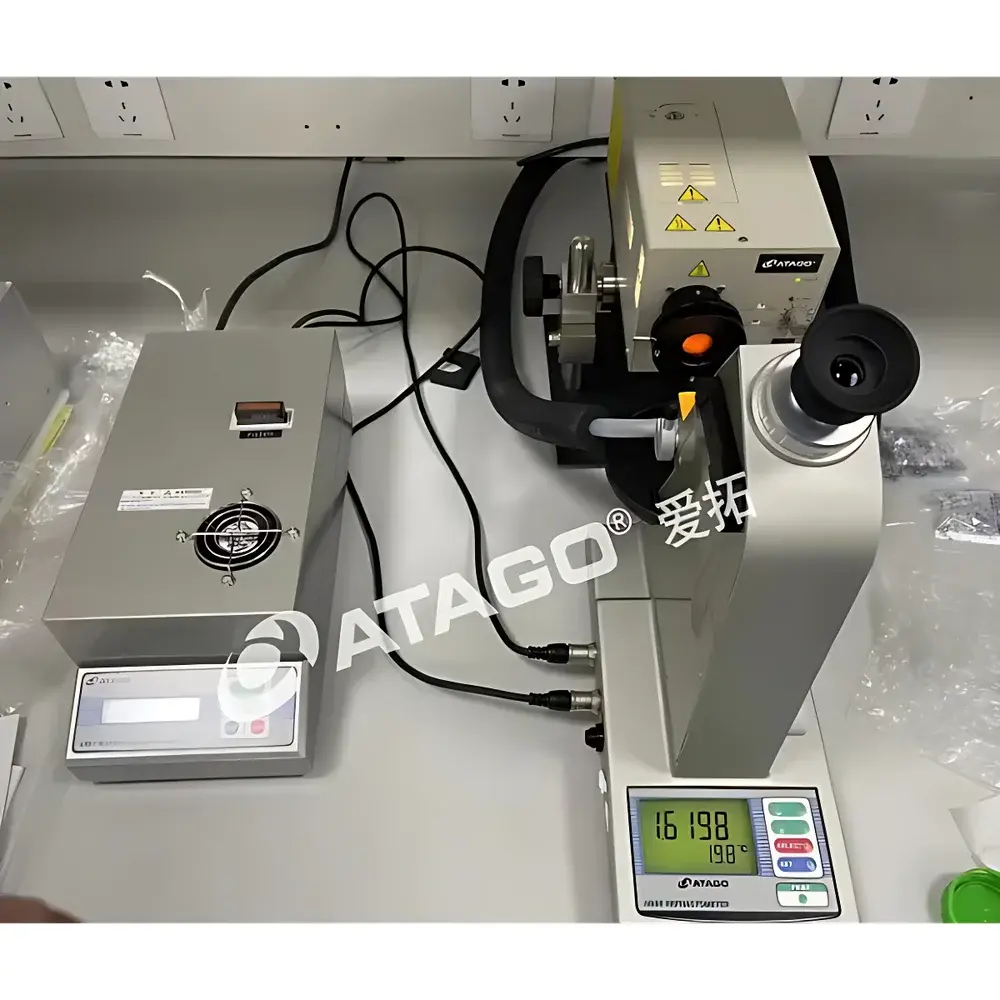
ATAGO DR-M2 Multi-Wavelength Abbe Refractometer
| Brand | ATAGO |
|---|---|
| Origin | Japan |
| Model | DR-M2 |
| Type | Benchtop Refractometer |
| Display | Digital LCD |
| Wavelength Range | 450–1550 nm (interference filter-based) |
| Refractive Index Range | 1.3278–1.7379 (at 450 nm) |
| Resolution | 0.0001 (nD), 0.1 (Abbe number) |
| Accuracy | ±0.0002 (nD, verified at 589 nm with standard test plate) |
| Operating Temperature | 5–50 °C |
| Power Supply | AC 100–240 V, 50/60 Hz |
| Dimensions (main unit) | 13 × 29 × 31 cm |
| Weight (main unit) | 6.0 kg |
Overview
The ATAGO DR-M2 Multi-Wavelength Abbe Refractometer is a precision benchtop optical instrument engineered for high-accuracy refractive index (nD) and Abbe number (vD) measurements across a broad spectral range—from 450 nm (visible blue) to 1550 nm (near-infrared). Based on the classical Abbe principle—utilizing total internal reflection at a prism-sample interface—the DR-M2 employs interchangeable interference filters to isolate discrete monochromatic wavelengths, enabling wavelength-dependent dispersion characterization. Unlike single-wavelength refractometers, this system supports rigorous material dispersion analysis essential for optical polymer development, lens design validation, and advanced thin-film metrology. Its digital readout eliminates parallax error inherent in traditional visual Abbe instruments, delivering reproducible nD values with ±0.0002 accuracy (traceable to 589 nm sodium-D line calibration) and 0.0001 resolution. The instrument operates without integrated temperature control, requiring external thermal stabilization (e.g., circulating water bath) for applications demanding strict ISO 17025-compliant measurement conditions.
Key Features
- Multi-wavelength capability via user-selectable interference filters (450, 589, 680, 1100, and 1550 nm)
- Digital LCD display with real-time nD and Abbe number output—no subjective visual alignment required
- High-resolution prism optics optimized for low-stray-light performance across UV-Vis-NIR bands
- Benchtop architecture with robust aluminum alloy chassis (6.0 kg net weight) for vibration-damped operation in shared lab environments
- Compliance with JIS Z 8806 and ASTM D1218 standards for refractive index determination of transparent solids and liquids
- Modular design supporting optional accessories: DP-63B digital printer (for GLP-compliant hardcopy records) and 60-C5 thermostatic water circulator (for temperature-controlled measurements per ISO 21748)
Sample Compatibility & Compliance
The DR-M2 accommodates solid samples—including optical lenses, polymer pellets, glass substrates, and semiconductor wafers—as well as homogeneous liquid samples with minimal volatility. Sample contact occurs via a sapphire prism (hardness 9 Mohs), resistant to scratching by most optical-grade polymers and inorganic glasses. For solid measurements, sample flatness must meet ≤0.5 µm surface roughness (per ISO 10110-7) to ensure consistent light coupling. The instrument satisfies key regulatory requirements for materials characterization labs: it supports audit-ready documentation when paired with DP-63B printer (enabling timestamped, operator-ID-tagged reports), and its measurement traceability aligns with ISO/IEC 17025 clause 6.4.1 (equipment verification). While not intrinsically compliant with FDA 21 CFR Part 11, its output can be integrated into validated LIMS workflows when used with controlled access protocols and electronic signature-capable reporting software.
Software & Data Management
The DR-M2 operates as a standalone instrument with no embedded microprocessor or USB connectivity; data acquisition is manual or printer-mediated. When used with the DP-63B digital printer (optional), all measurements are automatically printed with date, time, wavelength setting, and nD/vD values—providing raw data integrity for GLP audits. For laboratories requiring digital archiving, third-party serial-to-USB adapters may capture ASCII-formatted print outputs into spreadsheet or database systems. No proprietary software is provided; however, the instrument’s consistent output format enables straightforward parsing for automated QA/QC dashboards. Calibration verification follows ATAGO’s documented procedure using certified NIST-traceable reference plates (e.g., SF10 glass at 589 nm), with calibration logs maintained per ISO 9001 clause 7.1.5.
Applications
- Optical lens R&D: Dispersion profiling of CR-39, polycarbonate, and high-index resin formulations across visible and NIR bands
- Photovoltaic material QC: Refractive index mapping of anti-reflective coatings on silicon wafers (1100–1550 nm)
- Advanced polymer characterization: Correlation of nD shifts with molecular weight distribution in acrylic and epoxy resins
- Academic spectroscopy labs: Teaching wavelength-dependent refraction principles and Cauchy equation fitting
- Quality assurance in ophthalmic manufacturing: Final inspection of finished spectacle lenses per ANSI Z80.1-2020 optical tolerances
- Thin-film metrology support: Complementary measurement to ellipsometry for film thickness and composition modeling
FAQ
Does the DR-M2 include built-in temperature control?
No. The DR-M2 lacks an integrated Peltier or fluid-circulation temperature regulation system. For measurements requiring thermal stability (e.g., ±0.1 °C), users must pair it with an external thermostatic bath such as the ATAGO 60-C5.
Can the DR-M2 measure opaque or turbid samples?
No. It requires optically transparent, homogeneous samples with sufficient surface polish to ensure total internal reflection at the prism interface. Hazy, scattering, or highly absorptive materials yield unreliable or non-convergent readings.
What calibration standards are recommended for routine verification?
ATAGO provides certified reference plates (e.g., BK7 and SF10 optical glasses) calibrated at 589 nm. Users should verify calibration at least daily when performing GMP-aligned measurements, following SOPs aligned with ISO 17025 section 6.4.3.
Is the DR-M2 suitable for liquid sample analysis?
Yes—provided liquids are non-volatile, non-corrosive, and free of suspended particles. Common applications include solvent purity assessment and monomer refractivity screening in polymer synthesis.
How does the DR-M2 differ from the DR-M4 model?
The DR-M4 extends the long-wavelength limit to 1700 nm and offers enhanced NIR sensitivity; the DR-M2 is optimized for the 450–1550 nm range with identical core optics and metrological specifications.



