
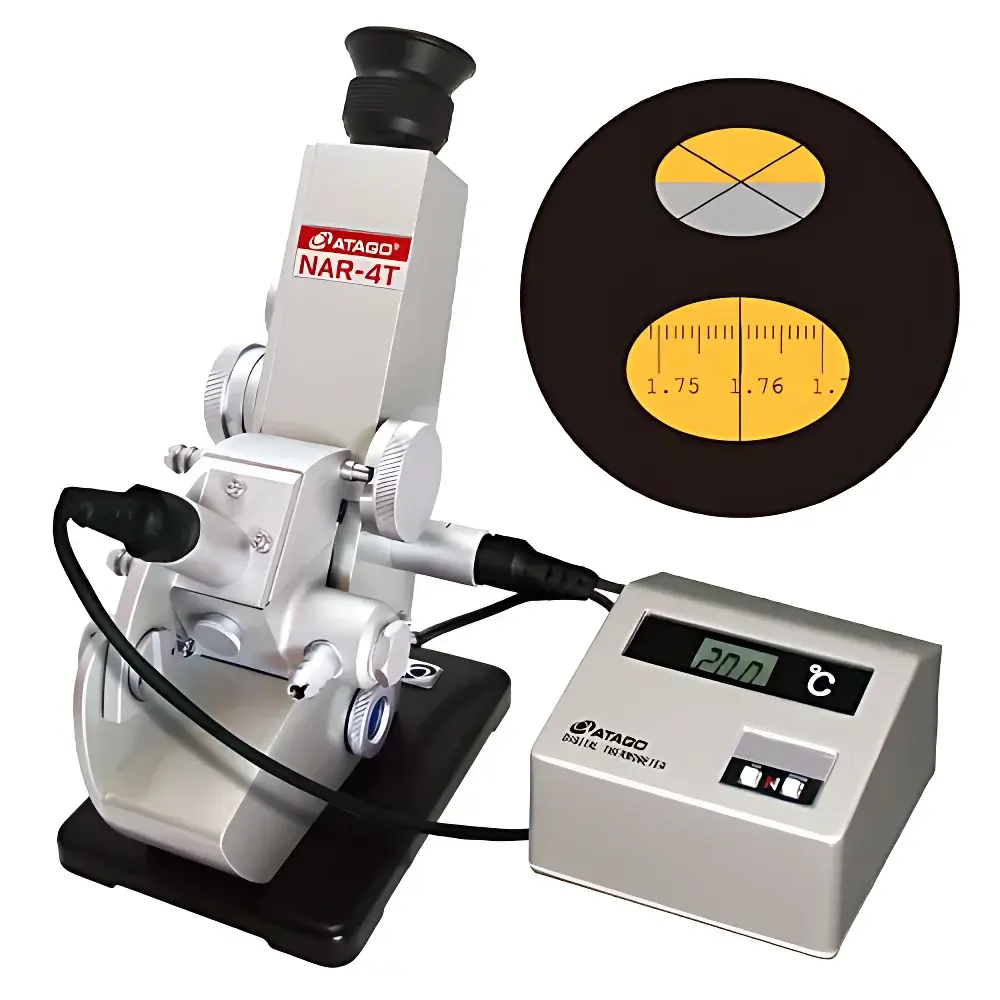
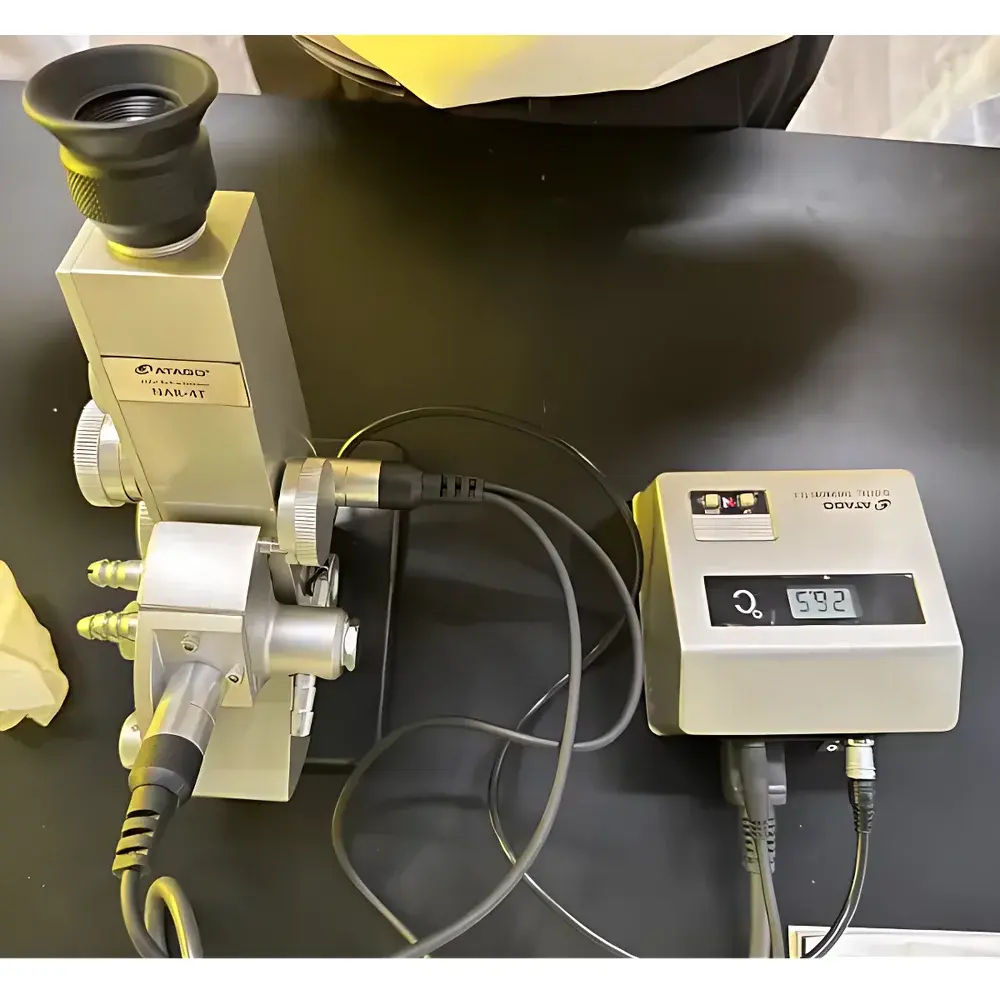
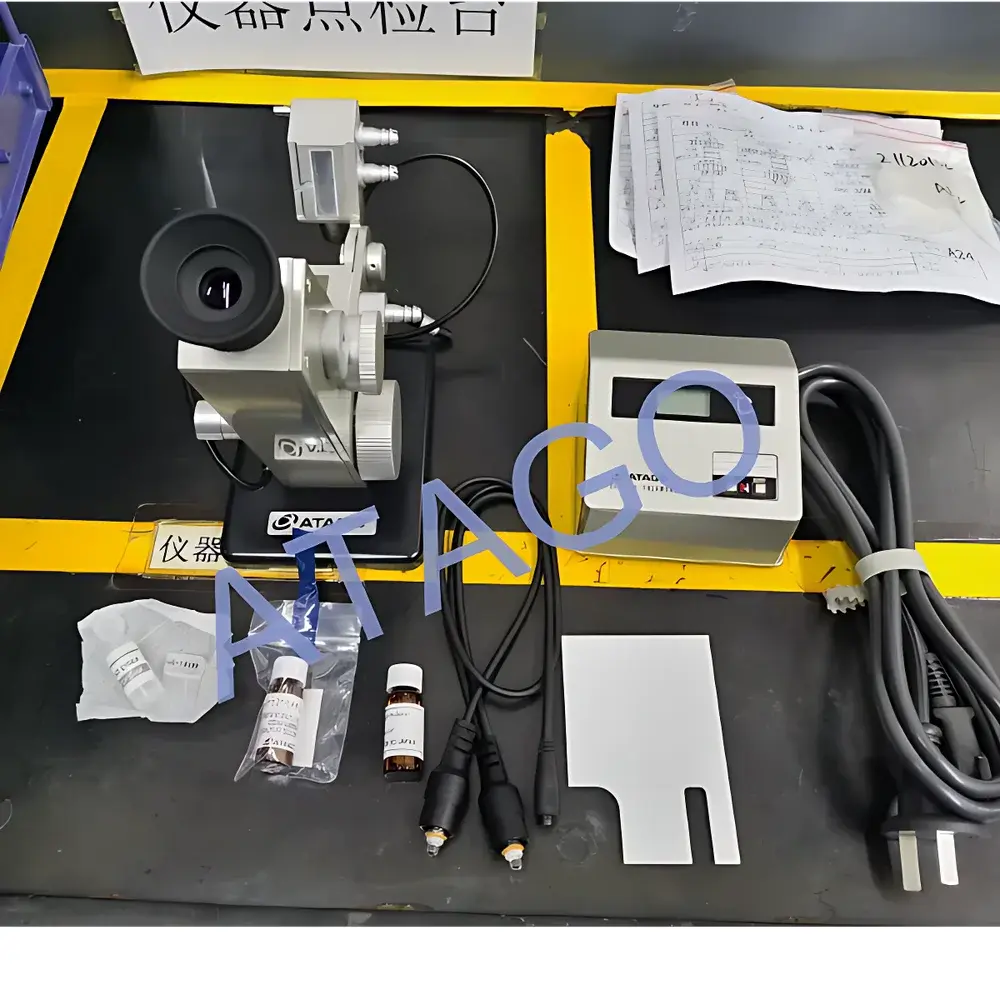
ATAGO NAR-4T High-Range Abbe Refractometer
| Brand | ATAGO |
|---|---|
| Origin | Japan |
| Model | NAR-4T |
| Type | Benchtop Abbe Refractometer |
| Measurement Range | nD 1.4700–1.8700 |
| Resolution | 0.001 (nD) |
| Accuracy | ±0.0002 (nD) |
| Temperature Display Range | 0.0–50.0 °C (±0.2 °C accuracy, 0.1 °C resolution) |
| Operating Ambient Temperature | 5–40 °C |
| Power Supply | AC 100–240 V, 50/60 Hz |
| Power Consumption | 5 VA |
| Dimensions (Main Unit) | 13 × 18 × 23 cm |
| Weight (Main Unit) | 1.8 kg |
| Dimensions (Temperature Display Unit) | 10 × 11 × 7 cm |
| Weight (Temperature Display Unit) | 0.5 kg |
Overview
The ATAGO NAR-4T High-Range Abbe Refractometer is a precision optical instrument engineered for the accurate determination of refractive index (nD) and mean dispersion in transparent and semi-transparent materials. Based on the classical Abbe principle—utilizing critical angle measurement under monochromatic sodium D-line illumination (589.3 nm)—the NAR-4T delivers high-fidelity optical characterization without digital interpolation or algorithmic correction. Its extended measurement range (nD 1.4700–1.8700) makes it uniquely suited for high-refractive-index solids such as optical glasses, fused silica, polymer lenses, epoxy resins, and thin-film coatings—materials commonly encountered in lens manufacturing, optical component QA/QC, and advanced materials R&D. Unlike digital handheld units, the NAR-4T employs a manually operated, dual-scale optical eyepiece system with vernier calibration, ensuring traceable, operator-independent readings compliant with ISO 21748 and ASTM D1218 standards for refractive index measurement.
Key Features
- Extended optical range optimized for high-nD materials: 1.4700 to 1.8700, covering crown glass (nD ≈ 1.52), flint glass (nD ≈ 1.62–1.89), polycarbonate (nD ≈ 1.58), and UV-curable acrylates (nD up to 1.75)
- Mechanically stabilized prism assembly with adjustable sample contact pressure, minimizing air-gap artifacts during solid-sample measurement
- High-resolution analog scale with vernier reading capability: 0.001 nD resolution and certified ±0.0002 nD accuracy at 20 °C (traceable to NIST-traceable reference oils)
- Integrated temperature monitoring via external digital display unit (0.0–50.0 °C, ±0.2 °C accuracy), enabling manual thermal compensation per ISO 17025-compliant procedures
- Benchtop mechanical architecture with vibration-damped base and anti-reflective coated optics, ensuring long-term stability in shared laboratory environments
- No electronic measurement circuitry—eliminates drift, battery dependency, or firmware-related calibration uncertainty
Sample Compatibility & Compliance
The NAR-4T accepts both liquid and solid samples. For liquids, standard application includes immersion oil verification, solvent purity assessment, and monomer formulation checks. For solids, the instrument supports flat, polished surfaces ≥10 mm × 10 mm with surface roughness <0.1 µm Ra—commonly achieved via optical polishing of lens blanks or wafer substrates. Sample mounting utilizes a spring-loaded prism clamp with calibrated torque control to ensure consistent optical coupling without deformation. The device complies with ISO 17025 requirements for reference instrumentation when used with documented calibration protocols, and supports GLP documentation workflows through manual logbook entry of operator, sample ID, ambient conditions, and temperature-corrected nD values. It is routinely employed in optical manufacturing facilities audited under IATF 16949 and ISO 9001 for incoming material inspection of optical-grade polymers and glass ingots.
Software & Data Management
The NAR-4T operates without embedded software or connectivity interfaces, aligning with laboratories requiring air-gapped instrumentation for regulatory integrity (e.g., FDA 21 CFR Part 11 Annex 11 environments where electronic records are not mandated). All measurements are recorded manually in bound logbooks or LIMS-integrated spreadsheets. Temperature data from the external display unit may be logged alongside nD readings to support post-acquisition thermal correction using published Sellmeier equations. For institutions requiring digital traceability, ATAGO recommends pairing the NAR-4T with its optional RS-232-compatible temperature monitor (model T-PC) and validated Excel-based calculation templates compliant with USP refractive index methodology.
Applications
- Optical lens manufacturing: verification of substrate refractive index prior to coating; batch-to-batch consistency checks for molded acrylic and CR-39 lenses
- Quality assurance of optical adhesives and encapsulants: detection of moisture ingress or monomer conversion via nD shift
- Research on novel high-index dielectrics: characterization of TiO2-doped sol-gel films and perovskite thin-film stacks
- Educational use in university physics and materials science labs: hands-on demonstration of dispersion, Cauchy’s equation, and wavelength-dependent refraction
- Geological specimen analysis: identification of gemstone simulants (e.g., distinguishing cubic zirconia (nD ≈ 2.15) from lower-index glass imitations via extrapolated calibration)
FAQ
Does the NAR-4T support automatic temperature compensation?
No. It provides real-time temperature monitoring via an external digital display, but correction must be applied manually using published temperature coefficients or Sellmeier models.
Can the NAR-4T measure curved or unpolished optical components?
No. Samples must have optically flat, polished surfaces with minimal scatter; curvature or surface haze introduces systematic error exceeding ±0.001 nD.
Is calibration verification possible without certified reference oils?
Yes—using traceable solid standards such as NIST SRM 104a (fused quartz, nD = 1.45845 ± 0.00005) or Schott reference glasses with certified nD values at 20 °C.
What maintenance is required for long-term accuracy?
Annual cleaning of prism surfaces with spectroscopic-grade methanol and lint-free wipes; biannual verification against primary standards; avoidance of abrasive contact or thermal shock to the main prism block.
Is the NAR-4T suitable for GMP-regulated pharmaceutical excipient testing?
Yes—for identity testing of high-refractive-index solvents (e.g., glycerol, propylene glycol) per USP , provided procedural controls, operator training, and calibration records meet ALCOA+ principles.





