
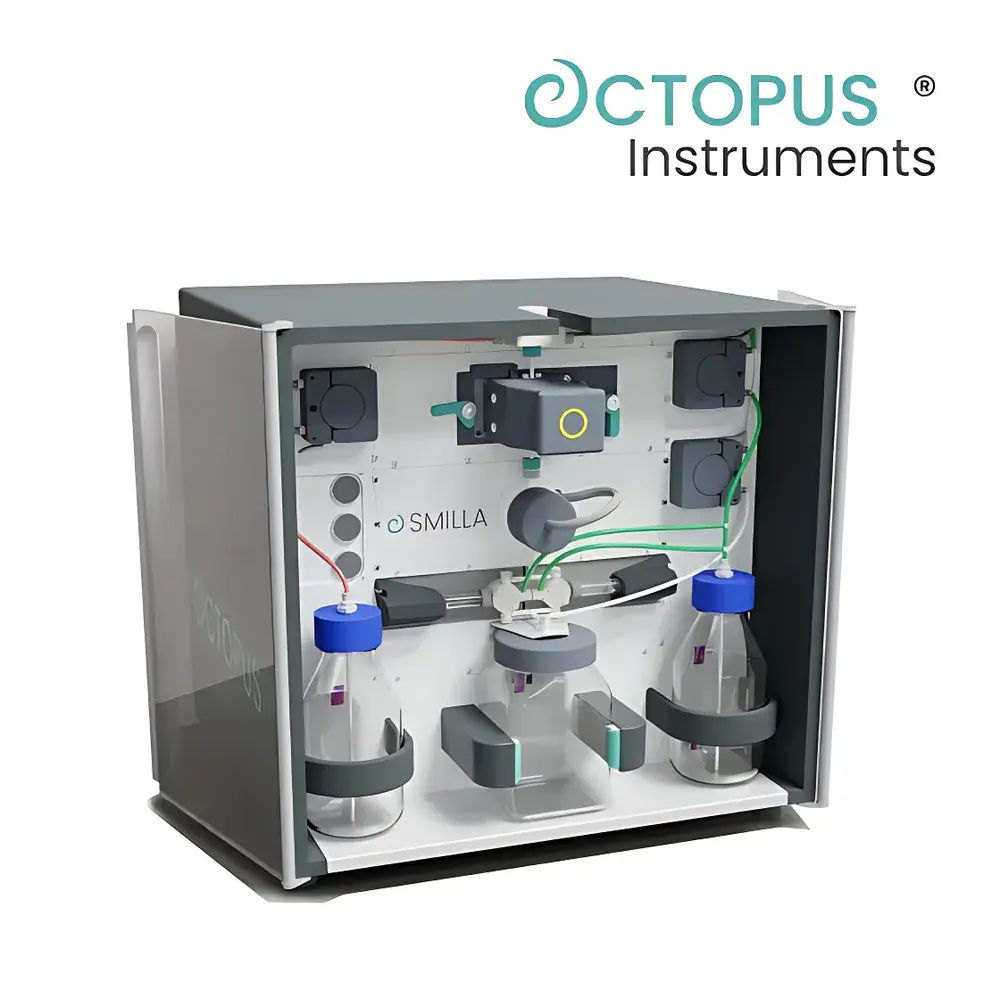
Octopus SAMILLA-FIM High-Resolution Flow Imaging Microscope (HiRes-FIM) Analyzer
| Brand | Octopus |
|---|---|
| Origin | Germany |
| Model | SAMILLA-FIM |
| Application Field | Pharmaceutical |
| Instrument Type | Dynamic |
| Measurement Range | 200 nm – 2 mm |
| Camera Options | 12 MP monochrome or color camera |
| Dispersion Method | Wet dispersion |
| Image Resolution | 12 MP |
| Measurement Parameters | Full particle size and shape characterization (equivalent spherical diameter, aspect ratio, circularity, convexity, solidity, elongation, roundness, etc.) |
Overview
The Octopus SAMILLA-FIM is a modular, high-resolution flow imaging microscope (HiRes-FIM) analyzer engineered for precise, regulatory-compliant analysis of visible and subvisible particles in liquid pharmaceutical formulations. Operating on the principle of hydrodynamic focusing and real-time digital imaging, the system captures high-fidelity, in-focus micrographs of individual particles as they pass through an optically optimized flow cell at controlled velocities. Unlike static microscopy or light obscuration methods, HiRes-FIM delivers both quantitative morphometric data and visual evidence—enabling root-cause investigation of particulate contamination, aggregation, or degradation. Its validated measurement range spans from 200 nm to 2 mm, covering the critical subvisible (≥2 µm) and visible (≥100 µm) particle classes defined in USP , USP , Ph. Eur. 2.9.19, and JP 6.07. The system’s core architecture supports traceable, auditable, and reproducible particle characterization under GMP/GLP conditions.
Key Features
- Modular, auto-configuring platform with RFID-enabled plug-and-play modules—HiRes-FIM imaging, pump, cleaning, and optical path modules are detected and initialized automatically upon insertion.
- High-resolution imaging engine featuring dual 12-megapixel camera options (monochrome for maximum contrast and sensitivity; color for material differentiation and pigment identification).
- Ultra-short exposure time (<1 µs) eliminates motion blur across the full dynamic range, ensuring sharp single-particle images even at high flow rates—validated per Ph. Eur. 2.9.19 requirements.
- Motorized, software-controlled zoom optics with interchangeable magnification modules (e.g., 5×, 10×, 20×, 40×), enabling rapid reconfiguration without manual recalibration.
- Adaptive illumination system supporting both transmitted-light (for transparent, translucent, or stained particles and microorganisms) and optional reflected-light modes (for optically dense or opaque particles).
- Integrated autofocus algorithm eliminating reliance on focus beads—maintains consistent depth-of-field across heterogeneous sample batches.
Sample Compatibility & Compliance
The SAMILLA-FIM accommodates a broad spectrum of liquid-phase samples including injectables, ophthalmic solutions, biologics, vaccines, and cell culture supernatants. Wet dispersion is achieved via precisely controlled peristaltic or syringe-based pumping, minimizing shear-induced artifacts. All fluidic pathways—including flow cell, tubing, and sample inlet—are constructed from USP Class VI-certified materials and support clean-in-place (CIP) protocols. The system complies fully with FDA 21 CFR Part 11 for electronic records and signatures, including audit trail logging, user access control, electronic signatures, and data integrity safeguards. It meets all analytical performance criteria specified in USP , USP , Ph. Eur. 2.9.19, ISO 21501-4, and ICH Q5A(R2) for subvisible particle assessment in biopharmaceutical products.
Software & Data Management
SAMILLA View is a purpose-built, Windows-based software platform that unifies instrument control, real-time image acquisition, automated particle detection, and multidimensional morphological analysis. Each detected particle is assigned a unique ID and associated with its full-resolution image plus ≥20 shape descriptors (e.g., Feret diameter, convex hull area, perimeter roughness, transparency index). Advanced classification tools allow rule-based grouping by morphology, intensity, texture, or user-defined thresholds. The software supports customizable reporting templates compliant with internal SOPs and regulatory submissions. Data export formats include CSV, PDF, and XML—fully compatible with LIMS integration via ASTM E1384 or HL7 standards. All raw images, processed results, and metadata are stored in a secure, version-controlled database with immutable audit trails meeting ALCOA+ principles.
Applications
- Regulatory batch release testing of parenteral drugs per USP/Ph. Eur. compendial requirements.
- Root-cause analysis of particle origin (e.g., silicone oil droplets, protein aggregates, cellulose fibers, stainless steel wear debris).
- Stability-indicating method development for biologics and complex drug products.
- Comparative assessment of filtration efficiency, container closure integrity, and extractables/leachables studies.
- Microbial enumeration and morphological profiling in sterile process validation.
- Development and qualification of alternative particle detection methods aligned with ICH Q5A and Q5C guidelines.
FAQ
Does SAMILLA-FIM require calibration with NIST-traceable particle standards?
Yes—system verification includes daily performance qualification using certified polystyrene latex (PSL) microspheres (e.g., 2 µm, 5 µm, 10 µm) and silica-based reference materials. Calibration certificates are generated and archived within the audit trail.
Can the system differentiate between viable and non-viable particles?
While not a microbiological analyzer per se, SAMILLA-FIM supports morphological discrimination of microbial cells (e.g., yeast, bacteria) based on size, shape, and optical density—particularly when combined with fluorescent staining protocols and optional epi-illumination modules.
Is offline analysis supported after data acquisition?
Yes—raw image stacks and feature databases can be exported and reprocessed using SAMILLA View on standalone workstations, enabling retrospective analysis, method refinement, or multi-site data harmonization.
How does the cleaning module prevent carryover between samples?
The integrated cleaning module executes programmable rinse cycles with deionized water and ethanol, followed by air purge. Flow path sensors monitor pressure differentials and conductivity to verify cleanliness before initiating the next analysis.
What level of technical support and validation documentation is provided?
Octopus supplies comprehensive IQ/OQ/PQ protocols, URS templates, risk assessments (ICH Q9), and 21 CFR Part 11 configuration files. On-site installation qualification and operator training are available globally through authorized service partners.



